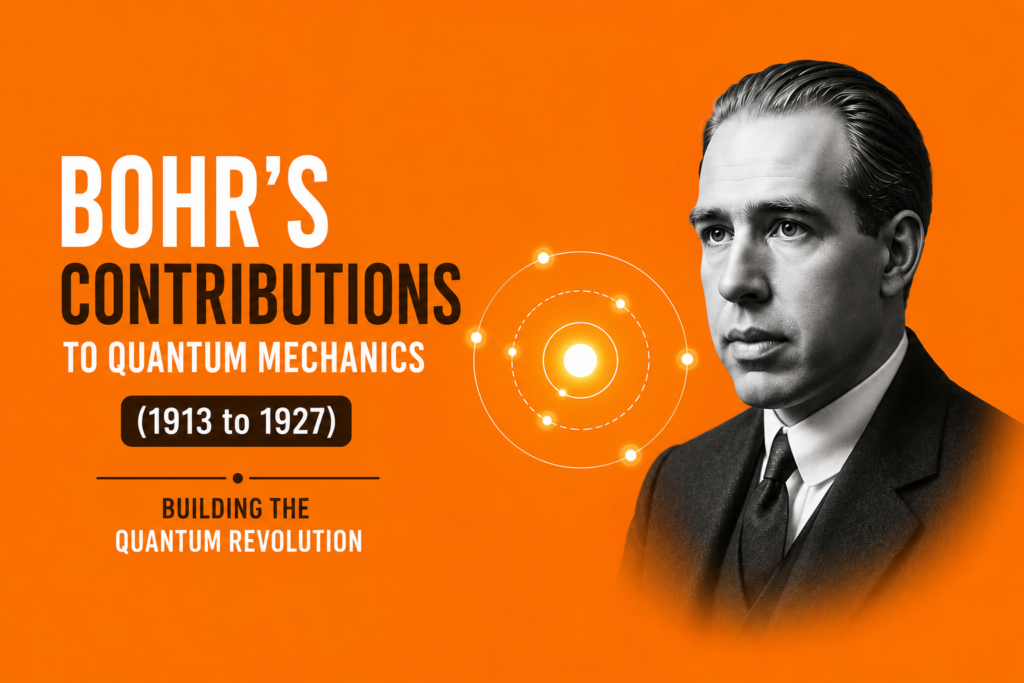
Few scientists can claim to have personally shepherded an entire scientific revolution from its earliest tentative beginnings through to its mature theoretical framework. Niels Bohr did exactly that. Across a remarkable fourteen year span, bohr’s contributions to quantum mechanics transformed atomic physics from a collection of puzzling experimental observations into a coherent, mathematically rigorous science that permanently reshaped humanity’s understanding of nature. This period, stretching from his groundbreaking 1913 atomic model through the historic 1927 Copenhagen interpretation, represents one of the most productive intellectual journeys in the history of science.
Understanding bohr’s contributions to quantum mechanics across these fourteen transformative years means tracing the golden age of quantum physics itself, watching how one physicist’s evolving ideas gradually built the theoretical foundation underlying virtually all modern quantum technology.
The Trilogy That Started Everything (1913)
Bohr’s quantum contributions began with what historians now call the 1913 trilogy papers, three groundbreaking publications introducing his revolutionary atomic model. Building upon Ernest Rutherford’s earlier nuclear discovery, Bohr proposed that electrons occupy specific, quantized electron orbits and energy levels, rather than any arbitrary continuous orbital distance from the nucleus.
This 1913 atomic postulate relied on quantizing angular momentum according to the relationship:
L = nh / 2π
Here, L represents angular momentum, n represents the principal quantum number, and h represents Planck’s constant. This single restriction meant that only specific, calculable orbital radii and corresponding energy levels were physically permitted within any atom, providing the essential theoretical foundation for everything Bohr would develop throughout the following decade.
Solving Hydrogen’s Ancient Mystery (1913)
Among Bohr’s earliest and most celebrated achievements was Bohr’s hydrogen atom solution, successfully explaining decades of previously mysterious spectral emission observations. Using his quantized energy level formula:
E_n = -13.6 eV / n²
Bohr demonstrated precisely why hydrogen gas produced light only at specific, discrete wavelengths rather than a continuous spectrum. This breakthrough provided the first genuinely successful theoretical bridge between classical mechanics and the emerging strangeness of early quantum theory, cementing Bohr’s reputation as a rising force within theoretical physics.
Connecting Energy to Light (1913)
Central to this early period was Bohr’s frequency condition, expressed through the elegant equation:
ΔE = hf
Here, ΔE represents the energy difference between two atomic energy levels, h represents Planck’s constant, and f represents the resulting photon frequency. This formula directly connected quantized atomic structure to observable spectral lines, providing precise mathematical predictions that matched experimental spectroscopy data with remarkable accuracy, immediately establishing bohr’s contributions to quantum mechanics as genuinely predictive science rather than mere theoretical speculation.
Building an Institution for Quantum Research (1921)
Recognizing that advancing quantum theory required sustained collaborative effort, Bohr founded his own research institute in Copenhagen in 1921, an achievement now known simply as the Bohr Institute. This institution quickly became the intellectual epicenter for the emerging old quantum theory era, attracting brilliant young physicists from across Europe eager to contribute toward this rapidly developing field.
The Copenhagen school founding at this institute created an environment where vigorous scientific debate and collaborative theoretical development could flourish, eventually producing many of quantum mechanics’ most important subsequent breakthroughs throughout the remainder of the 1920s.
Ensuring Theoretical Consistency (1913 – 1920)
As his atomic model gained acceptance, Bohr recognized the importance of ensuring his radical new quantum framework remained properly connected to well-established classical physics. This led to his development of the correspondence principle, demonstrating mathematically that quantum mechanical predictions converge toward classical physics results whenever systems involve very large quantum numbers.
This principle served as an essential consistency check throughout the ongoing quantum mechanics historical development, ensuring that increasingly sophisticated theoretical frameworks developed throughout the 1920s remained properly grounded in previously validated classical understanding.
Exploring Nuclear Physics (Mid-1930s)
Although primarily celebrated for his atomic model work, Bohr’s scientific contributions eventually extended into nuclear physics as well. His later liquid drop model introduction, proposing that atomic nuclei behave somewhat like a droplet of incompressible fluid held together by nuclear forces, provided crucial theoretical groundwork for understanding nuclear structure and behavior.
This compound nucleus theory, developed through Bohr’s continued research beyond his original atomic model timeline, eventually proved essential for understanding nuclear reactions, representing an important though often overlooked extension of bohr’s contributions to quantum mechanics into the related field of nuclear physics.
The Como Conference and Growing Philosophical Questions (1927)
By 1927, quantum theory had matured considerably beyond Bohr’s original atomic model, incorporating crucial mathematical contributions from Werner Heisenberg and Erwin Schrödinger throughout the intervening years. At the historic Como conference 1927, held in Italy to honor Alessandro Volta, Bohr first publicly presented his emerging complementarity principle, proposing that wave and particle descriptions represent complementary, mutually exclusive yet equally necessary aspects of quantum reality.
Establishing the Copenhagen Interpretation (1927)
This same pivotal year witnessed the crystallization of what became known as the 1927 Copenhagen interpretation, the dominant philosophical framework describing how quantum measurement and probability function within physical reality. This interpretation, developed through years of discussion at Bohr’s own institute, represented the mature culmination of bohr’s contributions to quantum mechanics, synthesizing his earlier atomic model insights with newer mathematical developments into a coherent, unified philosophical framework.
The Bohr Solvay physics debates that followed throughout subsequent Solvay Conference gatherings further refined and defended this interpretation against various theoretical challenges, cementing its position as the standard framework taught throughout physics education.
The Historic Clash That Tested Everything (1927 onward)
No account of bohr’s contributions to quantum mechanics would be complete without acknowledging the historic Niels Bohr vs Einstein debates that emerged during this same transformative period. Einstein’s persistent philosophical objections, eventually crystallizing through the EPR paradox in 1935, forced Bohr to articulate and defend his quantum framework with unprecedented rigor and clarity.
Bohr’s reply to Einstein throughout these exchanges, addressing Einstein’s concerns regarding spooky action at a distance and quantum mechanics’ apparent incompleteness, ultimately strengthened rather than weakened the Copenhagen interpretation’s theoretical foundations, demonstrating remarkable resilience against history’s most sophisticated scientific challenges.
Why This Fourteen Year Period Mattered So Much
The span from 1913 through 1927 represents nothing less than the complete birth and maturation of modern quantum theory. What began as a somewhat ad hoc mathematical postulate explaining hydrogen’s spectral lines evolved, through Bohr’s sustained intellectual leadership, into a comprehensive, philosophically sophisticated framework capable of describing the fundamental behavior of matter and energy throughout the universe.
This quantum revolution history demonstrates how scientific progress often requires not just isolated flashes of individual genius, but sustained, collaborative intellectual development spanning years of careful theoretical refinement and vigorous scientific debate.
Lasting Impact on Modern Technology
The theoretical foundations established through bohr’s contributions to quantum mechanics during this remarkable period continue underlying countless modern technologies. Semiconductor physics, laser systems, and emerging quantum computing research all trace their conceptual origins directly back to this foundational fourteen year period, demonstrating how thoroughly from Bohr model to modern technology developments continue building upon Bohr’s original theoretical achievements.
Frequently Asked Questions
What were Bohr’s most important contributions between 1913 and 1927?
Bohr’s key contributions included his 1913 atomic model explaining electron orbits, his frequency condition connecting energy to light, founding his research institute, developing the correspondence principle, and establishing the complementarity principle and Copenhagen interpretation by 1927.
Why is 1927 considered such an important year for quantum mechanics?
In 1927, Bohr introduced his complementarity principle at the Como conference, and the Copenhagen interpretation crystallized as the dominant philosophical framework for understanding quantum measurement and reality.
How did Bohr’s atomic model contribute to later quantum theory?
Bohr’s original 1913 model, though eventually refined by later physicists, established the crucial principle that atomic energy exists in discrete, quantized levels, forming the foundation for all subsequent quantum mechanical development.
What role did the Bohr Institute play in quantum mechanics history?
Founded in 1921, the Bohr Institute became the intellectual center for quantum research, attracting brilliant physicists and fostering the collaborative environment that produced many of quantum mechanics’ most important breakthroughs.
How did Bohr’s debates with Einstein shape quantum mechanics?
Einstein’s persistent challenges, particularly through the EPR paradox, forced Bohr to refine and defend the Copenhagen interpretation with greater rigor, ultimately strengthening quantum mechanics’ theoretical foundations.
Conclusion
Bohr’s contributions to quantum mechanics between 1913 and 1927 represent one of the most remarkable sustained intellectual achievements in the history of science, transforming atomic physics from puzzling experimental observations into a mature, philosophically sophisticated theoretical framework. From his original hydrogen atom breakthrough through the establishment of the Copenhagen interpretation and his historic debates with Einstein, this fourteen year period fundamentally reshaped humanity’s understanding of atomic and subatomic reality. More than a century later, this foundational work continues underlying modern technology and ongoing physics research, standing as permanent testament to how sustained scientific dedication can genuinely transform our understanding of the universe.