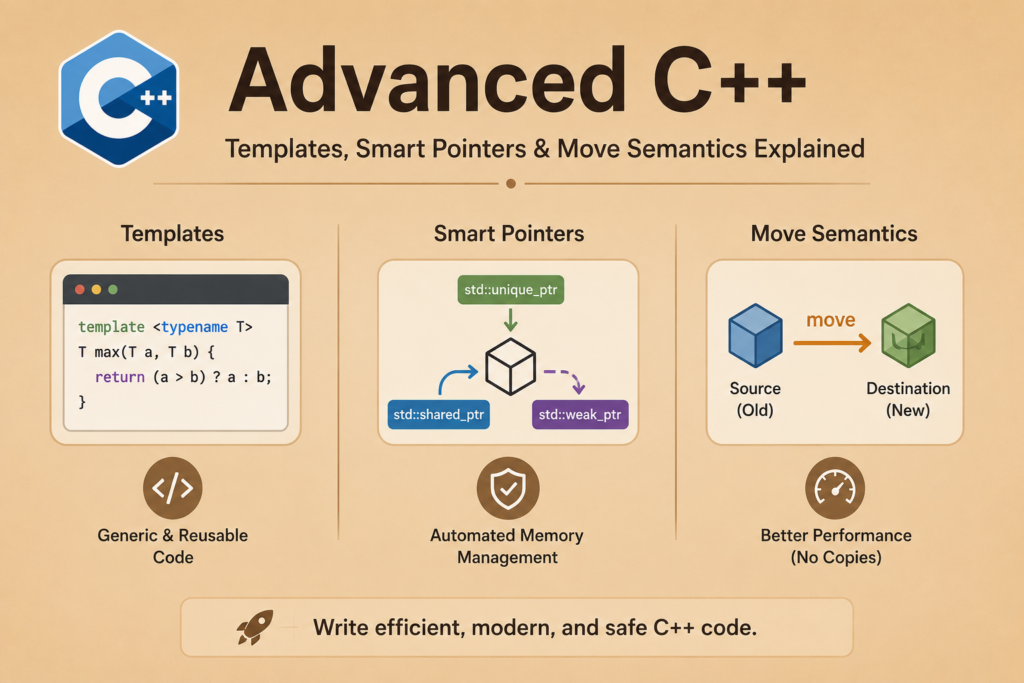
Advanced c++ is the gateway to writing faster, safer, and more expressive software with confidence. If basic C++ teaches you variables, loops, classes, and simple functions, advanced c++ teaches you how to build powerful systems that scale, perform, and remain maintainable under real-world pressure.
Modern developers use C++ in game engines, operating systems, embedded systems, trading platforms, high-performance servers, robotics, browsers, and AI infrastructure. To master it deeply, you need to understand templates, smart pointers, RAII, and move semantics. These tools unlock better abstraction, stronger performance, and cleaner memory ownership.
This guide explains the most important advanced concepts in a practical and human-friendly way, with examples you can actually use.
C++ Evolution (1979 – 2026)
C++ began as “C with Classes” and grew into one of the most powerful programming languages ever created. The work of Bjarne Stroustrup shaped a language that combines low-level control with high-level abstraction. That combination is the reason C++ still dominates performance-critical domains.
The language has changed dramatically over time. C++98 introduced standardized templates and the STL. C++11 transformed the language with move semantics, lambdas, auto, smart pointers, and rvalue references C++. C++14, C++17, C++20, and C++23 continued improving expressiveness, safety, and performance.
Today, C++ in modern technology is everywhere. It powers game engines, browsers, finance systems, cloud infrastructure, and embedded devices. This is why advanced c++ skills remain extremely valuable for serious developers.
Why advanced c++ Matters (2011 – 2026)
advanced c++ matters because it helps you write code that is both powerful and safe. Basic C++ can be dangerous when raw pointers, manual memory allocation, and unclear ownership rules are used carelessly. Advanced techniques solve many of these problems.
With templates, you can write reusable code without sacrificing performance. With smart pointers C++, you can automate memory cleanup and prevent leaks. With move semantics, you can avoid expensive copies and make resource-heavy programs faster.
In short, advanced c++ is where professional C++ development begins. It helps you design libraries, optimize applications, and build systems that are reliable under heavy workloads.
Advanced c++ Templates (1998 – 2026)
Templates are one of the most powerful features in C++. They allow you to write generic code that works with many data types. This is known as generic programming C++.
Instead of writing separate functions for int, double, string, and custom classes, you can write one template function and let the compiler generate the needed version. This creates compile-time polymorphism, which is often faster than runtime polymorphism because decisions are made during compilation.
Here is a simple function template:
#include <iostream>
using namespace std; template <typename T>
T maximum(T a, T b) {
return (a > b) ? a : b;
}int main() {
cout << maximum(10, 20) << endl;
cout << maximum(3.5, 2.1) << endl;
return 0;
}
In advanced c++, templates are used heavily in containers, algorithms, smart utilities, and high-performance libraries. The Standard Template Library is a major example. If you want to go deeper into containers and algorithms, a C++ STL guide is a natural next step.
Class Templates For Reusable Data Structures
Function templates are useful, but class templates are even more important when building reusable structures. A class template lets you define a class that works with any type.
Example:
#include <iostream>
using namespace std; template <typename T>
class Box {
private:
T value; public:
Box(T v) : value(v) {} Copy T getValue() const { return value; } }; int main() {
Box<int> intBox(100);
Box<string> stringBox("Advanced C++"); Copy cout << intBox.getValue() << endl; cout << stringBox.getValue() << endl; return 0;}
This is the foundation of a strong C++ templates guide. Containers like vector, map, optional, and unique_ptr are all template-based. Templates help developers create flexible code while preserving type safety.
Template Specialization For Precise Control
Sometimes a generic template is not enough. You may need a specific behavior for one data type. That is where template specialization becomes valuable.
Example:
#include <iostream>
using namespace std; template <typename T>
class Printer {
public:
void print(T value) {
cout << "Generic value: " << value << endl;
}
}; template <>
class Printer<bool> {
public:
void print(bool value) {
cout << "Boolean value: " << (value ? "true" : "false") << endl;
}
}; int main() {
Printer<int> p1;
Printer<bool> p2; Copy p1.print(42); p2.print(true); return 0;}
Template specialization gives you fine control while still keeping your design generic. It is widely used in libraries that need different handling for different types.
Smart Pointers C++ And Modern Memory Management (2011 – 2026)
Memory management is one of the biggest challenges in C++. Raw pointers are powerful, but they can cause memory leaks, dangling pointers, double deletes, and unclear ownership. If you have studied C++ pointers, you already know that pointer misuse can create serious bugs.
Smart pointers solve this by managing memory automatically. They use RAII resource acquisition, which means a resource is acquired during object construction and released during object destruction.
The three main smart pointers are:
- std::unique_ptr
- std::shared_ptr
- std::weak_ptr
A core advanced c++ skill is knowing which smart pointer to use and when.
std::unique_ptr For Exclusive Ownership
std::unique_ptr represents exclusive memory ownership. Only one unique pointer can own a resource at a time. When the unique pointer goes out of scope, it automatically deletes the object.
Example:
#include <iostream>
#include <memory>
using namespace std; class Player {
public:
Player() {
cout << "Player created" << endl;
} Copy ~Player() { cout << "Player destroyed" << endl; } void attack() { cout << "Player attacks!" << endl; } }; int main() {
unique_ptr<Player> player = make_unique<Player>();
player->attack(); Copy return 0;}
You do not need delete. The cleanup happens automatically. This improves modern memory management and makes memory ownership clear.
std::shared_ptr For Shared Ownership
std::shared_ptr allows multiple smart pointers to share ownership of the same object. The object is destroyed only when the last shared pointer is gone.
Example:
#include <iostream>
#include <memory>
using namespace std; class Texture {
public:
Texture() {
cout << "Texture loaded" << endl;
} Copy ~Texture() { cout << "Texture released" << endl; } }; int main() {
shared_ptr<Texture> texture1 = make_shared<Texture>(); Copy { shared_ptr<Texture> texture2 = texture1; cout << "Shared owners: " << texture1.use_count() << endl; } cout << "Shared owners: " << texture1.use_count() << endl; return 0;}
The unique pointer shared pointer decision is important. Use std::unique_ptr by default. Use std::shared_ptr only when shared ownership is truly needed.
RAII Resource Acquisition For Safer Code
RAII resource acquisition is one of the most powerful ideas in C++. It means resource lifetime is tied to object lifetime. When an object is created, it acquires a resource. When the object is destroyed, it releases the resource.
Resources can include:
- Heap memory
- File handles
- Network sockets
- Mutex locks
- Database connections
- GPU resources
RAII reduces manual cleanup and makes exception-safe code easier to write. It is one of the core reasons smart pointers C++ are so effective.
Move Semantics Tutorial (2011 – 2026)
Move semantics changed C++ forever. Before C++11, objects were often copied even when copying was unnecessary. Copying large objects can be expensive, especially if they manage dynamic memory, file handles, buffers, or other heavy resources.
Move semantics allows resources to be transferred from one object to another instead of copied. This can dramatically improve performance.
For advanced c++, move semantics is essential because it enables efficient containers, clean ownership transfer, and better optimization.
lvalue vs rvalue Explained Clearly
To understand move semantics, you must understand lvalue vs rvalue.
An lvalue has a name and a stable memory location. An rvalue is usually a temporary value that can be moved from.
Example:
int x = 10;      // x is an lvalue
int y = x + 5;   // x + 5 is an rvalue
Rvalue references C++ use double ampersands:
void process(int&& value) {
// value accepts an rvalue
}
Rvalue references allow C++ to detect temporary objects and safely move their resources.
std::move And Ownership Transfer
std::move does not move anything by itself. It casts an object into an rvalue reference, making it eligible for moving.
Example:
#include <iostream>
#include <string>
#include <utility>
using namespace std; int main() {
string source = "High performance C++";
string target = std::move(source); Copy cout << "Target: " << target << endl; cout << "Source after move: " << source << endl; return 0;}
After std::move, the source object is still valid, but its contents are unspecified. You can destroy it or assign a new value to it, but you should not rely on its old value.
Copy Constructor, Move Constructor, And Assignment Operator Optimization
In professional C++, you often manage resources inside classes. This is where constructors and assignment operators become important.
A copy constructor creates a new object by copying another object. A move constructor transfers resources from a temporary object. Assignment operator optimization helps avoid unnecessary work when assigning one object to another.
Example:
#include <iostream>
#include <cstring>
using namespace std; class Buffer {
private:
char* data;
size_t size; public:
Buffer(size_t s) : size(s) {
data = new char[size];
cout << "Buffer created" << endl;
} Copy ~Buffer() { delete[] data; cout << "Buffer destroyed" << endl; } Buffer(const Buffer& other) : size(other.size) { data = new char[size]; memcpy(data, other.data, size); cout << "Buffer copied" << endl; } Buffer(Buffer&& other) noexcept : data(other.data), size(other.size) { other.data = nullptr; other.size = 0; cout << "Buffer moved" << endl; } }; int main() {
Buffer a(1024);
Buffer b = std::move(a); Copy return 0;}
This example shows how moving avoids a deep copy. Instead of allocating new memory and copying data, ownership is transferred.
Advanced c++ Design Patterns For Real Projects
advanced c++ is not only about syntax. It is about thinking clearly about performance, safety, and design. In real projects, developers combine templates, RAII, smart pointers, and move semantics to produce robust systems.
For example, a game engine may use templates for component systems, std::unique_ptr for exclusive object ownership, std::shared_ptr for shared asset references, and move semantics for fast transfer of large resources. Strong knowledge of C++ functions also matters because clean interfaces make advanced features easier to use.
The best developers do not use advanced features just to look clever. They use them to solve concrete problems.
Performance And Safety Best Practices
advanced c++ does not mean complicated code. In fact, the goal is often the opposite: simpler ownership, fewer bugs, and stronger performance.
Use these best practices:
- Prefer std::unique_ptr for exclusive ownership.
- Use std::shared_ptr only when ownership must be shared.
- Avoid raw new and delete in application code.
- Use make_unique and make_shared.
- Mark move constructors noexcept when possible.
- Prefer const references for large read-only parameters.
- Use templates when they improve reuse and type safety.
- Avoid over-engineering with unnecessary template complexity.
- Understand object lifetime before optimizing.
- Measure performance before making assumptions.
These habits make your code cleaner and more trustworthy.
Common Mistakes Developers Should Avoid
Many developers learn advanced features but misuse them. The most common mistake is using std::shared_ptr everywhere. Shared ownership sounds convenient, but it can hide design problems and increase overhead.
Another mistake is calling std::move on objects that are still needed. Once an object has been moved from, you should treat it carefully.
Template overuse is also dangerous. Templates can create beautiful abstractions, but they can also produce unreadable error messages and long compile times. Use them with purpose.
Finally, never ignore RAII. Manual cleanup may seem simple in small examples, but in real software with exceptions and multiple return paths, RAII is safer and cleaner.
How Templates, Smart Pointers, And Move Semantics Work Together
The real power appears when these features work together.
Imagine a resource manager that stores objects in templates, controls memory through std::unique_ptr, and transfers ownership with std::move. This design is fast, safe, and expressive.
Example:
#include <iostream>
#include <memory>
#include <vector>
using namespace std; template <typename T>
class Manager {
private:
vector<unique_ptr<T>> items; public:
void add(unique_ptr<T> item) {
items.push_back(std::move(item));
} Copy void showCount() const { cout << "Items: " << items.size() << endl; } }; class Enemy {
public:
Enemy() {
cout << "Enemy created" << endl;
}
}; int main() {
Manager<Enemy> enemyManager;
enemyManager.add(make_unique<Enemy>());
enemyManager.showCount(); Copy return 0;}
This example combines templates, smart pointers, and move semantics in a practical way. It also demonstrates clear memory ownership without manual delete.
Industry Value (2024 – 2026)
Companies value C++ developers who can write high-performance and safe code. Knowledge of templates, memory ownership, RAII, and move semantics is especially important for systems programming, game development, robotics, simulations, fintech, and infrastructure.
The future of C++ remains strong because modern standards keep improving the language while preserving its performance-first identity. Developers who understand both old and new C++ can maintain legacy systems and build modern applications with confidence.
FAQs:
What is advanced c++?
advanced c++ refers to deeper C++ concepts such as templates, smart pointers, RAII, move semantics, rvalue references, template specialization, and performance-focused design. These concepts help developers write safer, faster, and more reusable code.
Are templates difficult to learn?
Templates can feel difficult at first, but they become easier with practice. Start with function templates, then class templates, then template specialization. Once you understand the pattern, templates become one of the most powerful tools in C++.
Should I always use smart pointers instead of raw pointers?
For ownership, yes, smart pointers are usually better. Use std::unique_ptr for exclusive ownership and std::shared_ptr for shared ownership. Raw pointers can still be useful for non-owning references, but they should not usually manage memory directly.
What is the main benefit of move semantics?
Move semantics improves performance by transferring resources instead of copying them. This is especially useful for large objects, dynamic arrays, strings, containers, file handles, and custom resource-managing classes.
Is std::move dangerous?
std::move is not dangerous if used correctly. The main rule is simple: after moving from an object, do not assume it still contains its old value. It remains valid, but its state may be changed.
How hard is advanced c++ for beginners?
advanced c++ can be challenging, but it is manageable if you learn step by step. First master classes, constructors, destructors, and basic memory. Then move into templates, smart pointers, and move semantics.
Conclusion
Advanced c++ gives developers the power to build fast, safe, and scalable software. Templates provide reusable and type-safe abstractions. Smart pointers bring modern memory management and clear ownership. Move semantics unlock serious performance by avoiding unnecessary copies.
The key is balance. Do not use advanced features just because they exist. Use them when they make your code clearer, safer, or faster. If you practice these ideas with real examples, advanced c++ will become one of your strongest programming skills.