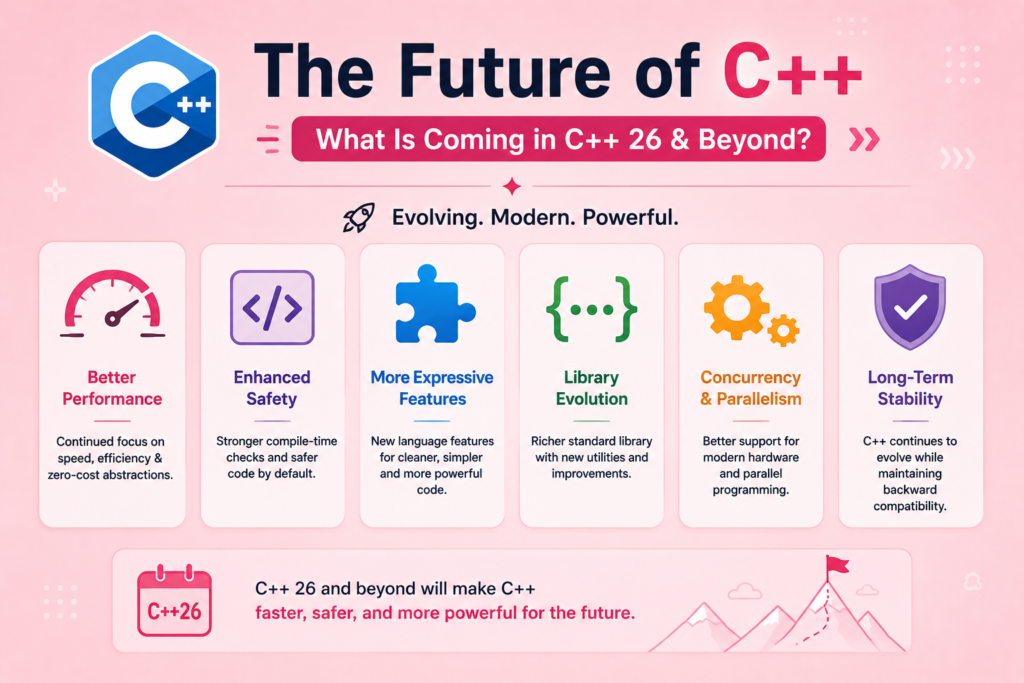
The future of c++ is not a distant horizon; it is being written right now in committee rooms, GitHub repositories, and compiler labs across the world. C++ has survived and thrived for over four decades by doing something remarkable: evolving without abandoning the developers who depend on it. From embedded firmware to billion-dollar financial systems, the language refuses to retire, and C++26 is shaping up to be one of its most transformative releases yet. If you care about high-performance programming, language design, or simply want to stay ahead of the curve, this deep dive is for you.
C++ releases follow a predictable three-year cadence. C++11 modernized the language entirely. C++14 and C++17 polished it. C++20 delivered coroutines, concepts, modules, and ranges in a landmark update. Now, with C++23 freshly ratified, the ISO WG21 committee is sprinting toward C++26 with an ambitious list of draft proposals that could redefine how we all write C++ code. Understanding what is coming helps you write better code today and prepares you to lead the transition tomorrow.
The Road That Led Here: C++ Standardization Roadmap (1998 – 2023)
To appreciate where the future of c++ is heading, you need to respect the journey. The C++ standardization roadmap spans decades of deliberate, committee-driven evolution. C++98 gave the language its first international standard. C++03 fixed critical issues. Then came the revolutionary C++11, which introduced lambdas, move semantics, auto, and smart pointers, essentially creating the modern C++ era.
C++14, C++17, and C++20 each layered on power and expressiveness. Bjarne Stroustrup, the language’s creator, has consistently championed a philosophy of zero-cost abstractions and backward compatibility. That philosophy is still very much alive in the proposals heading into C++26. Knowing the history of C++ makes it clear: every new standard learns from the previous one and corrects what the community identifies as friction points.
What Is WG21 and How Does C++ Get Made?
Before diving into features, it helps to understand the machinery. The ISO C++ committee, formally known as WG21, is the body responsible for approving every change to the C++ standard. It consists of subgroups covering core language, library evolution, and technical specifications. Proposals go through multiple rounds of review, often taking years from initial draft to ratification.
The work happening in WG21 right now is targeting C++26 with a final draft expected around 2025 and formal ISO publication in 2026. Several proposals have already reached advanced stages, and compiler support from GCC, Clang, and MSVC is beginning to catch up. Tracking these draft proposals gives developers a rare chance to prepare before the standard lands.
Reflection: The Feature C++ Has Needed for Decades
If one feature defines the future of c++ more than any other, it is static reflection. Reflection allows code to inspect and manipulate its own structure at compile time: examining class members, enumerating function parameters, and generating code based on type information without resorting to macros or verbose template gymnastics.
The reflection proposal for C++26 is technically sophisticated and genuinely exciting. Here is a simplified illustration of what reflection-based code could look like:
#include <meta>
struct Point {
double x;
double y;
};
template <typename T>
void printFields() {
constexpr auto members = std::meta::members_of(^T);
for constexpr (auto mem : members) {
std::cout << std::meta::name_of(mem) << “\n”;
}
}
// printFields<Point>() would print: x, y
This capability eliminates entire categories of boilerplate. Serialization libraries, ORM frameworks, and debugging tools that today require heavy macro magic or external code generators could be rewritten cleanly using language reflection. The compile-time introspection this enables is a dramatic leap forward in expressiveness.
Contracts: Writing Safer Code by Design (2026)
One of the most eagerly anticipated additions in the future of c++ is a formal contracts system. Contracts allow developers to express preconditions, postconditions, and assertions directly in function signatures, turning documentation into enforceable machine-readable guarantees.
The proposal, after years of debate and revision, appears to be converging on a workable design for C++26:
double divide(double numerator, double denominator)
pre(denominator != 0.0)
post(result: std::isfinite(result));
{
return numerator / denominator;
}
Contracts serve a dual purpose. During development and testing, violations can be caught immediately with diagnostic messages. In production, contract checks can be disabled with zero runtime overhead, preserving C++’s legendary performance characteristics. This directly addresses one of the loudest criticisms leveled at C++ compared to newer languages: that it is too easy to invoke undefined behavior silently.
Pattern Matching: Expressive Control Flow for Modern C++
C++ developers who have worked with Rust, Haskell, or Swift often return envious of those languages’ pattern matching capabilities. The future of c++ is set to close this gap significantly. Pattern matching in C++26 would allow powerful, readable decomposition of values without chains of if-else or switch statements:
inspect (shape) {
is Circle c => std::cout << “Circle radius: ” << c.radius;
is Rectangle r => std::cout << “Width: ” << r.width;
is Triangle t => std::cout << “Base: ” << t.base;
};
Pattern matching integrates naturally with variant types and polymorphic hierarchies. It reduces the cognitive overhead of branching logic and produces code that is dramatically easier to read, audit, and extend. Combined with concepts from C++20, pattern matching enables compile-time type safety across complex branching scenarios.
Memory Safety: C++ Addresses Its Biggest Criticism
The elephant in the room surrounding the future of c++ has always been memory safety. High-profile security agencies, including NSA and CISA, have publicly encouraged migration away from memory-unsafe languages. C++ has responded on two fronts: lifetime annotations and a formalized C++ memory safety future roadmap.
The C++ Safety and Security Study Group within WG21 is actively working on proposals that introduce borrow-checking-inspired lifetime analysis, safer pointer wrappers, and expanded use of type safety guarantees without sacrificing backward compatibility. The philosophy is not to turn C++ into Rust but to give developers the tools to opt into safety guarantees when they need them while retaining full control when they do not.
Profile-based safety, where developers declare compliance with specific safety profiles and the compiler enforces those guarantees, is one promising approach gaining traction. This approach respects C++’s heterogeneous user base, from those writing safety-critical aerospace firmware to those building high-frequency trading engines.
Library Evolution: std::execution and Sender/Receiver (2026)
Beyond language features, the C++ standard library is undergoing a parallel evolution. The most significant upcoming library addition is std::execution, the formal standardization of the sender/receiver concurrency model. This replaces the patchwork of thread-based, future-based, and coroutine-based approaches with a unified, composable framework for asynchronous programming:
auto result = std::execution::schedule(thread_pool)
std::execution::then([] { return compute_heavy_task(); })
std::execution::then([](auto val) { return val * 2; });
std::execution::sync_wait(result);
This model addresses hardware concurrency in a principled way. It maps naturally to modern hardware architectures with multiple cores, GPU offloading, and heterogeneous computing environments. For anyone building high-performance concurrent systems, std::execution represents a genuine paradigm shift.
Performance Modernizations: What Stays, What Changes
A recurring concern whenever the future of c++ is discussed is whether performance will be sacrificed for convenience. The answer from the committee is an emphatic no. Every major proposal targeting C++26 has been evaluated against the zero-overhead principle. Reflection is compile-time only. Contracts can be disabled entirely in production. Pattern matching compiles down to the same machine code as hand-written branching logic.
Performance modernizations in C++26 also include improvements to constexpr evaluation, expanded SIMD support through the std::experimental::simd library moving closer to standardization, and better tooling integration for profile-guided optimization. These changes make C++ in modern technology even more competitive, not less. C++ in modern technology continues to set the benchmark for raw performance in cloud infrastructure, gaming engines, and embedded systems.
Deprecations and Cleanup: Shedding the Old Skin
No evolution is complete without some pruning. C++26 is expected to formally deprecate several legacy constructs that have cleaner modern replacements. The trigraph system, already removed in C++17, set the precedent. C-style varargs, certain uses of volatile, and some pre-C++11 header patterns are under review.
Language deprecations in C++26 are not about breaking code; they are about giving developers a clear signal that certain patterns are no longer idiomatic and that compiler support may eventually phase them out. This gradual, signaled approach is how the C++ community manages backward compatibility without turning the language into a museum of outdated idioms.
Compiler Support: When Can You Actually Use It?
Understanding draft proposals is exciting, but real adoption depends on compiler support. GCC, Clang, and MSVC have all demonstrated varying degrees of experimental support for C++26 features under feature flags. Clang, in particular, has been aggressive about implementing reflection experiments. Developers can already experiment with early versions of pattern matching and contracts using compiler-specific flags today.
The practical timeline: expect broad compiler support for core C++26 features by 2027 across major platforms, with production-ready stability following in 2028. For teams already on C++20 or C++23, the upgrade path will be incremental and well-supported.
C++26 and the Broader Programming Landscape
The future of c++ does not exist in a vacuum. It is shaped in part by what other languages are doing. Rust has forced a serious conversation about memory safety. Python’s explosion in AI and data science has sparked comparisons that C++ must acknowledge. Anyone curious about where C++ fits should explore the advanced C++ concepts that already set it apart, or read a detailed breakdown of C++ vs Python to understand why performance-critical work still gravitates toward C++.
For developers who have been on the fence about diving deep into the language, there is no better time. OOP in C++ remains a foundational skill, and the upcoming changes in C++26 build directly on those object-oriented principles with reflection and contracts that make class-based design even more powerful.
Frequently Asked Questions
What Is the Release Date for C++26?
The C++26 standard is on track for formal ISO publication in 2026, following the committee’s established three-year cadence. The final draft from WG21 is expected to be approved around 2025, with the formal document following shortly after. Major compilers will ship production-ready support progressively through 2026 and 2027.
Will C++26 Break Existing Code?
No. Backward compatibility is a foundational principle of the future of c++ and is protected zealously by the WG21 committee. C++26 adds new capabilities and deprecates some older patterns, but existing valid C++20 and C++23 code will continue to compile and run correctly. Any deprecations come with ample warning periods before removal is ever considered.
What Is Reflection in C++26?
Static reflection in C++26 allows code to inspect its own types and structure at compile time without macros or external tools. It enables automatic serialization, powerful generic programming, and introspection-based utilities. The feature has been in development for over a decade and C++26 represents its best chance yet at formal standardization.
How Will Contracts Improve C++ Code Safety?
Contracts introduce formal preconditions, postconditions, and assertions into function signatures. They make program assumptions explicit, detectable, and enforcer at runtime during development. In production builds, they can be completely disabled for zero overhead. This dramatically improves the type safety and correctness of C++ programs without requiring a new language.
Is C++ Still Relevant Compared to Rust and Python?
Absolutely. While Rust addresses memory safety and Python dominates scripting and AI, C++ occupies a critical middle ground: systems-level control with mature ecosystems, decades of tooling, and an enormous installed base. The future of c++ is not about competing with Rust or Python but about being the best possible language for the domains it owns, which are game development, finance, aerospace, compilers, and infrastructure. C++ game development alone represents billions of dollars of active investment in the language’s future.
What Is std::execution in C++26?
std::execution is the proposed standardization of the sender/receiver model for asynchronous and concurrent programming. It provides a composable, structured way to express task pipelines that execute across threads, thread pools, or even GPU hardware. It replaces ad hoc approaches with a unified, efficient, and expressive framework that scales from single-core embedded systems to massively parallel cloud computing architectures.
Conclusion
The future of c++ is brighter, safer, and more expressive than at any point in the language’s history. C++26 brings reflection for compile-time introspection, contracts for enforceable correctness guarantees, pattern matching for readable control flow, std::execution for modern concurrency, and a serious memory safety roadmap that responds to real-world criticism without surrendering the language’s performance soul. These are not superficial additions; they are architectural improvements that will reshape how C++ code is written for the next decade.
Whether you are just getting started with C++ or have been writing it for years, the trajectory is clear: the language is modernizing rapidly, the committee is listening to its community, and the best version of C++ is still ahead of us. Study the fundamentals, track the proposals, experiment with the compiler flags, and get ready. C++26 is coming, and it is going to be extraordinary.