If there is one topic that separates beginner C++ programmers from truly capable ones, it is c++ pointers. Pointers are powerful, precise, and yes, they can be intimidating at first. But once you understand what they are and how they work, an entirely new dimension of programming opens up to you. c++ pointers give you direct access to memory, the ability to build complex data structures, and the kind of fine-grained control over your program that no other high-level language can match.
This guide covers everything you need to know about c++ pointers and memory management. From the very basics of what a pointer is to dynamic memory allocation, pointer arithmetic, double pointers, and modern smart pointers, every concept is explained clearly with working code examples. By the time you finish reading, c++ pointers will no longer feel like a mystery. They will feel like one of the most useful tools in your programming arsenal.
What Are C++ Pointers and How Do They Work
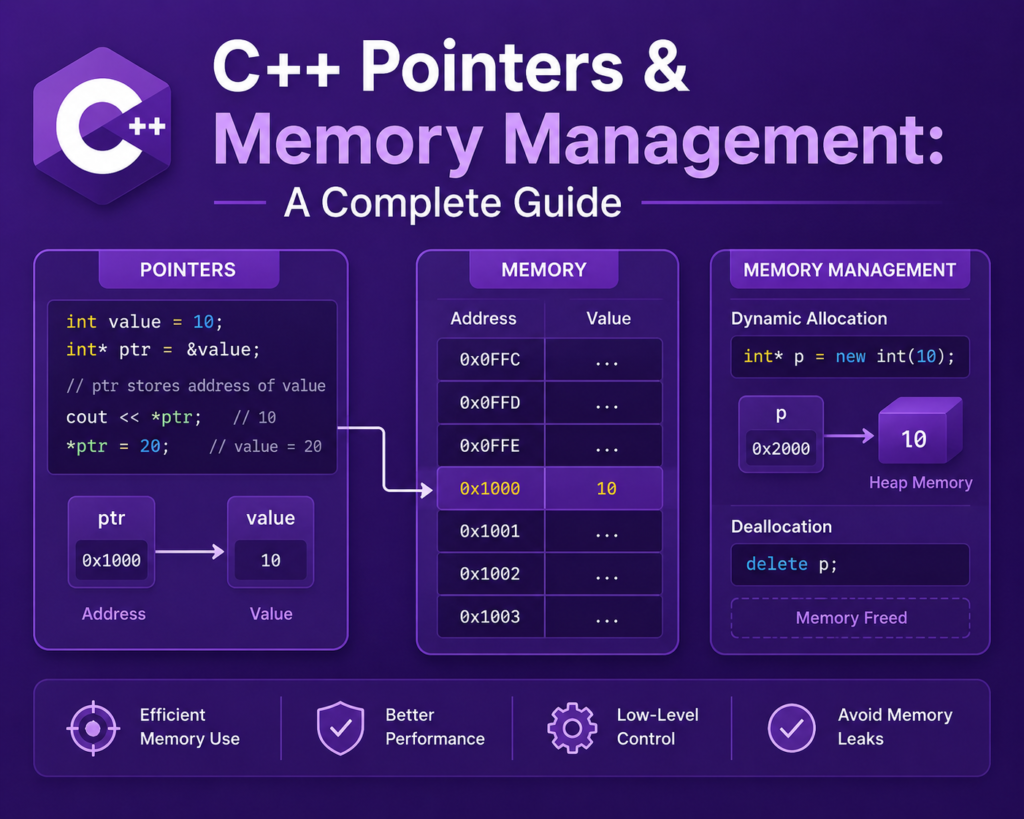
At the most fundamental level, a pointer is a variable that stores a memory address. Every variable in your program lives at a specific location in RAM, identified by a unique byte address. A pointer holds that address, giving you a direct line to that specific location in memory.
To declare a pointer in C++, you use the asterisk operator before the variable name. To get the address of an existing variable, you use the address-of operator, which is the ampersand symbol. To access the value stored at the address a pointer holds, you dereference it using the asterisk again.
#include <iostream>
using namespace std;

int main() {
    int age = 25;
    int* ptr = &age;

    cout << "Value of age: " << age << endl;
    cout << "Address of age: " << &age << endl;
    cout << "Pointer holds address: " << ptr << endl;
    cout << "Value via pointer: " << *ptr << endl;

    return 0;
}
In this example, ptr stores the memory address of the variable age. Using the dereference operator, *ptr gives you the actual value stored at that address, which is 25. This is the core mechanism of c++ pointers: store an address, use that address to read or modify the value it points to.
Understanding this basic model is the foundation for everything else. Once you genuinely see that a pointer is nothing more than a variable holding a number, and that number is a memory address, the rest of pointer programming starts to make complete sense.
Stack vs Heap Memory: Where Your Data Lives
Before diving deeper into c++ pointers, it is essential to understand the two main areas of memory your program uses: the stack and the heap.
The stack is where local variables live. When you declare a variable inside a function, it is created on the stack. Stack memory is managed automatically. When a function returns, all the variables it created on the stack are destroyed immediately. Stack allocation is fast but limited in size.
The heap is a much larger pool of memory that your program can request and use dynamically at runtime. Unlike the stack, heap memory is not managed automatically. You request it when you need it and you are responsible for releasing it when you are done. This is where dynamic memory allocation enters the picture, and this is where c++ pointers become absolutely essential.
#include <iostream>
using namespace std;

int main() {
    // Stack allocation - automatic
    int stackVar = 10;

    // Heap allocation - manual, requires pointer
    int* heapVar = new int(20);

    cout << "Stack variable: " << stackVar << endl;
    cout << "Heap variable: " << *heapVar << endl;

    // Must manually free heap memory
    delete heapVar;
    heapVar = nullptr;

    return 0;
}
The new keyword requests memory from the heap and returns a pointer to the allocated space. The delete keyword releases that memory back to the system. Failing to call delete after new is one of the most damaging mistakes in C++ programming and leads directly to memory leaks, where your program consumes more and more RAM without ever releasing it.
For developers studying C++ functions, understanding the distinction between stack and heap memory explains why variables declared inside functions disappear when those functions return, and why heap-allocated objects persist until explicitly deleted.
Dynamic Memory Allocation With New and Delete
Dynamic memory allocation is the practice of requesting memory at runtime rather than at compile time. This is one of the most powerful capabilities that c++ pointers unlock. When you do not know at compile time how much memory your program will need, dynamic allocation is the answer.
#include <iostream>
using namespace std;

int main() {
    int size;
    cout << "How many numbers do you want to store? ";
    cin >> size;

    // Dynamically allocate an array on the heap
    int* numbers = new int[size];

    for (int i = 0; i < size; i++) {
        numbers[i] = (i + 1) * 10;
    }

    cout << "Stored values: ";
    for (int i = 0; i < size; i++) {
        cout << numbers[i] << " ";
    }
    cout << endl;

    // Free the dynamically allocated array
    delete[] numbers;
    numbers = nullptr;

    return 0;
}
Notice that when deleting a dynamically allocated array, you must use delete[] rather than just delete. Using the wrong form leads to undefined behavior and potential memory corruption. Setting the pointer to nullptr after deletion is a critical safety habit. A pointer that still holds an address after the memory it pointed to has been freed is called a dangling pointer, and dereferencing one causes crashes and unpredictable bugs.
Dynamic memory allocation is how professional C++ applications handle data whose size is unknown until runtime. It is the engine behind dynamic arrays, linked lists, trees, graphs, and virtually every complex data structure used in real-world software.
C++ Pointers and Pointer Arithmetic
One of the genuinely unique features of c++ pointers is that you can perform arithmetic on them. Adding or subtracting an integer from a pointer moves it forward or backward through memory by a number of positions equal to the size of the type it points to. This is pointer arithmetic, and it is how C++ handles arrays at a deep level.
#include <iostream>
using namespace std;

int main() {
    int scores[] = {85, 92, 78, 96, 88};
    int* ptr = scores;  // Points to first element

    cout << "Traversing array with pointer arithmetic:" << endl;

    for (int i = 0; i < 5; i++) {
        cout << "Score " << i + 1 << ": " << *ptr << endl;
        ptr++;  // Move to next element
    }

    return 0;
}
When you increment ptr using ptr++, it does not just add 1 to the raw address. It adds the size of an int in bytes, typically 4 bytes on modern systems, moving the pointer exactly to the next integer in the array. This is why pointer arithmetic is type-aware and why it works so elegantly with arrays.
Pointer arithmetic is the backbone of how C-style strings and raw arrays work internally. It is also why understanding c++ pointers is so important for anyone studying C++ arrays, since under the hood, array names in C++ are essentially pointers to the first element.
Pointers and Functions: Passing by Reference
One of the most practical applications of c++ pointers is passing variables to functions in a way that allows the function to modify the original value. By default, C++ passes arguments by value, meaning the function receives a copy. With pointers, you pass the address, allowing the function to reach back and directly modify the original variable.
#include <iostream>
using namespace std;

void doubleValue(int* ptr) {
    *ptr = *ptr * 2;
}

void swapValues(int* a, int* b) {
    int temp = *a;
    *a = *b;
    *b = temp;
}

int main() {
    int number = 15;
    doubleValue(&number);
    cout << "Doubled value: " << number << endl;

    int x = 100, y = 200;
    swapValues(&x, &y);
    cout << "After swap - x: " << x << ", y: " << y << endl;

    return 0;
}
The doubleValue function receives a pointer to number. When it modifies *ptr, it is directly changing the original variable in memory. The swapValues function similarly works on the actual variables, not copies. This pass-by-pointer pattern is fundamental to writing C++ functions that need to produce multiple outputs or modify their inputs.
Double Pointers: Pointers to Pointers
A double pointer is a pointer that stores the address of another pointer. While this sounds abstract, it has concrete and important uses in C++ programming, particularly when dealing with two-dimensional arrays and functions that need to modify a pointer itself.
#include <iostream>
using namespace std;

int main() {
    int value = 42;
    int* ptr = &value;
    int** doublePtr = &ptr;

    cout << "Value: " << value << endl;
    cout << "Via pointer: " << *ptr << endl;
    cout << "Via double pointer: " << **doublePtr << endl;

    // Modify value through double pointer
    **doublePtr = 99;
    cout << "Modified value: " << value << endl;

    return 0;
}
To reach the actual value through a double pointer, you dereference it twice using **. Double pointers are used in dynamic two-dimensional array allocation, in certain linked list and tree operations, and whenever a function needs to change what a pointer itself points to rather than just the value at the pointer’s address.
Null Pointers and Safe Pointer Practices
A null pointer is a pointer that does not point to any valid memory location. In modern C++, you should always initialize pointers to nullptr rather than leaving them uninitialized or setting them to zero. An uninitialized pointer holds whatever random address happens to be in that memory location, and dereferencing it causes a segmentation fault, one of the most common and feared crashes in C++ programming.
#include <iostream>
using namespace std;

int main() {
    int* ptr = nullptr;

    // Always check before dereferencing
    if (ptr != nullptr) {
        cout << "Value: " << *ptr << endl;
    } else {
        cout << "Pointer is null. Cannot dereference." << endl;
    }

    // Safe allocation
    ptr = new int(55);

    if (ptr != nullptr) {
        cout << "Value: " << *ptr << endl;
        delete ptr;
        ptr = nullptr;
    }

    return 0;
}
Always check a pointer for nullptr before dereferencing it. Always set a pointer to nullptr after deleting the memory it points to. These two habits alone will save you from the vast majority of pointer-related bugs that plague C++ programs in the wild.
Smart Pointers: Modern C++ Memory Management
Raw pointers are powerful but require strict discipline to use safely. Modern C++ introduced smart pointers specifically to automate memory management while preserving the power of pointers. Smart pointers are objects that behave like pointers but automatically release their memory when they go out of scope, eliminating memory leaks entirely.
#include <iostream>
#include <memory>
using namespace std;

class Resource {
public:
    Resource() {
        cout << "Resource acquired." << endl;
    }
    ~Resource() {
        cout << "Resource released automatically." << endl;
    }
    void use() {
        cout << "Using the resource." << endl;
    }
};

int main() {
    // unique_ptr - sole ownership
    unique_ptr<Resource> res1 = make_unique<Resource>();
    res1->use();

    // shared_ptr - shared ownership
    shared_ptr<Resource> res2 = make_shared<Resource>();
    shared_ptr<Resource> res3 = res2;  // Both share ownership

    cout << "Reference count: " << res2.use_count() << endl;

    return 0;
    // Memory is freed automatically when smart pointers go out of scope
}
unique_ptr holds sole ownership of a resource. When it goes out of scope, the memory is deleted automatically. shared_ptr allows multiple pointers to share ownership of the same resource. The memory is released only when the last shared_ptr owning it is destroyed. There is also weak_ptr, which observes a shared resource without owning it, preventing circular reference issues.
For anyone exploring advanced C++ concepts, smart pointers are absolutely essential knowledge. They represent the modern, safe way to handle dynamic memory while preserving every bit of the performance and control that makes C++ the language of choice for systems programming.
C++ Pointers in OOP and Data Structures
c++ pointers integrate deeply with object-oriented programming. In OOP in C++, pointers to base class types are the mechanism that enables polymorphism. When you store a derived class object through a base class pointer, virtual functions allow the correct overridden method to be called at runtime. Without pointers, runtime polymorphism in C++ would simply not exist.
Pointers also form the building blocks of every important data structure in computer science. Linked lists, binary trees, graphs, hash tables, and stacks all depend on pointers to connect their nodes. Each node holds a pointer to the next node, the child nodes, or the neighboring nodes. Without c++ pointers, there would be no dynamic data structures at all.
C++ Pointers in Modern Technology
In C++ in modern technology, c++ pointers continue to be absolutely central. Operating system kernels written in C++ use pointers to manage hardware resources and memory-mapped devices. Game engines use pointers extensively for managing scene graphs, entity hierarchies, and rendering pipelines. Network software uses pointer-based buffers to process incoming and outgoing data at maximum speed.
For developers interested in C++ game development, Unreal Engine relies heavily on pointer-based systems for its actor hierarchy, component model, and garbage collection mechanisms. Understanding raw pointers and smart pointers is not optional for any serious Unreal Engine developer. It is a core requirement from day one.
The performance characteristics that c++ pointers enable, direct memory access, zero-overhead data traversal, cache-friendly data layouts, are precisely why C++ remains the dominant language in high-performance computing, embedded systems, and real-time applications decades after its creation.
Frequently Asked Questions
What Is the Difference Between a Pointer and a Reference in C++?
A pointer stores a memory address and can be reassigned to point to different variables. A reference is an alias for an existing variable and cannot be reassigned after initialization. Pointers can be null, references cannot. Pointers require explicit dereferencing to access the value they point to, while references are used directly like the original variable. Both are used for passing by address in functions, but references are generally safer and cleaner when reassignment is not needed.
What Is a Memory Leak in C++ and How Do You Prevent It?
A memory leak occurs when heap memory is allocated with the new keyword but never released with delete. Over time, a leaking program consumes increasing amounts of RAM until the system runs out of memory or the program crashes. You prevent memory leaks by always matching every new with a corresponding delete, always using delete[] for arrays, setting pointers to nullptr after deletion, and preferring smart pointers like unique_ptr and shared_ptr which handle deallocation automatically.
What Is a Dangling Pointer and Why Is It Dangerous?
A dangling pointer is a pointer that still holds an address after the memory at that address has been freed. Dereferencing a dangling pointer causes undefined behavior, which can result in incorrect output, data corruption, security vulnerabilities, or program crashes. You avoid dangling pointers by setting every pointer to nullptr immediately after calling delete on it.
What Is the Difference Between New and Malloc in C++?
The new keyword is the C++ way to allocate heap memory. It calls the constructor of the object being created, initializes the memory properly, and returns a typed pointer. malloc is a C function that allocates raw bytes without calling any constructor and returns a void pointer that must be cast to the correct type. In C++, you should always prefer new and delete over malloc and free, and in modern C++ you should prefer smart pointers over raw new and delete entirely.
When Should You Use Smart Pointers Instead of Raw Pointers?
In modern C++, you should use smart pointers by default for any dynamically allocated memory. Use unique_ptr when a resource has a single clear owner. Use shared_ptr when multiple parts of your program need to share ownership of the same resource. Reserve raw pointers for situations where you genuinely need non-owning observation of a resource, interfacing with C libraries, or performance-critical inner loops where the overhead of smart pointer management is unacceptable.
Conclusion
C++ pointers are one of the most powerful and rewarding topics in the entire language. They demand respect and careful handling, but they give back extraordinary capability in return. From direct memory access and dynamic allocation to pointer arithmetic, double pointers, and the elegance of modern smart pointers, every concept covered in this guide builds toward one goal: giving you complete, confident mastery over how your program uses memory.
C++ pointers are not a relic of an older era. They are a living, vital part of modern C++ development. Every serious C++ application, from game engines to operating systems to financial trading platforms, depends on pointer-based memory management to achieve the performance that makes C++ irreplaceable. When you master them, you do not just become a better C++ programmer. You become a better programmer in every language you ever touch.