The profound story of andrew ng and computer vision is an epic narrative of how a single visionary educator successfully bridged the massive gap between elite academic research and practical, global-scale application. For years, advanced visual perception remained locked away in specialized, ivory-tower laboratories, understood by only a handful of expert scientists. Andrew Ng, a brilliant professor at Stanford University, fundamentally challenged this status quo. By championing deep learning, he played a critical role in the broader history of computer vision, transforming how modern machines interpret our world. His journey is marked by legendary projects, massive online educational movements, and a relentless focus on making complex artificial intelligence accessible to every software engineer. By exploring his career, we discover exactly how he propelled the industry from rudimentary edge detection toward the sophisticated, data-centric architectures that define our technological present.
Early Academic Foundations (2000 – 2010)
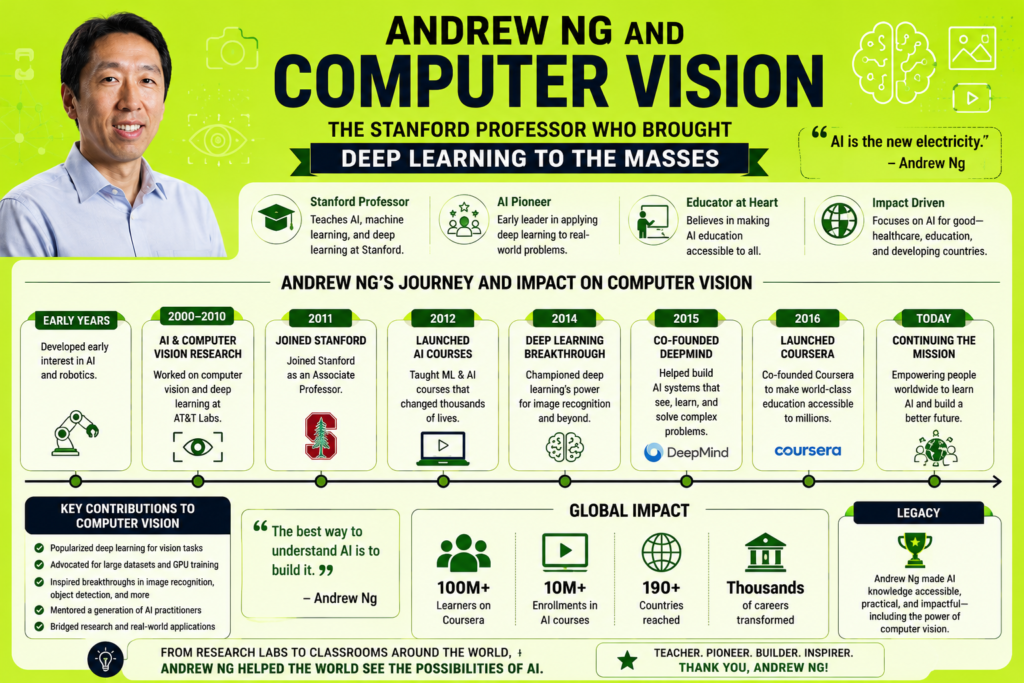
Long before he became the face of modern AI education, Andrew Ng was already a driving force inside the Stanford AI Lab. During the early two-thousands, his research focused on the intersection of machine learning and robotics. He was deeply interested in how to make machines learned to see so they could navigate the physical world. One of his most iconic early projects was the Stanford autonomous helicopter project, which used sophisticated machine learning algorithms to enable high-precision aerobatic flight. This work was a significant departure from traditional, manually programmed flight controls. It required the robot to learn its own movement patterns, a concept that would later become a core tenet of his philosophy on deep learning.
During this period, he also pioneered Make3D, a groundbreaking project that focused on building 3D models from a single still image. By developing innovative algorithms for depth estimation, he proved that a computer could infer the structure of a scene just by analyzing light and shadows, a key milestone in the broader computer vision timeline. These early successes solidified his reputation as a pioneer who wasn’t just interested in theory; he was obsessed with building useful, general-purpose systems that could interact with reality. His work during these years laid the essential, foundational bricks for the massive neural network architectures that would dominate the next decade of development.
The Google Brain Revolution (2011 – 2013)
The most transformative chapter in the history of andrew ng and computer vision occurred in 2011, when he partnered with Jeff Dean and Greg Corrado to launch the Google Brain project. Their ambitious goal was to explore the potential of massive neural networks by utilizing Google’s vast computing infrastructure. This was a radical departure from the small-scale experiments common at the time. The team built an enormous network utilizing a cluster of 16,000 processor core network, designed to mimic some aspects of biological brain activity.
This experiment famously resulted in the “Google cat” discovery. By training a massive neural network on 10 million unlabeled YouTube video frames, the machine autonomously learned to identify cats without being explicitly told what a cat looked like. This event made headlines worldwide and served as a powerful proof of concept for the power of unsupervised feature learning scaling. It demonstrated that deep networks did not need perfect, human-labeled datasets to identify complex objects; they just needed enough data and sufficient computing power to find patterns on their own. This breakthrough effectively helped convince the global research community that deep learning was the future of visual intelligence, forever changing the history of pattern recognition.
Democratizing AI Education (2012 – 2017)
As his research gained global attention, Andrew Ng recognized a major bottleneck: the world didn’t have enough experts to build the future of AI. In 2011, he launched his Stanford machine learning class online, which was one of the first massive open online courses (MOOCs) that enrolled over 100,000 students. This move sparked the Coursera AI education launch, an initiative that would eventually educate millions of people worldwide. Through his deeplearning.ai computer vision specialization, he codified the fundamental principles of convolutional networks, object detection, and sequence modeling for a global audience.
By providing clear, structured pathways for learners, he helped standardize the industry’s approach to training visual models. His educational materials became the “go-to” resources for engineers entering the field, ensuring that the next generation of researchers would have a shared understanding of deep network scaling laws and baseline dataset refinement strategies. He moved the discourse away from complex, inaccessible jargon toward a structured pipeline guidelines approach, making it possible for standard developers to build complex applications that were once deemed “impossible.” This educational shift was arguably as important as his technical research, as it created a massive, global talent pool that continues to drive the current pace of innovation.
Industrial Scaling and Data Centric AI (2018 – 2026)
In his recent entrepreneurial work, Andrew Ng has pivoted toward the practical application of AI in manufacturing and industrial settings. Through Landing AI, he developed LandingLens, a powerful platform that lets manufacturers build custom visual inspection systems in minutes. His approach emphasizes a data centric AI vision system approach, where the focus shifts from constantly tweaking the model’s code to rigorously improving the quality and consistency of the training data. This methodology has proven to be a game-changer for high-yield defect detection metrics in factory environments.
His current vision focuses on the Andrew Ng visual automation tech stack perspective, which prioritizes the MLOps structured pipeline guidelines required to deploy models at scale. Whether it is identifying microscopic scratches on a smartphone display or detecting missing components on a printed circuit board, he argues that small, high-quality datasets are often more effective than massive, noisy ones. By bringing computer vision technology to the assembly line, he is helping industries move past manual inspection and into a future where machines handle quality control with flawless, objective precision. This focus on “no-code” deployment tools demonstrates his commitment to making advanced visual technology accessible to businesses that lack a dedicated research department.
FAQs:
What was the “Google Brain cat experiment” and why did it matter?
It was a landmark experiment where a massive neural network learned to recognize cats from 10 million YouTube images without being explicitly taught. It proved that deep learning could discover complex visual features autonomously if given enough data and computing power.
How did Andrew Ng change AI education?
By launching one of the first MOOCs at Stanford and co-founding Coursera, he made high-level machine learning concepts accessible to millions. His courses provided the standardized curriculum that allowed an entire generation of developers to master deep learning.
What is “Data Centric AI” and why does he promote it?
He argues that instead of obsessing over code changes or model architecture, engineers should focus on improving the quality and consistency of their data. In his view, “data centric” approaches are more reliable for building real-world, industrial-grade applications.
What is the goal of Landing AI?
Landing AI aims to bring computer vision to the manufacturing sector. By offering easy-to-use platforms like LandingLens, the company enables factory workers—not just AI researchers—to build and deploy visual inspection models to automate quality control.
Conclusion
The influence of Andrew Ng on the field of visual AI is immense. Through his groundbreaking research at the Stanford AI Lab, his leadership at Google Brain, and his tireless commitment to education, he has fundamentally shaped how the world perceives machine intelligence. He proved that deep learning could scale to massive proportions, demonstrated that neural networks could learn autonomously from vast amounts of data, and created the educational infrastructure necessary to sustain a global AI revolution. As we look toward the future of computer vision technology, his emphasis on high-quality data and practical, industrial deployment will remain a guiding light for researchers and engineers alike. He transformed AI from a niche academic pursuit into a powerful, democratized utility that is currently optimizing factories, powering autonomous systems, and enabling more accurate medical diagnostics than ever before. His legacy is not just the models he built, but the millions of learners who are now using those same principles to solve the challenges of tomorrow.