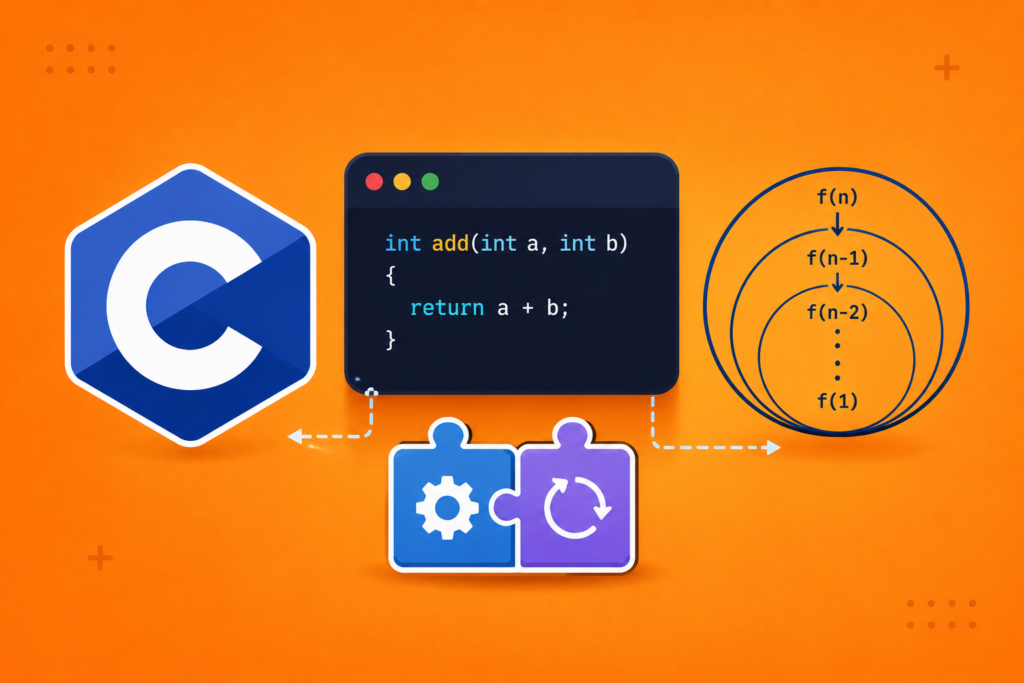
C functions and recursion represent two of the most transformative concepts in the entire C programming language. The moment you understand functions, your code transforms from a flat sequence of statements into a structured, modular system where each piece of logic has its own name, its own purpose, and its own clearly defined boundaries. The moment you understand recursion, you gain the ability to solve problems that would require extraordinarily complex loops and temporary variables using elegant, self-referential logic that reads almost like a mathematical proof. Whether you are just beginning your C journey or reinforcing your foundational skills, mastering c functions and recursion will permanently elevate the quality of everything you write.
What Is a Function in C and Why Does It Matter
A function in C is a named, self-contained block of code that performs a specific task, can receive input through parameters, and can return a result to the caller. Functions are the primary tool for achieving modularity in C programming. Instead of writing one enormous main function that does everything, you divide your program into smaller, focused functions that each do one thing well.
The C programming legacy that Dennis Ritchie established placed functions at the absolute center of program design. C does not have classes or objects. Its primary organizational unit is the function. Every C program begins execution in the main function, and every piece of logic your program performs flows through function calls. Understanding c functions and recursion is therefore not optional knowledge for a C programmer. It is the fundamental skill that separates beginners who write working code from programmers who write well-structured, maintainable systems.
The Anatomy of a C Function
Every C function has four components: a return type, a name, a parameter list, and a body. Understanding each component precisely is the foundation of c functions and recursion:
c:
/* return_type function_name(parameter_list) { body } */

int add(int a, int b) {
    return a + b;
}
The return type int declares that this function will produce an integer value when it finishes. The name add identifies the function. The parameter list (int a, int b) declares two integer inputs that the function receives from the caller. The body contains the logic, and the return statement sends the computed value back.
When a function has no return value, you use the void return type. When a function takes no parameters, you use void in the parameter list for explicitness:
c:
void print_greeting(void) {
    printf("Hello from a void function!\n");
}
Function Declaration vs Definition: Getting the Order Right
C requires that a function be declared before it is used. A function declaration, also called a function prototype, tells the compiler the function’s name, return type, and parameter types without providing the body. The function definition provides the actual body:
c:
#include <stdio.h>

/* Function prototype - declaration without body */
int multiply(int x, int y);
double circle_area(double radius);

int main(void) {
    int product = multiply(6, 7);
    double area = circle_area(5.0);

    printf("Product: %d\n", product);
    printf("Circle area: %.2f\n", area);
    return 0;
}

/* Function definitions - body provided after main */
int multiply(int x, int y) {
    return x * y;
}

double circle_area(double radius) {
    const double PI = 3.14159265358979;
    return PI * radius * radius;
}
The prototypes at the top allow main to call multiply and circle_area even though their definitions appear later in the file. Without the prototypes, the compiler would encounter the calls in main before it knows anything about those functions, producing errors or warnings.
Parameter Passing in C: Pass by Value
C passes arguments to functions by value, meaning the function receives a copy of each argument rather than the original variable. Changes made to parameters inside the function have no effect on the variables in the calling code:
c:
#include <stdio.h>

void try_to_modify(int x) {
    x = 999;   /* Modifies the local copy only */
    printf("Inside function: x = %d\n", x);
}

int main(void) {
    int number = 42;
    printf("Before call: number = %d\n", number);
    try_to_modify(number);
    printf("After call: number = %d\n", number);
    return 0;
}
The output will show that number remains 42 after the function call despite the assignment inside the function. The function operated on its own local copy of x, leaving the original untouched. This pass-by-value behavior is a deliberate design choice that makes function behavior predictable and prevents unintended side effects.
Passing Pointers to Modify Variables
When you genuinely need a function to modify a variable in the calling code, you pass a pointer to that variable. The function then uses pointer dereferencing to modify the value at the original memory address:
c:
#include <stdio.h>

void swap(int *a, int *b) {
    int temp = *a;
    *a = *b;
    *b = temp;
}

void get_min_max(int arr[], int length, int *min, int *max) {
    int i;
    *min = arr[0];
    *max = arr[0];
    for (i = 1; i < length; i++) {
        if (arr[i] < *min) *min = arr[i];
        if (arr[i] > *max) *max = arr[i];
    }
}

int main(void) {
    int x = 10, y = 20;
    printf("Before swap: x=%d, y=%d\n", x, y);
    swap(&x, &y);
    printf("After swap: x=%d, y=%d\n", x, y);

    int numbers[] = {34, 7, 89, 12, 56, 43};
    int min, max;
    get_min_max(numbers, 6, &min, &max);
    printf("Min: %d, Max: %d\n", min, max);

    return 0;
}
This is the standard pattern for functions that need to return multiple values or modify caller variables. The & operator takes the address of a variable and the * operator in the function signature declares a pointer parameter.
Variable Scope in Functions: Local and Global
Variable scope determines where a variable is accessible. Local variables declared inside a function exist only for the duration of that function call. Global variables declared outside all functions persist for the entire program lifetime and are accessible from any function:
c:
#include <stdio.h>

int global_count = 0;   /* Global variable */

void increment_counter(void) {
    int local_step = 1;     /* Local variable */
    global_count += local_step;
    printf("Counter: %d\n", global_count);
    /* local_step ceases to exist when function returns */
}

int calculate_sum(int n) {
    int sum = 0;    /* Local to this function */
    int i;
    for (i = 1; i <= n; i++) {
        sum += i;
    }
    return sum;
}

int main(void) {
    increment_counter();
    increment_counter();
    increment_counter();
    printf("Final count: %d\n", global_count);
    printf("Sum 1 to 100: %d\n", calculate_sum(100));
    return 0;
}
Each call to increment_counter creates a fresh local_step variable and destroys it when the function returns. The global_count variable persists across all calls. While global variables are convenient, over-relying on them creates tight coupling between functions that makes code harder to test and maintain. Prefer passing values through parameters and returning results.
The Call Stack: What Happens When Functions Execute
Every time a function is called, C creates a stack frame on the call stack. The stack frame holds the function’s local variables, parameter values, and the return address indicating where execution should resume after the function finishes. When the function returns, its stack frame is removed and execution resumes at the saved return address.
c:
#include <stdio.h>

int square(int n) {
    return n * n;       /* Stack frame 3 */
}

int sum_of_squares(int a, int b) {
    return square(a) + square(b);  /* Stack frame 2 */
}

int main(void) {
    int result = sum_of_squares(3, 4);  /* Stack frame 1 */
    printf("Sum of squares: %d\n", result);
    return 0;
}
When main calls sum_of_squares, a stack frame for sum_of_squares is pushed onto the stack. When sum_of_squares calls square, a stack frame for square is pushed. When square returns, its frame is popped. When sum_of_squares returns, its frame is popped and main resumes. Understanding the call stack is essential for understanding c functions and recursion because recursion pushes many stack frames before any of them are popped.
What Is Recursion in C: A Function Calling Itself
Recursion is the technique of writing a function that calls itself as part of its own definition. This sounds circular and paradoxical at first, but it is a powerful and mathematically rigorous technique for solving problems that have a naturally recursive structure.
Every valid recursive function must have two things. First, a base condition that stops the recursion. Second, a recursive case that calls the function with a simpler or smaller input, moving toward the base condition. Without the base condition, recursion would continue infinitely until the call stack fills up and the program crashes with a stack overflow.
The classic introductory example is the factorial function. The factorial of n, written as n!, is defined as n multiplied by (n-1) factorial, with the base case that the factorial of 0 is 1:
c:
#include <stdio.h>

int factorial(int n) {
    /* Base condition: stops the recursion */
    if (n == 0 || n == 1) {
        return 1;
    }
    /* Recursive case: calls itself with n-1 */
    return n * factorial(n - 1);
}

int main(void) {
    int i;
    for (i = 0; i <= 10; i++) {
        printf("%d! = %d\n", i, factorial(i));
    }
    return 0;
}
When factorial(5) is called, it calls factorial(4), which calls factorial(3), which calls factorial(2), which calls factorial(1), which returns 1. Then each pending call resolves: factorial(2) returns 2, factorial(3) returns 6, factorial(4) returns 24, factorial(5) returns 120. This unwinding of recursive calls is the fundamental mechanism of c functions and recursion.
Fibonacci Numbers: Classic Recursive Problem
c:
The Fibonacci sequence is another textbook demonstration of recursion. Each Fibonacci number is the sum of the two preceding numbers, starting with 0 and 1:
#include <stdio.h>

int fibonacci(int n) {
    /* Base conditions */
    if (n == 0) return 0;
    if (n == 1) return 1;
    /* Recursive case */
    return fibonacci(n - 1) + fibonacci(n - 2);
}

int main(void) {
    int i;
    printf("First 15 Fibonacci numbers:\n");
    for (i = 0; i < 15; i++) {
        printf("F(%d) = %d\n", i, fibonacci(i));
    }
    return 0;
}
This implementation is elegant but inefficient for large values of n because it recalculates the same Fibonacci numbers many times. fibonacci(10) calls fibonacci(9) and fibonacci(8). fibonacci(9) calls fibonacci(8) and fibonacci(7). fibonacci(8) is calculated twice. This exponential redundancy is a critical insight about naive recursion that leads to optimization techniques like memoization.
Binary Search: Powerful Recursion in Practice
Binary search on a sorted array is one of the most practical demonstrations of recursive thinking. It eliminates half the remaining search space with each recursive call, achieving logarithmic time complexity:
c:
#include <stdio.h>

int binary_search(int arr[], int left, int right, int target) {
    /* Base condition: target not found */
    if (left > right) {
        return -1;
    }

    int mid = left + (right - left) / 2;

    if (arr[mid] == target) {
        return mid;     /* Found */
    } else if (arr[mid] < target) {
        return binary_search(arr, mid + 1, right, target);  /* Right half */
    } else {
        return binary_search(arr, left, mid - 1, target);   /* Left half */
    }
}

int main(void) {
    int sorted[] = {2, 7, 14, 23, 38, 45, 67, 89, 94, 102};
    int length = 10;
    int target = 45;

    int index = binary_search(sorted, 0, length - 1, target);

    if (index != -1) {
        printf("Found %d at index %d\n", target, index);
    } else {
        printf("%d not found in array\n", target);
    }
    return 0;
}
Each recursive call halves the search range. An array of 1 million elements requires at most 20 recursive calls to find any element or confirm it is absent.
Tower of Hanoi: Pure Recursive Elegance
The Tower of Hanoi puzzle perfectly illustrates why recursion exists. Moving n disks from source to destination using three pegs seems impossibly complex iteratively but reduces to a beautifully simple recursive solution:
c:
#include <stdio.h>

void hanoi(int n, char source, char destination, char auxiliary) {
    if (n == 1) {
        printf("Move disk 1 from %c to %c\n", source, destination);
        return;
    }
    hanoi(n - 1, source, auxiliary, destination);
    printf("Move disk %d from %c to %c\n", n, source, destination);
    hanoi(n - 1, auxiliary, destination, source);
}

int main(void) {
    int disks = 3;
    printf("Tower of Hanoi with %d disks:\n", disks);
    hanoi(disks, 'A', 'C', 'B');
    return 0;
}
Three disks require 7 moves. Four disks require 15 moves. The number of moves is always 2^n minus 1, a consequence of the recursive doubling structure. No iterative solution approaches this clarity and conciseness.
Recursive vs Iterative: Choosing the Right Approach
Both recursion and iteration can solve the same problems. The choice depends on clarity, performance requirements, and the natural structure of the problem:
c:
#include <stdio.h>

/* Iterative factorial */
int factorial_iterative(int n) {
    int result = 1;
    int i;
    for (i = 2; i <= n; i++) {
        result *= i;
    }
    return result;
}

/* Recursive factorial */
int factorial_recursive(int n) {
    if (n <= 1) return 1;
    return n * factorial_recursive(n - 1);
}

int main(void) {
    printf("Iterative 10!: %d\n", factorial_iterative(10));
    printf("Recursive 10!: %d\n", factorial_recursive(10));
    return 0;
}
The iterative version uses a loop counter and accumulates the result. The recursive version mirrors the mathematical definition of factorial. Both produce identical results. The iterative version uses constant stack space. The recursive version uses stack space proportional to n. For small n, recursion is cleaner. For very large n, iteration avoids stack overflow risks.
Library Functions vs User-Defined Functions
C provides a rich set of library functions through its standard library, declared in header files like stdio.h, stdlib.h, math.h, and string.h. Understanding how library functions and user-defined functions complement each other is important for writing effective C programs:
c:
#include <stdio.h>
#include <math.h>
#include <stdlib.h>

/* User-defined function using library functions internally */
double hypotenuse(double a, double b) {
    return sqrt(a * a + b * b);    /* sqrt from math.h */
}

int compare_ints(const void *a, const void *b) {
    return (*(int*)a - *(int*)b);   /* Used by qsort */
}

int main(void) {
    double h = hypotenuse(3.0, 4.0);
    printf("Hypotenuse: %.2f\n", h);  /* Should be 5.00 */

    int numbers[] = {64, 17, 92, 3, 45, 28};
    int len = 6;
    qsort(numbers, len, sizeof(int), compare_ints);   /* qsort from stdlib.h */

    int i;
    printf("Sorted: ");
    for (i = 0; i < len; i++) {
        printf("%d ", numbers[i]);
    }
    printf("\n");
    return 0;
}
Library functions like sqrt and qsort are production-quality implementations tested across decades. User-defined functions give you domain-specific logic tailored to your problem. Skilled C programmers combine both fluently.
C Functions and Recursion in the Broader Learning Path
Mastering c functions and recursion opens the door to every advanced topic in the language. Functions are the vehicle through which every other concept is applied, and recursion is the technique that makes certain categories of problems elegant and tractable.
For anyone building their C skills systematically, understanding C control flow within functions is the complementary skill that makes function bodies genuinely powerful. Loops, conditionals, and switches inside well-designed functions are what give C programs their computational intelligence.
When you are ready to go deeper, C pointers explained reveals how functions interact with memory at the most fundamental level. Pointer parameters, pointer return values, and function pointers are advanced capabilities that transform what your functions can do.
Working with collections of data inside functions leads naturally to C arrays and strings, where you will write functions that process character sequences, search arrays, and manipulate buffers with the same pointer-based techniques that the standard library uses internally.
For the historical context that makes function-based design make sense as a deliberate philosophy, the C programming legacy shows why Ritchie and Thompson built UNIX from composable, single-purpose functions and why that approach produced software that has proven remarkably durable.
Developers curious about how C’s approach to functions compares to higher-level languages will find C vs Python revealing: Python functions are objects that can be passed around and modified dynamically, while C functions are fixed addresses in memory, closer to the machine and predictable in cost.
Frequently Asked Questions
What Is the Difference Between a Function Declaration and a Function Definition in C?
A function declaration, also called a function prototype, tells the compiler the function’s name, return type, and parameter types without providing the body. A function definition provides the actual implementation inside curly braces. Declarations allow you to call a function before its definition appears in the source file. Definitions are what actually generate the executable code. Every function must have exactly one definition in a program but can have multiple declarations across different files.
What Is a Base Condition in Recursion and Why Is It Required?
A base condition is the specific case in a recursive function where the function stops calling itself and returns a direct answer. Without a base condition, the function would call itself indefinitely, each call pushing a new stack frame onto the call stack until memory is exhausted and the program crashes with a stack overflow error. The base condition ensures that every chain of recursive calls eventually terminates. Writing the base condition correctly and ensuring the recursive case always moves toward it are the two most critical skills in designing recursive solutions.
What Is Stack Overflow in the Context of C Recursion?
Stack overflow occurs when a recursive function makes so many nested calls that it exhausts the call stack memory the operating system allocated for the program. Each function call consumes stack space for its local variables and return address. When recursion is very deep, either from a large input or from missing or incorrect base conditions, the accumulated stack frames exceed available stack memory. The operating system terminates the program. Preventing stack overflow requires ensuring your base condition is reachable, choosing iterative solutions for problems with very large input sizes, or using techniques like tail recursion optimization when the compiler supports it.
When Should I Use Recursion Instead of a Loop in C?
Use recursion when the problem has a naturally recursive structure, meaning the solution to a problem of size n depends directly on solutions to smaller instances of the same problem. Tree traversal, directory enumeration, divide-and-conquer algorithms like merge sort and quick sort, and mathematical sequences like Fibonacci and factorial all fit this pattern. Use iteration when the problem is straightforwardly sequential, when performance is critical and you need to avoid call stack overhead, or when the recursion depth could be large enough to risk stack overflow. Clarity and correctness should guide the choice more than any rigid rule.
What Is the Difference Between Pass by Value and Pass by Pointer in C Functions?
Pass by value means the function receives a copy of the argument. Changes to the parameter inside the function do not affect the original variable. Pass by pointer means the function receives the memory address of the argument. Using the dereference operator on that pointer inside the function modifies the original variable directly. C only supports pass by value natively. Passing a pointer is technically still passing by value, because the address itself is copied, but it achieves the effect of pass by reference because the function can use that address to reach and modify the original data.
Conclusion
C functions and recursion are the twin pillars of structured, expressive C programming. Functions give your code modularity, reusability, and clarity by packaging logic into named, callable units with defined inputs and outputs. Recursion gives your code the power to solve inherently recursive problems with mathematical elegance, expressing in a few lines what would require complex iterative state management to achieve otherwise.
The path to mastering c functions and recursion runs through deliberate practice. Write functions that solve real problems. Start with simple utilities that perform arithmetic or string operations. Progress to functions that pass and return pointers. Then tackle recursion starting with factorial and Fibonacci before moving to binary search and sorting algorithms. Build the intuition for when recursion clarifies and when iteration serves better.
Every sophisticated C program ever written, from the UNIX utilities that Dennis Ritchie and Ken Thompson built to the Linux kernel running millions of servers today, is ultimately a collection of well-designed functions working together. That design philosophy is the heart of the C programming legacy, and it begins with mastering exactly the concepts this guide has covered.