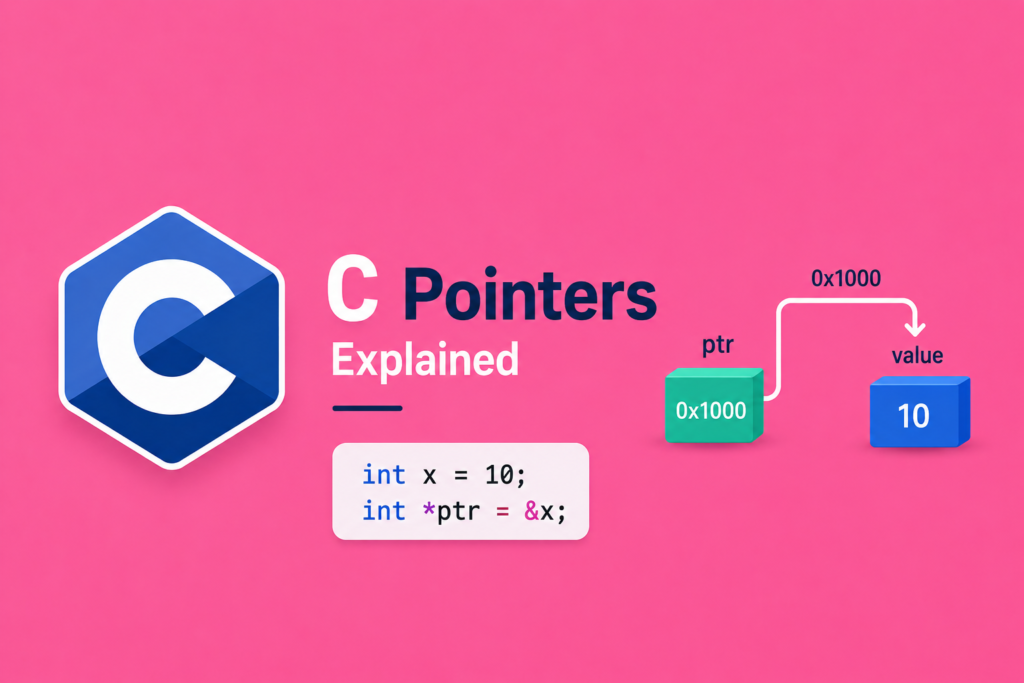
C pointers explained properly can transform a confused beginner into a confident systems programmer. Pointers are the feature that separates C from nearly every other high-level language. They are the mechanism through which C achieves its legendary performance, its ability to manage memory with surgical precision, and its capacity to build the kind of low-level software that runs the digital infrastructure of the modern world. Most programmers find pointers intimidating at first encounter. That reaction is understandable but entirely unnecessary. Pointers follow strict, logical rules that become deeply intuitive once you see them demonstrated clearly with real code. This guide gives you c pointers explained from first principles through advanced applications, with every concept grounded in working examples you can compile and run immediately.
Why Pointers Exist: The Problem They Solve
To truly appreciate c pointers explained at a deep level, you need to understand the problem pointers solve. Every variable in your C program lives somewhere in memory. When you declare int age = 25, the compiler allocates a specific memory location, typically 4 bytes, and stores the value 25 at that address. Normally you access age by name and the compiler handles the memory address automatically.
But sometimes you need to know exactly where in memory something lives. You need to pass a variable to a function and have that function modify the original, not a copy. You need to allocate memory dynamically at runtime because you do not know at compile time how much you will need. You need to build data structures like linked lists and trees where nodes connect to each other through stored addresses. For all of these requirements, you need pointers.
The C programming legacy that Dennis Ritchie built at Bell Labs placed pointers at the center of the language because UNIX itself required this level of memory control. Operating systems must manage hardware addresses, map memory regions, and manipulate data at specific locations. Only a language with direct pointer support can do this efficiently, and that is precisely why C became the language of systems software.
What Is a Pointer: The Core Concept
A pointer is a variable that stores a memory address as its value. While an ordinary int variable stores an integer like 42, an int pointer variable stores the address of a memory location that contains an integer. This indirection, storing an address rather than a value directly, is the essence of what pointers are.
Every memory address in a typical system is a number. On a 64-bit system, addresses are 64-bit numbers. A pointer is simply a variable sized to hold one of these address numbers, along with type information telling the compiler what kind of data lives at that address:
c:
#include <stdio.h>

int main(void) {
    int value = 42;
    int *ptr;           /* Declare a pointer to int */

    ptr = &value;       /* Store the address of value in ptr */

    printf("Value of variable:   %d\n", value);
    printf("Address of variable: %p\n", (void*)&value);
    printf("Value of pointer:    %p\n", (void*)ptr);
    printf("Value at pointer:    %d\n", *ptr);

    return 0;
}
Two operators make pointers work. The address-of operator & takes a variable and returns its memory address. The indirection operator *, also called the dereference operator, takes a pointer and returns the value stored at the address it holds. These two operators are the entire mechanical foundation of c pointers explained.
Declaring and Initializing Pointers Correctly
Pointer declaration syntax confuses many beginners because the * symbol appears in both declarations and expressions but means different things in each context. In a declaration, * indicates you are declaring a pointer variable. In an expression, * dereferences a pointer to access the value at its address:
c:
#include <stdio.h>

int main(void) {
    int a = 10;
    int b = 20;

    int *p1 = &a;   /* p1 points to a */
    int *p2 = &b;   /* p2 points to b */

    printf("p1 points to: %d\n", *p1);   /* 10 */
    printf("p2 points to: %d\n", *p2);   /* 20 */

    /* Change the value at the address p1 holds */
    *p1 = 99;
    printf("a is now: %d\n", a);          /* 99 */

    /* Make p1 point to b instead */
    p1 = p2;
    printf("p1 now points to: %d\n", *p1); /* 20 */

    return 0;
}
Always initialize pointers before using them. An uninitialized pointer holds a garbage address. Dereferencing it causes undefined behavior, usually a segmentation fault that crashes your program. Assign a valid address with & or set the pointer to NULL immediately at declaration if you do not yet have an address to assign.
The NULL Pointer: Safe Initialization
NULL is a special constant that represents an invalid or absent address. Initializing pointers to NULL when you do not yet have a valid address is essential defensive programming:
c:
#include <stdio.h>

int main(void) {
    int *ptr = NULL;   /* Safe initialization */

    /* Always check before dereferencing */
    if (ptr != NULL) {
        printf("Value: %d\n", *ptr);
    } else {
        printf("Pointer is null. Nothing to dereference.\n");
    }

    int number = 55;
    ptr = &number;     /* Now it has a valid address */

    if (ptr != NULL) {
        printf("Value: %d\n", *ptr);   /* 55 */
    }

    return 0;
}
Dereferencing a NULL pointer is undefined behavior that almost always causes a segmentation fault. The check if (ptr != NULL) before dereferencing is a habit that prevents an entire class of crashes, especially important when pointers are returned from functions that might fail.
Pointer Arithmetic: Moving Through Memory
C pointers explained at an intermediate level must cover pointer arithmetic, one of the most powerful and distinctive capabilities of C. When you perform arithmetic on a pointer, C automatically scales the operation by the size of the pointed-to type. Adding 1 to an int pointer does not add 1 to the address; it adds sizeof(int) bytes, moving the pointer to the next integer in memory:
c:
#include <stdio.h>

int main(void) {
    int numbers[] = {10, 20, 30, 40, 50};
    int *ptr = numbers;   /* Points to first element */
    int i;

    printf("Traversing array with pointer arithmetic:\n");
    for (i = 0; i < 5; i++) {
        printf("Address: %p  Value: %d\n", (void*)ptr, *ptr);
        ptr++;   /* Moves forward by sizeof(int) bytes */
    }

    /* Reset and demonstrate subtraction */
    ptr = numbers;
    printf("\nDirect access with offsets:\n");
    printf("ptr+0: %d\n", *(ptr + 0));
    printf("ptr+2: %d\n", *(ptr + 2));
    printf("ptr+4: %d\n", *(ptr + 4));

    return 0;
}
This is precisely how C arrays work internally. The array name numbers is itself a pointer to the first element. Array indexing with numbers[i] is exactly equivalent to *(numbers + i). Understanding this equivalence is a landmark moment in mastering c pointers explained.
Pointers and Functions: Achieving Pass by Reference
One of the most practical applications of c pointers explained is enabling functions to modify variables in the calling code. C passes arguments by value, meaning functions receive copies. Passing a pointer gives the function access to the original variable through its address:
c:
#include <stdio.h>

void swap(int *a, int *b) {
    int temp = *a;
    *a = *b;
    *b = temp;
}

void compute_stats(int arr[], int n, int *sum, int *max, int *min) {
    int i;
    *sum = arr[0];
    *max = arr[0];
    *min = arr[0];
    for (i = 1; i < n; i++) {
        *sum += arr[i];
        if (arr[i] > *max) *max = arr[i];
        if (arr[i] < *min) *min = arr[i];
    }
}

int main(void) {
    int x = 5, y = 10;
    printf("Before: x=%d, y=%d\n", x, y);
    swap(&x, &y);
    printf("After:  x=%d, y=%d\n", x, y);

    int data[] = {34, 17, 89, 42, 56, 8, 73};
    int sum, max, min;
    compute_stats(data, 7, &sum, &max, &min);
    printf("Sum: %d  Max: %d  Min: %d\n", sum, max, min);

    return 0;
}
The compute_stats function returns three values simultaneously, something impossible with a single return value, by writing through pointer parameters. This pattern appears constantly in professional C code.
The void Pointer: The Generic Pointer Type
A void pointer, declared as void *, can hold the address of any data type. It is the generic pointer type in C, used when the type of data at the address is not known at compile time or when you need a single function to work with multiple types:
c:
#include <stdio.h>

void print_value(void *ptr, char type) {
    switch (type) {
        case 'i':
            printf("Integer: %d\n", *(int*)ptr);
            break;
        case 'f':
            printf("Float: %.2f\n", *(float*)ptr);
            break;
        case 'c':
            printf("Char: %c\n", *(char*)ptr);
            break;
    }
}

int main(void) {
    int i = 42;
    float f = 3.14f;
    char c = 'Z';

    print_value(&i, 'i');
    print_value(&f, 'f');
    print_value(&c, 'c');

    return 0;
}
The standard library’s malloc function returns void *, which you cast to the appropriate pointer type after allocation. The qsort and bsearch functions use void * for their generic comparison callbacks. Understanding void pointers is essential for reading and writing generic C code.
Double Pointers: Pointers to Pointers
A double pointer stores the address of another pointer. This second level of indirection is necessary when a function needs to modify a pointer variable in the calling code, or when working with two-dimensional arrays and arrays of strings:
c:
#include <stdio.h>
#include <stdlib.h>

void allocate_array(int **pp, int size) {
    *pp = (int*)malloc(size * sizeof(int));
    if (*pp == NULL) {
        printf("Allocation failed\n");
        return;
    }
    int i;
    for (i = 0; i < size; i++) {
        (*pp)[i] = i * i;
    }
}

int main(void) {
    int *arr = NULL;
    int *ptr = NULL;
    int value = 99;
    int *single = &value;
    int **double_ptr = &single;

    printf("Value via double pointer: %d\n", **double_ptr);

    /* Modifying the pointer through double pointer */
    allocate_array(&arr, 5);
    if (arr != NULL) {
        int i;
        for (i = 0; i < 5; i++) {
            printf("arr[%d] = %d\n", i, arr[i]);
        }
        free(arr);
    }

    return 0;
}
The allocate_array function receives int **pp, a pointer to the pointer arr in main. Writing to *pp modifies arr itself, not just what arr points to. Without the double pointer, the function could only modify the local copy of arr, leaving the original unchanged.
Function Pointers: Storing Functions in Pointers
One of the most advanced and powerful aspects of c pointers explained is that functions themselves have addresses in memory, and you can store those addresses in function pointers. This enables callbacks, dispatch tables, and plugin architectures:
c:
#include <stdio.h>

int add(int a, int b)      { return a + b; }
int subtract(int a, int b) { return a - b; }
int multiply(int a, int b) { return a * b; }

void apply_and_print(int x, int y, int (*operation)(int, int), const char *name) {
    int result = operation(x, y);
    printf("%s(%d, %d) = %d\n", name, x, y, result);
}

int main(void) {
    /* Declare array of function pointers */
    int (*ops[3])(int, int) = {add, subtract, multiply};
    const char *names[] = {"add", "subtract", "multiply"};
    int i;

    for (i = 0; i < 3; i++) {
        apply_and_print(10, 3, ops[i], names[i]);
    }

    return 0;
}
Function pointers are how C implements the equivalent of virtual functions, callbacks, and strategy patterns without classes. The C standard library’s qsort uses a function pointer for the comparison function, allowing it to sort any data type with the same implementation.
Dangling Pointers and Wild Pointers: Errors to Avoid
C pointers explained honestly must address the errors that pointers make possible. A dangling pointer points to memory that has been freed or has gone out of scope. A wild pointer is an uninitialized pointer containing a garbage address. Both cause undefined behavior:
c:
#include <stdio.h>
#include <stdlib.h>

int *get_local_pointer(void) {
    int local = 42;
    return &local;   /* DANGER: returns address of local variable */
}   /* local is destroyed here - returned pointer now dangling */

int main(void) {
    /* Wild pointer - never do this */
    /* int *wild;          */
    /* printf("%d", *wild); CRASH */

    /* Dangling pointer after free */
    int *ptr = (int*)malloc(sizeof(int));
    *ptr = 100;
    printf("Before free: %d\n", *ptr);
    free(ptr);
    ptr = NULL;   /* Set to NULL immediately after free */

    /* Now safe: null check prevents use-after-free */
    if (ptr != NULL) {
        printf("Value: %d\n", *ptr);
    } else {
        printf("Pointer safely nulled after free.\n");
    }

    return 0;
}
The three golden rules of safe pointer use: always initialize pointers before use, always set pointers to NULL after freeing the memory they point to, and always check for NULL before dereferencing. Following these rules prevents the majority of pointer-related bugs.
Pointers in the Broader Learning Path
Mastering c pointers explained is the gateway to the most powerful capabilities in the C language. Once you understand pointers deeply, concepts that previously seemed advanced become accessible and even natural.
The immediate next step for most developers is C arrays and strings, where pointer arithmetic is the underlying mechanism for everything from iterating through character sequences to implementing efficient search and copy operations on buffers.
Understanding how pointers interact with heap allocation leads directly into C memory management, the discipline of using malloc, calloc, realloc, and free to build dynamic data structures like linked lists, trees, and hash tables that grow and shrink at runtime.
For those interested in where C is applied professionally, C for embedded systems demonstrates how pointer-based direct memory mapping is used to control hardware registers, configure peripherals, and write device drivers where specific memory addresses correspond to physical hardware components.
The broader perspective on why pointers were designed into C the way they were is illuminated by exploring the C programming legacy built by Dennis Ritchie. The UNIX operating system required functions to manipulate arbitrary memory addresses, and pointers were the language feature that made that possible without resorting to assembly.
Developers curious about how C’s pointer model compares to modern alternatives will find C vs C++ revealing: C++ adds references as a safer alternative to pointers for many use cases, smart pointers for automatic memory management, and strong type checking that catches many pointer errors at compile time rather than runtime.
For C programming for beginners who want to truly solidify their understanding of pointers before moving to advanced topics, the most effective approach is writing small programs that deliberately use each pointer concept: basic dereferencing, pointer arithmetic through arrays, swap functions, and finally dynamic allocation and deallocation.
Frequently Asked Questions
What Is a Pointer in C and Why Is It Important?
A pointer is a variable that stores the memory address of another variable rather than storing a value directly. Pointers are important because they enable functions to modify caller variables, allow dynamic memory allocation at runtime, make efficient array traversal possible through pointer arithmetic, and provide the foundation for building data structures like linked lists and trees. Without pointers, C could not do the systems-level work that makes it valuable for operating systems, embedded firmware, and high-performance software.
What Is the Difference Between the * and & Operators with Pointers?
The & operator is the address-of operator. Applied to a variable, it returns the memory address where that variable lives. The * operator is the dereference operator. Applied to a pointer, it accesses the value stored at the address the pointer holds. In declarations, * indicates you are declaring a pointer variable rather than dereferencing one. These two operators are inverses of each other: &x gives you the address of x, and if ptr holds that address, then *ptr gives you back the value of x.
What Causes a Segmentation Fault With Pointers?
A segmentation fault occurs when your program attempts to access a memory address it does not have permission to access. Common pointer-related causes include dereferencing a NULL pointer, dereferencing an uninitialized wild pointer containing a garbage address, dereferencing a dangling pointer to memory that has already been freed, accessing memory beyond the bounds of an allocated region, and writing to read-only memory. The operating system detects the illegal access and terminates the program with a segmentation fault signal.
What Is a NULL Pointer and When Should I Use It?
NULL is a constant representing an invalid or absent memory address, typically defined as 0 or (void*)0. You should initialize all pointers to NULL when you declare them if you do not have a valid address to assign immediately. You should set pointers to NULL immediately after freeing the memory they point to. You should always check whether a pointer is NULL before dereferencing it, especially when pointers come from functions that can return NULL to indicate failure. These habits prevent the vast majority of pointer-related crashes.
What Is the Difference Between a Pointer and an Array in C?
An array name in C is a constant pointer to the first element of the array. You can use pointer arithmetic on an array name to access elements, and you can use array subscript notation on a pointer. The key difference is that an array name is a constant: you cannot assign a new address to it. A pointer variable is mutable: you can reassign it to point anywhere. Also, sizeof applied to an array name returns the total size of the array, while sizeof applied to a pointer returns the size of the pointer itself, which is 8 bytes on a 64-bit system regardless of what it points to.
What Are Function Pointers and When Are They Useful?
A function pointer stores the address of a function in memory. You can use it to call a function indirectly, pass a function as an argument to another function, or store multiple functions in an array for dispatch. Function pointers are useful for implementing callbacks where code you write will call a function you specify later, for building dispatch tables where different functions are called based on a runtime value, and for plugin architectures where functionality is loaded and registered at runtime. The C standard library uses function pointers in qsort and bsearch for their comparison arguments.
Conclusion
C pointers explained thoroughly and practiced consistently become one of the most valuable skills in any programmer’s toolkit. The initial confusion many beginners experience with pointers dissolves quickly once you understand the fundamental model: every variable lives at a memory address, a pointer holds that address, the & operator gives you the address, and the * operator takes you back to the value.
From that foundation, everything else follows logically. Pointer arithmetic scales by type size, enabling elegant array traversal. Pointer parameters enable functions to modify caller variables. Dynamic allocation with malloc and free gives programs the ability to create data structures of any size at runtime. Double pointers enable modification of pointers themselves. Function pointers turn functions into first-class values that can be stored, passed, and called indirectly.
The engineers who built the C programming legacy understood that giving programmers direct access to memory addresses was not a dangerous concession but a powerful capability that enables the software closest to the hardware, operating systems, embedded firmware, and compilers, to be written with the clarity and efficiency that assembly language alone could not provide. Mastering pointers connects you directly to that tradition and opens every advanced door that C has to offer.