The moment you start writing serious software, you realize that a list of instructions is simply not enough. Real-world programs are complex, interconnected, and constantly changing. That is exactly why oop in c++ exists. Object-oriented programming gives you a powerful framework for organizing code into meaningful, reusable, and maintainable structures. Instead of thinking in terms of raw functions and variables, you begin thinking in terms of objects, the same way you think about the real world around you.
oop in c++ is not just a feature of the language. It is a complete shift in how you approach problem solving. A car, a bank account, a user profile, a game character: all of these can be modeled as objects in C++, each with their own data and behavior. When you master oop in c++, you gain the ability to build software that is logical, scalable, and genuinely elegant. This guide covers every core concept with clear explanations and working code examples.
Why OOP in C++ Changed Programming Forever (1980 – 1985)
Before object-oriented programming became mainstream, most software was written in a procedural style. Code was organized around functions and procedures, and data was passed around between them. For small programs this worked fine. For large, complex systems it became an unmanageable nightmare. Functions became tangled together, data was modified from unpredictable places, and maintaining or extending a codebase was brutally difficult.
When Bjarne Stroustrup introduced C++ in the early 1980s, he brought object-oriented programming into the systems programming world for the very first time at scale. Inspired by a language called Simula, which introduced classes and objects, Stroustrup extended C with these powerful concepts. The result was a language that could handle both low-level hardware operations and high-level software design simultaneously.
oop in c++ gave the world a way to model software after real-world entities. Code became more intuitive. Systems became easier to extend. Teams could work on different parts of a codebase without stepping on each other. The four pillars of oop in c++ including encapsulation, abstraction, inheritance, and polymorphism became the foundation of modern software engineering. They still are today.
Understanding Classes and Objects in C++
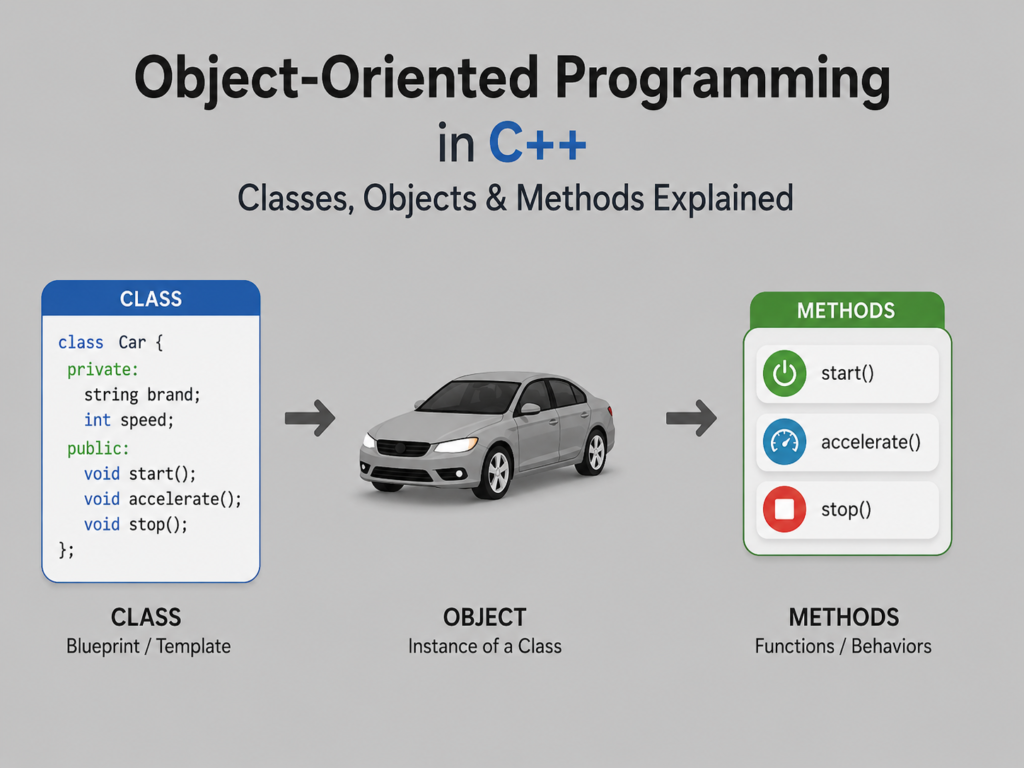
At the heart of oop in c++ are two fundamental concepts: classes and objects. A class is a blueprint. It defines what data an entity holds and what actions it can perform. An object is a specific instance of that class, created from the blueprint and living in memory with its own unique state.
Think of a class as the architectural plan for a house. The plan itself is not a house. But you can build as many houses from that plan as you like. Each house is an object: it follows the same blueprint but has its own address, its own color, its own occupants.
#include <iostream>
using namespace std;

class Car {
public:
    string brand;
    string model;
    int year;

    void displayInfo() {
        cout << year << " " << brand << " " << model << endl;
    }
};

int main() {
    Car car1;
    car1.brand = "Toyota";
    car1.model = "Camry";
    car1.year = 2022;

    Car car2;
    car2.brand = "Honda";
    car2.model = "Civic";
    car2.year = 2023;

    car1.displayInfo();
    car2.displayInfo();

    return 0;
}
In this example, Car is the class. car1 and car2 are two separate objects created from that class. Each object holds its own data, its own object state, but they share the same structure defined by the class. This is the essence of oop in c++.
Access Specifiers: Public, Private, and Protected
One of the most important concepts in oop in c++ is controlling who can access what. C++ provides three access specifiers that determine the visibility of class members: public, private, and protected.
Members declared as public are accessible from anywhere in the program. Members declared as private are accessible only from within the class itself. Members declared as protected are accessible within the class and by any class that inherits from it.
#include <iostream>
using namespace std;

class BankAccount {
private:
    double balance;

public:
    BankAccount(double initialBalance) {
        balance = initialBalance;
    }

    void deposit(double amount) {
        if (amount > 0) {
            balance += amount;
        }
    }

    void withdraw(double amount) {
        if (amount > 0 && amount <= balance) {
            balance -= amount;
        }
    }

    void displayBalance() {
        cout << "Balance: $" << balance << endl;
    }
};

int main() {
    BankAccount account(1000.0);
    account.deposit(500.0);
    account.withdraw(200.0);
    account.displayBalance();

    return 0;
}
The balance variable is private. Nothing outside the class can directly read or modify it. All interactions happen through the public methods deposit, withdraw, and displayBalance. This is data hiding in action, one of the most powerful protective mechanisms in oop in c++. It ensures that the internal workings of an object remain safe from unintended interference.
For anyone building on a solid foundation by studying C++ functions, class methods are the natural next step. They are functions that belong to a class and operate on its data.
Encapsulation in C++: Protecting Your Data
Encapsulation in C++ is the practice of bundling data and the methods that operate on that data together inside a single class, while restricting direct access to the internal data from the outside world. The bank account example above is a perfect demonstration of encapsulation.
Encapsulation solves one of the biggest problems in large software systems: uncontrolled access to shared data. When any part of a program can freely modify any variable, tracking bugs becomes nearly impossible. Encapsulation creates clear boundaries. Only the class itself knows how to safely read and modify its own data. Everything else interacts through controlled, tested public methods.
oop in c++ without encapsulation is like a bank vault with no door. You might have organized everything neatly inside, but without protection, it is not secure. Encapsulation is what makes your objects trustworthy and your code maintainable over time.
Constructors and Destructors: Building and Cleaning Up Objects
Every object needs to be initialized properly when it is created and cleaned up properly when it is destroyed. In oop in c++, constructors and destructors handle these responsibilities automatically.
A constructor is a special method that has the same name as the class and no return type. It runs automatically whenever a new object is created. A destructor has the same name as the class but is preceded by a tilde symbol and runs automatically when the object goes out of scope or is explicitly deleted.
#include <iostream>
using namespace std;

class Player {
public:
    string name;
    int health;

    // Constructor
    Player(string playerName, int playerHealth) {
        name = playerName;
        health = playerHealth;
        cout << name << " has entered the game!" << endl;
    }

    // Destructor
    ~Player() {
        cout << name << " has left the game." << endl;
    }

    void displayStatus() {
        cout << name << " - Health: " << health << endl;
    }
};

int main() {
    Player player1("Arthur", 100);
    Player player2("Morgan", 85);

    player1.displayStatus();
    player2.displayStatus();

    return 0;
}
When player1 and player2 are created, the constructor runs immediately and prints the entry message. When the program ends and the objects go out of scope, the destructor fires automatically. This automatic lifecycle management is one of the most elegant features of oop in c++ and prevents resource leaks that plague procedural programs.
Inheritance in C++: Building on What Already Exists
Inheritance is one of the four pillars of oop in c++ and one of the most powerful. It allows a new class, called a derived class, to inherit the properties and methods of an existing class, called a base class. This eliminates code duplication and creates a natural hierarchy between related types.
#include <iostream>
using namespace std;

class Animal {
public:
    string name;

    Animal(string animalName) {
        name = animalName;
    }

    void eat() {
        cout << name << " is eating." << endl;
    }

    void sleep() {
        cout << name << " is sleeping." << endl;
    }
};

class Dog : public Animal {
public:
    Dog(string dogName) : Animal(dogName) {}

    void bark() {
        cout << name << " says: Woof!" << endl;
    }
};

class Cat : public Animal {
public:
    Cat(string catName) : Animal(catName) {}

    void meow() {
        cout << name << " says: Meow!" << endl;
    }
};

int main() {
    Dog dog1("Rex");
    Cat cat1("Whiskers");

    dog1.eat();
    dog1.bark();

    cat1.sleep();
    cat1.meow();

    return 0;
}
Dog and Cat both inherit from Animal. They automatically have access to the eat and sleep methods without any duplication. Each adds its own unique behavior on top. The C++ inheritance tutorial concept shown here is used everywhere in professional software, from game engines to user interface frameworks. This is also where the access specifier protected becomes important, as it allows derived classes to access members of the base class while keeping them hidden from the outside world.
Polymorphism in C++: One Interface, Many Forms
Polymorphism in C++ means that a single interface can represent different underlying forms. It allows you to write code that works with objects of different types through a common interface, making your programs dramatically more flexible and extensible.
The most powerful form of polymorphism in oop in c++ uses virtual functions. When a base class declares a method as virtual, derived classes can override it with their own implementation. The correct version of the method is selected at runtime based on the actual type of the object.
#include <iostream>
using namespace std;

class Shape {
public:
    virtual void draw() {
        cout << "Drawing a shape." << endl;
    }
};

class Circle : public Shape {
public:
    void draw() override {
        cout << "Drawing a Circle." << endl;
    }
};

class Rectangle : public Shape {
public:
    void draw() override {
        cout << "Drawing a Rectangle." << endl;
    }
};

int main() {
    Shape* shape1 = new Circle();
    Shape* shape2 = new Rectangle();

    shape1->draw();
    shape2->draw();

    delete shape1;
    delete shape2;

    return 0;
}
Both shape1 and shape2 are declared as pointers to Shape, but at runtime they hold Circle and Rectangle objects respectively. When draw is called, C++ automatically uses the correct version of the method for each actual object type. This is the magic of virtual functions and runtime polymorphism.
For developers exploring C++ pointers, this example also shows how pointers to base class types are used to achieve polymorphic behavior, one of the most important patterns in advanced C++ programming.
Abstraction in C++: Hiding Complexity Behind Simple Interfaces
Abstraction in C++ means exposing only what is necessary to the user of a class while hiding all the internal complexity. It is closely related to encapsulation but operates at a higher level. Where encapsulation hides data, abstraction hides implementation details.
Abstract classes in C++ are created using pure virtual functions. A class with at least one pure virtual function cannot be instantiated directly. It serves purely as a blueprint that derived classes must implement.
#include <iostream>
using namespace std;

class Vehicle {
public:
    virtual void startEngine() = 0;  // Pure virtual function
    virtual void stopEngine() = 0;

    void refuel() {
        cout << "Refueling the vehicle." << endl;
    }
};

class ElectricCar : public Vehicle {
public:
    void startEngine() override {
        cout << "Electric motor started silently." << endl;
    }

    void stopEngine() override {
        cout << "Electric motor stopped." << endl;
    }
};

class PetrolCar : public Vehicle {
public:
    void startEngine() override {
        cout << "Petrol engine roaring to life!" << endl;
    }

    void stopEngine() override {
        cout << "Petrol engine turned off." << endl;
    }
};

int main() {
    Vehicle* v1 = new ElectricCar();
    Vehicle* v2 = new PetrolCar();

    v1->startEngine();
    v2->startEngine();

    delete v1;
    delete v2;

    return 0;
}
Vehicle defines what every vehicle must be able to do without specifying how. Each derived class provides its own implementation. The user of these classes only needs to know the interface, not the underlying mechanics. This is abstraction working at its finest inside oop in c++.
Method Overloading: Same Name, Different Behavior
Method overloading is a feature of oop in c++ that allows a class to have multiple methods with the same name but different parameter lists. The compiler selects the correct version based on the arguments provided at the call site.
#include <iostream>
using namespace std;

class Calculator {
public:
    int add(int a, int b) {
        return a + b;
    }

    double add(double a, double b) {
        return a + b;
    }

    int add(int a, int b, int c) {
        return a + b + c;
    }
};

int main() {
    Calculator calc;

    cout << calc.add(3, 4) << endl;
    cout << calc.add(2.5, 3.7) << endl;
    cout << calc.add(1, 2, 3) << endl;

    return 0;
}
Method overloading makes interfaces clean and intuitive. Instead of writing addIntegers, addDoubles, and addThreeIntegers, you write add and let the compiler figure out which version to call. This is one of the features that makes oop in c++ so expressive and developer-friendly.
OOP in C++ Across Real-World Industries
Oop in c++ is not confined to textbooks and tutorials. It powers some of the most demanding and critical software systems on the planet. In C++ in modern technology, object-oriented design is used to build operating systems, browser engines, database systems, and artificial intelligence frameworks. Every major piece of infrastructure software in the modern world has object-oriented C++ somewhere in its foundation.
For developers interested in C++ game development, oop in c++ is absolutely central. Game engines like Unreal Engine are built almost entirely around classes and objects. Every game character, every weapon, every level element, every particle effect is modeled as an object with its own data and behavior. Inheritance hierarchies allow game developers to create complex entity systems with minimal code duplication. Polymorphism allows the engine to treat all game objects through a unified interface while each responds to events in its own unique way.
For those looking at advanced C++ concepts, the principles of oop in c++ form the bedrock upon which templates, the Standard Template Library, smart pointers, and modern design patterns are all built. You simply cannot go deep into C++ without a thorough command of object-oriented programming.
Frequently Asked Questions
What Is the Difference Between a Class and an Object in C++?
A class is a blueprint or template that defines the structure and behavior of a type. An object is a specific instance of that class created in memory during program execution. One class can produce many objects, each holding its own independent data while sharing the same methods and structure defined by the class.
What Are the Four Pillars of OOP in C++?
The four pillars of oop in c++ are encapsulation, abstraction, inheritance, and polymorphism. Encapsulation bundles data and methods together and restricts direct access. Abstraction hides implementation details behind clean interfaces. Inheritance allows derived classes to reuse and extend base class functionality. Polymorphism allows a single interface to represent multiple underlying types.
What Is the Difference Between Public, Private, and Protected in C++?
Public members are accessible from anywhere in the program. Private members are only accessible from within the class that declares them. Protected members are accessible within the class and from any derived class that inherits from it. These access specifiers are the tools of encapsulation in oop in c++.
What Is a Virtual Function in C++?
A virtual function is a member function declared in a base class that can be overridden in a derived class. When a virtual function is called through a base class pointer or reference, C++ automatically selects the correct overridden version at runtime based on the actual type of the object. This runtime selection is the mechanism behind polymorphism in c++.
Why Should You Use OOP in C++ Instead of Procedural Programming?
Object-oriented programming organizes code around real-world entities, making it more intuitive, modular, and maintainable. Encapsulation protects data from unintended modification. Inheritance eliminates code duplication. Polymorphism allows flexible and extensible designs. For any software project beyond a certain size or complexity, oop in c++ makes the difference between manageable code and a tangled, unmaintainable mess.
Conclusion
Oop in c++ is one of the most transformative ideas in the history of software development. It changed how programmers think, how teams collaborate, and how software scales. From the simple elegance of a class blueprint to the sophisticated power of virtual functions and abstract interfaces, every concept in object-oriented programming exists to make your code better organized, more reusable, and more resilient to change.
The examples in this guide are the building blocks. In the real world, these concepts combine to create systems of extraordinary complexity and capability. Game engines, operating systems, financial platforms, and medical software all owe their architecture to the object-oriented principles that C++ brought into mainstream programming over four decades ago.
When you truly master oop in c++, you do not just write code that works. You write code that lasts.