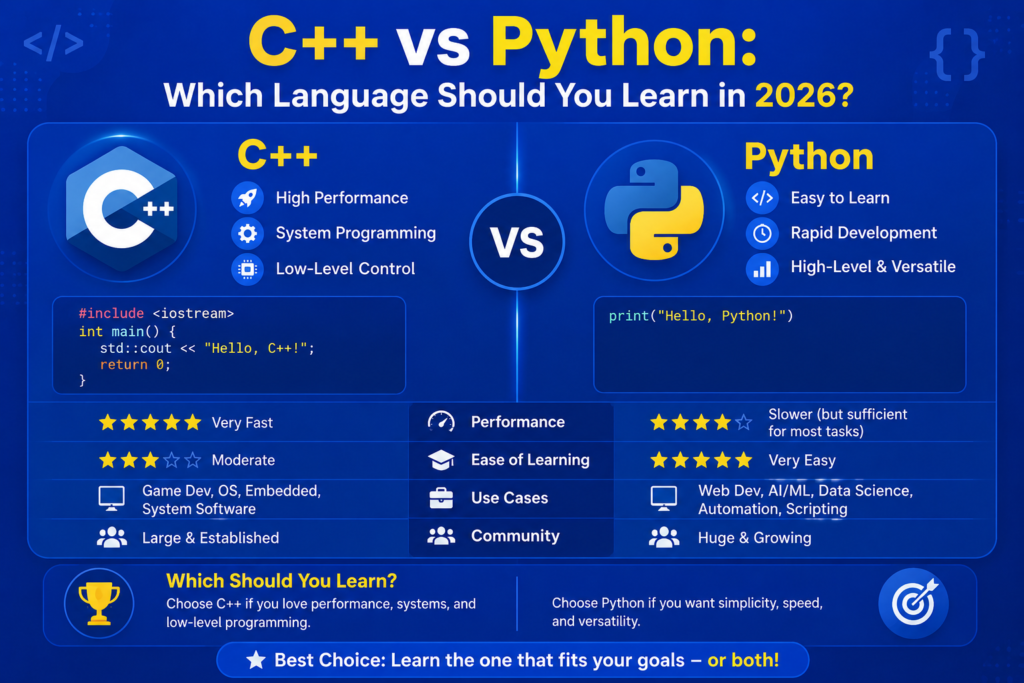
The debate around c++ vs python is one of the most searched and most argued topics in the entire programming world. Both languages are genuinely powerful. Both have massive communities, strong job markets, and decades of proven success. But they are built for very different purposes, attract very different kinds of programmers, and reward very different learning styles. Choosing between them is not about picking the better language. It is about picking the right language for your specific goals.
This article breaks down c++ vs python across every dimension that matters: performance, syntax, use cases, career opportunities, learning curve, and real-world applications. By the time you finish reading, you will know exactly which one deserves your time and energy in 2026.
Understanding the Core Philosophy: c++ vs python
Before comparing specifics, it helps to understand what each language was designed to do. C++ was created by Bjarne Stroustrup at AT&T Bell Laboratories in the early 1980s. His goal was to extend the C language with object-oriented programming while preserving absolute performance and hardware-level control. C++ was built for programmers who need maximum speed and direct access to system resources.
Python was created by Guido van Rossum and first released in 1991. His goal was almost the opposite: to create a language that was readable, simple, and fast to write. Python prioritizes developer productivity and code clarity over raw execution speed. It is an interpreted language, meaning code is executed line by line at runtime rather than compiled into machine code before execution.
This fundamental philosophical difference explains nearly every specific difference in the c++ vs python comparison. C++ says: give the programmer maximum power and trust them to use it responsibly. Python says: make the programmer as productive as possible and handle as much complexity automatically as you can.
Syntax and Readability: c++ vs python in Daily Coding
One of the most immediately visible differences in the c++ vs python debate is how code actually looks. Python is famous for its syntax brevity and readability. It uses indentation to define code blocks, requires fewer symbols, and reads almost like plain English. C++ uses curly braces, requires explicit type declarations, and demands more precise, verbose syntax.
Here is the same simple task written in both languages. First, a C++ program that prints numbers from 1 to 5:
#include <iostream>
using namespace std;

int main() {
    for (int i = 1; i <= 5; i++) {
        cout << i << endl;
    }
    return 0;
}
Now the same task in Python:
python
for i in range(1, 6):
    print(i)
The difference is stark. The Python version is three lines. The C++ version is eight lines. For beginners, Python feels immediately approachable. For experienced developers, C++ syntax communicates precise intentions about types, memory, and scope that Python’s dynamic typing leaves implicit.
Python uses dynamic typing, meaning you do not declare variable types. The interpreter figures them out at runtime. C++ uses static typing, meaning every variable must be declared with an explicit type before use. Static typing catches entire categories of bugs at compile time that Python only discovers when the program actually runs.
Performance: Where C++ Dominates the c++ vs python Comparison
When it comes to raw execution speed, c++ vs python is not a close contest. C++ is a compiled language. Your source code is transformed into optimized machine code before the program ever runs. The processor executes that machine code directly, with no interpreter standing between the code and the hardware. The result is execution speed that can be ten to one hundred times faster than equivalent Python code depending on the task.
Here is a simple benchmark comparing loop performance. In C++:
#include <iostream>
#include <chrono>
using namespace std;

int main() {
    auto start = chrono::high_resolution_clock::now();

    long long sum = 0;
    for (long long i = 0; i < 100000000; i++) {
        sum += i;
    }

    auto end = chrono::high_resolution_clock::now();
    auto duration = chrono::duration_cast<chrono::milliseconds>(end - start);

    cout << "Sum: " << sum << endl;
    cout << "Time: " << duration.count() << " ms" << endl;
    return 0;
}
The equivalent Python code:
python
import time

start = time.time()
total = sum(range(100000000))
end = time.time()

print(f"Sum: {total}")
print(f"Time: {(end - start) * 1000:.2f} ms")
The C++ version typically completes in under 100 milliseconds. The pure Python version takes several seconds. This execution time difference is the core reason C++ remains irreplaceable in high-performance computing, real-time systems, game engines, and financial trading platforms where microseconds genuinely matter.
Python partially compensates through libraries like NumPy and TensorFlow that are themselves written in C or C++ under the hood. When Python code calls these libraries, it is actually executing C speed operations. But when Python runs pure Python loops and logic, it pays the full cost of interpretation.
Use Cases: Where Each Language Truly Excels
The c++ vs python comparison becomes much clearer when you look at the domains where each language dominates.
C++ owns the world of performance-critical applications. Operating system development, browser engines, game engines, embedded systems, robotics, aerospace navigation, financial trading systems, and database engines all rely on C++. If the software must be fast, run on constrained hardware, or interact directly with system resources, C++ is almost always the tool of choice. For deeper context on this, exploring C++ in modern technology reveals just how comprehensively this language powers the infrastructure of the digital world.
Python owns the world of rapid development, data science, machine learning, and scripting. Python is the dominant language for machine learning and artificial intelligence research. Libraries like TensorFlow, PyTorch, scikit-learn, and pandas have made Python the universal language of data science. Backend development frameworks like Django and Flask have made Python extremely popular for web server development as well. When prototype speed and development velocity matter more than raw execution speed, Python wins comfortably.
Consider this simple data analysis example in Python that would take far more code in C++:
python
import pandas as pd
import numpy as np

data = pd.read_csv("sales_data.csv")
monthly_avg = data.groupby("month")["revenue"].mean()
top_months = monthly_avg.nlargest(3)
print(top_months)
This five-line script reads a CSV file, groups data by month, calculates averages, and finds the top three months. Doing the same thing in C++ would require hundreds of lines of code or a significant third-party library. Python’s ecosystem simply makes certain categories of tasks dramatically easier.
C++ vs python for Game Development
Game development is a domain where the c++ vs python comparison reveals a clear winner. Professional game development at scale overwhelmingly uses C++. Unreal Engine, one of the most powerful game engines in the world, is built on C++. The physics simulations, rendering pipelines, collision detection systems, and animation controllers that bring games to life all run in C++. For anyone serious about C++ game development, learning C++ is not optional. It is the entry requirement.
Python does have a place in game development through libraries like Pygame, which is excellent for learning, prototyping, and simple 2D games. But Pygame cannot compete with Unreal Engine for AAA game development. The execution time gap between the two languages makes Python unsuitable for real-time rendering at 60 or 120 frames per second with complex physics and thousands of objects on screen simultaneously.
For game development as a serious career path, C++ is the undisputed choice in the c++ vs python debate.
Learning Curve: c++ vs python for Beginners (2026)
For absolute beginners in 2026, Python is the gentler entry point into programming. Its syntax brevity means you spend less time fighting the language and more time learning programming concepts. You can write a working program in Python within minutes of your first lesson. The feedback loop is fast and encouraging.
Here is a beginner Python program:
python
name = input("What is your name? ")
age = int(input("How old are you? "))
birth_year = 2026 - age
print(f"Hello {name}! You were born around {birth_year}.")
The equivalent C++ program:
cpp
#include <iostream>
#include <string>
using namespace std;

int main() {
    string name;
    int age;

    cout << "What is your name? ";
    getline(cin, name);

    cout << "How old are you? ";
    cin >> age;

    int birthYear = 2026 - age;
    cout << "Hello " << name << "! You were born around " << birthYear << "." << endl;

    return 0;
}
C++ requires understanding headers, namespaces, explicit types, and the distinction between cin and getline before you can write this simple program. These are not impossible concepts, but they add friction for a complete beginner.
However, starting with Python does not mean you should avoid C++. Many professional developers learn Python first, build programming intuition, then move to C++ when they need performance or want to work in systems programming. Others start with C++ and find Python feels effortlessly simple afterward. Both paths work.
For those who are ready to begin with C++, a solid guide on getting started with C++ covers everything from environment setup to your first program with the clarity needed to make that first step confident and productive.
Object-Oriented Programming: c++ vs python Approach
Both C++ and Python support object-oriented programming, but they implement it very differently. Here is a class in C++:
#include <iostream>
#include <string>
using namespace std;

class BankAccount {
private:
    string owner;
    double balance;

public:
    BankAccount(string name, double initialBalance) {
        owner = name;
        balance = initialBalance;
    }

    void deposit(double amount) {
        balance += amount;
    }

    void displayBalance() {
        cout << owner << ": $" << balance << endl;
    }
};

int main() {
    BankAccount account("Alice", 1000.0);
    account.deposit(500.0);
    account.displayBalance();
    return 0;
}
The same class in Python:
python
class BankAccount:
    def __init__(self, owner, balance):
        self.__owner = owner
        self.__balance = balance

    def deposit(self, amount):
        self.__balance += amount

    def display_balance(self):
        print(f"{self.__owner}: ${self.__balance}")

account = BankAccount("Alice", 1000.0)
account.deposit(500.0)
account.display_balance()
C++ enforces access control strictly through public, private, and protected specifiers at compile time. Python’s access control is more of a convention, using double underscores to signal private members without truly preventing access. C++ gives you virtual functions and multiple inheritance with precise control. Python offers simpler syntax but less rigorous enforcement. For anyone who wants to master object-oriented design rigorously, the discipline that OOP in C++ demands is actually a significant learning advantage.
Career Opportunities: c++ vs python Job Market in 2026
Both languages offer strong career paths in 2026, but in different industries and roles.
Python jobs are concentrated in data science, machine learning, artificial intelligence, web backend development, automation, and DevOps. Python developer roles are abundant, entry barriers are relatively low, and the rise of AI has created an enormous surge in demand for Python programmers who can work with machine learning frameworks. The developer job market for Python in data science and AI is one of the hottest in the technology industry right now.
C++ jobs are found in game development, embedded systems, operating systems, financial technology, robotics, aerospace, and high-performance computing. These roles often pay very well, sometimes significantly more than equivalent Python roles, because the knowledge required is more specialized and the systems being built are more critical. A C++ developer at a high-frequency trading firm or a game engine company commands a premium salary.
For developers interested in systems-level thinking, hardware interaction, and absolute performance, C++ opens doors that Python simply cannot. For developers drawn to data science, AI research, and rapid application development, Python is the natural home. In 2026, both languages are essential parts of the programming landscape.
Memory Management: A Critical c++ vs python Difference
One of the most significant technical differences in c++ vs python is how each handles memory. C++ gives you direct control over memory allocation and deallocation. You decide when memory is requested, where it lives, and when it is released. This control enables extraordinary performance optimization but also introduces the risk of memory leaks, dangling pointers, and segmentation faults if done carelessly.
Python uses garbage collection to manage memory automatically. Objects are tracked by a reference counting system, and memory is reclaimed automatically when objects are no longer needed. This eliminates entire categories of memory-related bugs but also means Python programs can have unpredictable pauses when garbage collection runs and cannot achieve the same memory efficiency as carefully optimized C++ code.
For developers who want to understand memory deeply, studying C++ pointers builds a level of understanding about how computers actually work that Python’s automatic memory management intentionally hides. That understanding makes you a better programmer in any language.
c++ vs python: Code Comparison Summary
Here is a final side-by-side look at reading a file and counting words, a common real-world task, in both languages.
C++ version:
#include <iostream>
#include <fstream>
#include <string>
using namespace std;

int main() {
    ifstream file("document.txt");
    string word;
    int count = 0;

    while (file >> word) {
        count++;
    }

    cout << "Word count: " << count << endl;
    return 0;
}
Python version:
python
with open("document.txt", "r") as file:
    content = file.read()
    word_count = len(content.split())
    print(f"Word count: {word_count}")
Python requires less code for this task. C++ requires more explicit management but gives you finer control over how the file is read and processed. For a task like this where performance is not critical, Python wins on developer productivity. For a task where you need to process gigabytes of text at maximum speed, C++ wins on execution time.
Frequently Asked Questions
Is C++ Harder to Learn Than Python?
Yes, C++ has a significantly steeper learning curve than Python. C++ requires understanding explicit memory management, static typing, pointers, compile-time rules, and more complex syntax from the very beginning. Python’s dynamic typing, minimal syntax, and automatic memory management make it much more approachable for beginners. However, the discipline and deep understanding that C++ builds make you a stronger programmer overall.
Which Is Faster, C++ or Python?
C++ is dramatically faster than Python for most computational tasks. As a compiled language, C++ produces optimized machine code that executes directly on the processor. Python is an interpreted language that pays a runtime overhead cost for every operation. In raw benchmarks, C++ can be 10 to 100 times faster than pure Python code. Python closes this gap in specific domains by calling C-based libraries like NumPy, but for general-purpose code, C++ wins on execution time by a large margin.
Should a Complete Beginner Start With C++ or Python in 2026?
For most complete beginners in 2026, Python is the better starting point. Its readable syntax lets you focus on learning programming concepts without fighting language complexity. Once you understand variables, loops, functions, and classes in Python, transitioning to C++ becomes significantly easier. However, if your specific goal is game development, embedded systems, or systems programming from the start, beginning with C++ directly is a valid and rewarding choice.
Can You Use Python and C++ Together?
Yes, absolutely. Many professional projects use both languages together. Python is often used for high-level scripting, configuration, and data processing while C++ handles the performance-critical core. Python can call C++ code through extensions and binding libraries like pybind11 and Cython. This hybrid approach gives you Python’s development speed for the parts where it does not matter and C++ speed for the parts where it does.
Which Language Has Better Job Prospects in 2026?
Both have strong job markets but in different sectors. Python dominates in data science, machine learning, AI, and web backend development, which are among the fastest-growing sectors in technology. C++ dominates in game development, embedded systems, financial technology, and high-performance computing, which typically offer higher salaries for specialized roles. The best choice depends on which industry excites you more and where you want to build your career.
Conclusion
The c++ vs python debate does not have a single correct answer. It has the right answer for your specific situation. Python is the friendlier, faster-to-learn language that dominates data science, machine learning, and rapid development. C++ is the powerful, performance-first language that runs the world’s most demanding software. Both deserve respect and both open genuinely exciting career paths.
c++ vs python is ultimately a question of purpose. If you want to build AI models, analyze data, and develop web backends quickly, Python is your language for 2026. If you want to build game engines, operating systems, embedded systems, and high-frequency trading platforms where every microsecond matters, C++ is your language. And if you are ambitious enough to learn both, you will have a programming skill set that is virtually unmatched in the industry.
The most important thing is to start. Pick one, commit to it, and build real things with it. The best language is always the one you actually use.