What is Deep Reinforcement Learning (Deep RL)?
Imagine teaching a dog a new trick. You give a command. The dog tries something. You offer a treat for good behavior or a gentle correction for mistakes. Over time, the dog learns which actions lead to rewards. This simple learning loop, trial and error guided by feedback, is the essence of reinforcement learning. Now imagine giving that dog a supercomputer brain capable of processing millions of experiences per second. That is deep reinforcement learning. This remarkably powerful technology combines the trial and error learning of reinforcement learning with the pattern recognition prowess of deep neural networks.
Deep reinforcement learning has produced some of the most astonishing achievements in artificial intelligence. It taught itself to play Atari games better than any human. It mastered the ancient game of Go, defeating world champions. It learned to control robotic hands with remarkable dexterity. These feats were once considered decades away. Deep reinforcement learning made them reality.
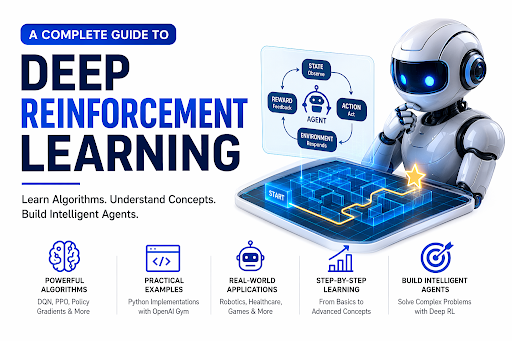
The core idea behind deep reinforcement learning is beautifully simple. An agent interacts with an environment, taking actions and observing results. It receives rewards or penalties based on its choices. Over time, it learns a strategy, called a policy, that maximizes its total reward. The “deep” part comes from using artificial neural networks to handle complex environments with high dimensional inputs like images or sensor readings. The reinforcement learning history shows how this field evolved from simple tabular methods to the sophisticated deep learning approaches used today.
The Evolution from Traditional Reinforcement Learning
Traditional reinforcement learning worked well for small problems with limited states and actions. A classic example is a grid world where an agent learns to navigate from start to goal. The number of possible positions might be a few dozen. The agent could visit every state many times and learn optimal actions through trial and error.
But real world problems are not small. A self-driving car perceives a continuous stream of camera images. The number of possible states is essentially infinite. Traditional methods cannot handle this complexity. They require storing a value for every possible state, which is impossible when states are continuous or high dimensional.
Deep reinforcement learning solved this problem by using neural networks as function approximators. Instead of storing a value for every state, the neural network learns to predict values for any state it encounters. This generalization capability is what makes deep reinforcement learning applicable to real world problems. The evolution of machine learning algorithms highlights how deep learning revolutionized not just supervised learning but reinforcement learning as well.
How Artificial Neural Networks Power Deep RL
Artificial neural networks are the engine that drives deep reinforcement learning. These networks, inspired by the biological brain, consist of layers of interconnected nodes. Each connection has a weight that adjusts as the network learns. With enough layers and nodes, neural networks can approximate almost any function.
In deep reinforcement learning, neural networks serve different roles depending on the algorithm. A deep Q-network approximates the value of taking each action in a given state. A policy network directly maps states to actions. An actor-critic network uses one network to choose actions and another to evaluate them.
The neural network takes raw observations as input, like pixels from a game screen or sensor readings from a robot. It processes this information through hidden layers that extract increasingly abstract features. The output layer produces either action values or action probabilities. The rise of neural networks ai evolution provides essential context for understanding how these powerful function approximators enabled deep reinforcement learning to tackle previously unsolvable problems.
Core Concepts and Terminology
Before diving into algorithms, it is essential to understand the fundamental concepts that underpin deep reinforcement learning.
The Agent, Environment, and State
Every deep reinforcement learning system involves three core components. The agent is the learner or decision maker. The environment is everything the agent interacts with. The state is a snapshot of the environment at a particular moment.
The agent observes the current state, takes an action, and receives a reward. The environment transitions to a new state based on the action. This cycle repeats. The agent’s goal is to learn a policy that maximizes cumulative reward over time.
The relationship between states, actions, and rewards is formally described by a Markov Decision Process (MDP) . This mathematical framework captures the sequential decision making nature of deep reinforcement learning problems.
Understanding the Reward Function
The reward function is arguably the most important design choice in deep reinforcement learning. Rewards are the only feedback the agent receives about the quality of its actions. A well designed reward function guides the agent toward desired behaviors. A poorly designed reward function can lead to unintended and sometimes harmful consequences.
In a chess playing agent, rewards might be positive for winning, negative for losing, and small intermediate rewards for capturing pieces. In a robotic grasping task, rewards might be positive for successfully lifting an object and negative for dropping it or using excessive force.
Reward signals must balance immediate feedback with long term outcomes. Sparse rewards, like only giving feedback at the end of an episode, make learning difficult because the agent does not know which actions led to success. Dense rewards provide frequent feedback but must be carefully shaped to avoid unintended behaviors.
The Exploration vs. Exploitation Dilemma
The exploration vs. exploitation dilemma is a fundamental challenge in deep reinforcement learning. Exploitation means choosing actions that are known to yield high rewards based on past experience. Exploration means trying new actions that might lead to even higher rewards, but might also lead to poor outcomes.
Imagine a restaurant. You know a dish you have ordered before is delicious. Exploitation means ordering that same dish again. Exploration means trying something new. The new dish might become your new favorite, or it might be disappointing.
In deep reinforcement learning, balancing exploration and exploitation is critical. Too much exploitation and the agent may get stuck in a suboptimal strategy. Too much exploration and the agent may never settle on a good policy. Common strategies include epsilon greedy, where the agent chooses random actions with a small probability, and entropy regularization, which encourages diverse action selection.
Top Deep Reinforcement Learning Algorithms
The field of deep reinforcement learning has produced several influential algorithms, each with distinct strengths and tradeoffs.
Value-Based Methods: Deep Q-Learning (DQN)
Deep Q-Learning, often called DQN, was a breakthrough algorithm that demonstrated deep reinforcement learning could learn directly from high dimensional sensory inputs. Developed by DeepMind in 2013, DQN learned to play Atari 2600 games from raw pixel input, achieving superhuman performance on many titles.
DQN works by learning a Q-function, which estimates the expected cumulative reward for taking a specific action in a specific state. The Q-function is represented by a deep neural network. The network takes the state as input and outputs a Q-value for each possible action. The agent selects the action with the highest Q-value.
The algorithm uses two key innovations to stabilize training. Experience replay stores past transitions in a memory buffer and samples randomly during training, breaking correlations between consecutive experiences. A target network provides stable Q-value targets that update slowly, preventing the learning target from moving too rapidly.
The Bellman equation for updating Q-values is:
Q(s,a) = r + γ × max over actions of Q(s’, a’)
Where r is the immediate reward, γ is the discount factor, and s’ is the next state. DQN minimizes the difference between predicted Q-values and this target. The shocking AlphaGo breakthrough showed how similar value-based methods could achieve world class performance in complex games.
Policy Gradient Methods
While value-based methods learn Q-functions and derive policies from them, policy gradient methods learn policies directly. A policy is a mapping from states to actions. In deep reinforcement learning, policies are represented by neural networks that output action probabilities.
The policy gradient theorem provides the mathematical foundation for these methods. It states that the gradient of expected reward with respect to policy parameters can be computed without knowing the full environment dynamics. This allows deep reinforcement learning algorithms to improve policies through gradient ascent.
Policy gradient methods have advantages over value-based methods. They can learn stochastic policies, which are useful when the optimal strategy involves randomness. They handle continuous action spaces naturally, while value-based methods require discretization. They also tend to be more stable, though they often require more samples to converge.
Actor-Critic Methods and PPO
Actor-critic methods combine the best of value-based and policy gradient approaches. They maintain two networks: an actor that learns the policy and a critic that learns the value function. The critic evaluates the actor’s actions, providing feedback that guides policy improvement.
Proximal Policy Optimization, or PPO, has become one of the most popular actor-critic methods in deep reinforcement learning. PPO improves upon earlier algorithms by constraining policy updates to prevent destructive changes. It clips the update size, ensuring the new policy does not diverge too far from the old policy. This stability makes PPO reliable across many problems.
PPO has been used to train agents for complex robotics tasks, video game playing, and large scale simulations. Its combination of stability, sample efficiency, and ease of implementation has made it a go to choice for practitioners. The modern artificial intelligence applications increasingly rely on PPO and similar algorithms for real world deployments.
Real-World Deep RL Applications
Deep reinforcement learning has moved from research labs into practical applications across industries.
Autonomous Vehicles and Robotics
Self driving cars face a sequential decision making problem of immense complexity. The vehicle must perceive its environment, predict the behavior of other road users, and decide on actions like steering, acceleration, and braking. Deep reinforcement learning provides a natural framework for learning driving policies directly from experience.
Companies like Waymo and Tesla use deep reinforcement learning to improve their autonomous driving systems. The agent learns in simulation, experiencing millions of driving scenarios that would be impossible to replicate safely on real roads. The policy learns to navigate intersections, merge onto highways, and respond to unexpected obstacles.
Robotics applications extend beyond driving. Quadruped robots learn to walk, run, and recover from falls using deep reinforcement learning. Manipulator arms learn to grasp objects of varying shapes and sizes. The remarkable history of artificial intelligence in autonomous vehicles shows how these technologies have evolved from research curiosities to practical systems.
Healthcare and Drug Discovery
Deep reinforcement learning is transforming healthcare by optimizing treatment policies and accelerating drug discovery. In personalized medicine, deep RL agents learn optimal dosing strategies for patients with chronic conditions like diabetes or hypertension. The agent observes the patient state, chooses a treatment, and receives rewards based on health outcomes.
Drug discovery involves searching an enormous space of possible molecules. Deep reinforcement learning guides this search by treating molecule generation as a sequential decision problem. The agent builds molecules atom by atom, receiving rewards based on predicted drug properties. This approach has discovered promising candidates for diseases including cancer and fibrosis.
The incredible AI in healthcare history and evolution demonstrates how deep reinforcement learning builds upon decades of AI research to improve patient outcomes and accelerate medical breakthroughs.
Video Games and Complex Simulations
Video games have served as a testing ground for deep reinforcement learning algorithms. Games provide complex, challenging environments with clear reward structures. They also allow agents to experience millions of training episodes quickly, far faster than real world training.
OpenAI Five trained to play Dota 2, a complex team strategy game. The agent learned from scratch through self play, eventually defeating world champion teams. AlphaStar mastered StarCraft II, a real time strategy game with imperfect information and a vast action space.
Beyond entertainment, deep reinforcement learning applied to games has advanced the field generally. Techniques developed for game playing, like multi agent training and hierarchical learning, transfer to real world problems. The history of computer vision in artificial intelligence shows a similar pattern where game environments accelerated progress.
Getting Started with Deep Reinforcement Learning in Python
For practitioners wanting to implement deep reinforcement learning in Python, several excellent libraries simplify the process.
OpenAI Gym provides a collection of environments for developing and testing deep reinforcement learning algorithms. Classic control problems like CartPole and MountainCar are perfect for learning. Atari games and robotics simulations offer more challenging benchmarks.
Stable Baselines3 offers reliable implementations of popular deep reinforcement learning algorithms including DQN, PPO, and SAC. These implementations follow best practices and are thoroughly tested. A basic PPO implementation can be written in just a few lines of code.
PyTorch and TensorFlow provide the deep learning backends. Building a custom deep reinforcement learning agent requires defining a neural network, implementing the environment interaction loop, and writing the update logic based on the chosen algorithm.
For beginners, starting with DQN in a simple environment like CartPole is recommended. The core concepts of experience replay, target networks, and epsilon greedy exploration are easier to understand in a simple setting before scaling to complex problems.
Frequently Asked Questions
1. What is the difference between reinforcement learning and deep reinforcement learning?
Reinforcement learning uses tabular methods or simple function approximators for small problems. Deep reinforcement learning uses deep neural networks to handle complex, high dimensional environments like images or sensor streams.
2. How does deep Q-learning (DQN) work?
DQN learns a neural network that estimates the value of taking each action in a given state. It uses experience replay and a target network to stabilize training.
3. What is the exploration vs. exploitation dilemma?
The agent must balance trying new actions to discover better strategies (exploration) with choosing known good actions to maximize reward (exploitation).
4. What are the main deep reinforcement learning algorithms?
The main algorithms include value-based methods like DQN, policy gradient methods like REINFORCE, and actor-critic methods like PPO and SAC.
5. How long does it take to train a deep reinforcement learning agent?
Training time varies dramatically. Simple environments may train in minutes on a laptop. Complex game playing agents may require days or weeks on clusters of GPUs.
6. What are the best resources for deep reinforcement learning Python?
OpenAI Gym provides environments. Stable Baselines offers reliable algorithm implementations. The Spinning Up in Deep RL course from OpenAI provides excellent educational materials.
Conclusion
Deep reinforcement learning stands as one of the most remarkably powerful achievements in modern artificial intelligence. By combining the trial and error learning of reinforcement learning with the pattern recognition capabilities of deep neural networks, it enables machines to master tasks that were once considered uniquely human. From playing complex games to controlling robotic limbs, deep reinforcement learning continues to push the boundaries of what AI can accomplish.
The journey from traditional reinforcement learning to deep reinforcement learning mirrors the broader evolution of AI toward handling real world complexity. The development of algorithms like DQN, policy gradient methods, and PPO has created a rich toolkit for practitioners. Each algorithm offers different tradeoffs between stability, sample efficiency, and ease of implementation. As the Future of artificial intelligence technology continues to unfold, deep reinforcement learning will undoubtedly play a central role in shaping intelligent systems.
For those inspired to explore further, the incredible rise of multimodal artificial intelligence and the fascinating large language models history show how different AI paradigms are converging. Deep reinforcement learning enables systems that learn from interaction, perception, and language simultaneously. The historic deep blue vs kasparov artificial intelligence match demonstrated that machines could defeat human champions, and deep reinforcement learning has expanded that capability far beyond chess.
Whether you are a student beginning your journey or a practitioner building production systems, understanding deep reinforcement learning opens doors to creating truly autonomous agents. The field is advancing rapidly, but the fundamental principles remain accessible. With curiosity and persistence, anyone can contribute to this exciting frontier of artificial intelligence.