laplace demon is one of the most powerful and fascinating ideas in the history of science and philosophy. Introduced by Pierre-Simon Laplace, this thought experiment challenges our understanding of free will, predictability, and the nature of reality itself.
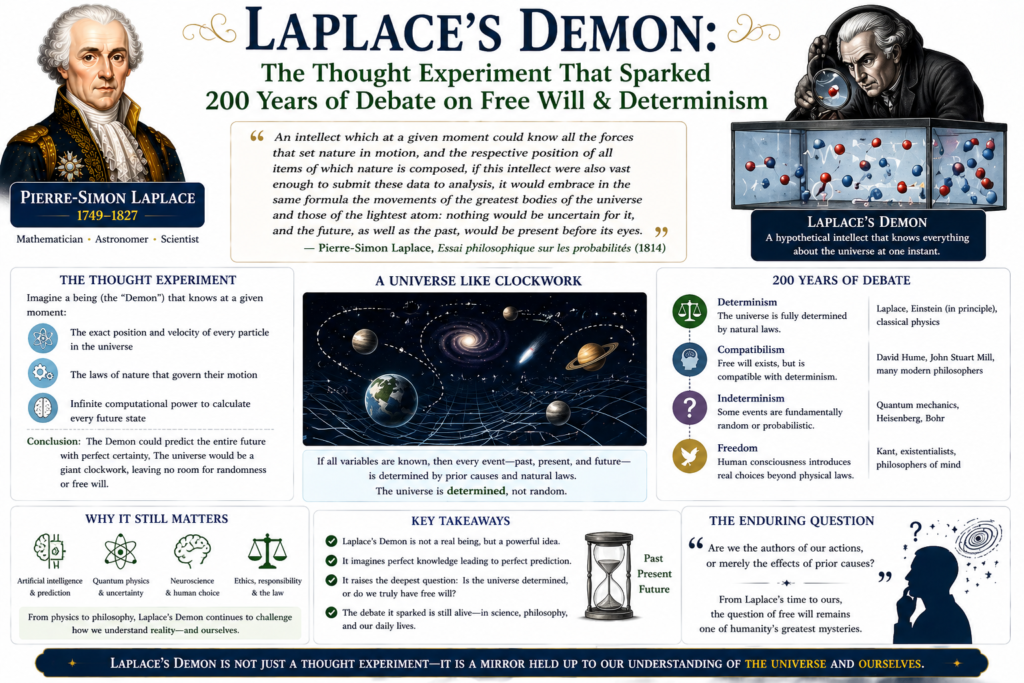
At its core, laplace demon suggests that if an intelligent being knew the exact position and momentum of every atom in the universe, it could predict the future with perfect accuracy. This bold claim created a massive debate in scientific determinism and the philosophy of mind, a debate that continues even today.
Origins of laplace demon (1814 – 1820)
The concept of laplace demon appeared in Laplace’s philosophical writings in the early 19th century. During this time, Newtonian mechanics dominated scientific thought.
Laplace imagined a hypothetical intelligence, often called a demon, that could calculate the entire causal chain of the universe. By knowing all initial conditions, this entity could see both past and future as a single deterministic sequence.
This idea became a cornerstone of scientific determinism and shaped the free will debate for generations.
Who Was Pierre Simon Laplace and His Vision
To understand laplace demon, we must first recognize Pierre-Simon Laplace, one of the greatest scientific minds in history.
Laplace believed that the universe operates according to precise mathematical laws. His work in celestial mechanics demonstrated that planetary motion follows predictable patterns.
He extended this logic to all physical systems, proposing that nothing happens randomly. Everything is part of a deterministic system governed by causality.
Mathematical Foundation Behind laplace demon
The idea of laplace demon is deeply rooted in classical physics. It relies on equations that describe motion and forces.
For example, Newton’s second law:
This equation shows how forces determine motion. If all forces and positions are known, future motion can be calculated.
Similarly, in dynamical systems, the state of a system evolves according to differential equations:
Here, the future state depends entirely on the current state. This forms the mathematical backbone of laplace demon.
Laplace also relied on gravitational theory and laplace’s equation to describe physical systems.
Scientific Determinism Explained
Laplace demon represents the ultimate form of scientific determinism. According to this view, every event is caused by previous events in a continuous causal chain.
If we know all variables, we can predict outcomes with certainty. This idea eliminates randomness and supports a fully predictable universe.
This concept influenced fields like physics and philosophy, shaping our understanding of causality and predictability.
Free Will Debate and Human Agency
One of the most controversial aspects of laplace demon is its impact on free will.
If everything is predetermined, do humans truly have choice? This question lies at the heart of the free will debate.
Some argue that laplace demon leads to fatalism, where all actions are inevitable. Others believe that human agency can coexist with determinism through complex interactions.
This debate continues in modern philosophy of mind and ethics.
Limits of Knowledge and Practical Challenges
While laplace demon is theoretically powerful, it faces practical limitations.
To predict the universe, the demon would need infinite computational power and complete knowledge of all atoms. In reality, this is impossible.
Even small errors in initial conditions can lead to vastly different outcomes, a concept explored in chaos theory.
This shows that while determinism may be true in theory, it is difficult to apply in practice.
Quantum Mechanics Challenge (1900 – Present)
The rise of quantum mechanics introduced a major challenge to laplace demon.
According to the uncertainty principle:
This equation states that we cannot know both position and momentum of a particle with perfect accuracy.
This limitation undermines the idea of complete predictability. Quantum mechanics suggests that randomness is a fundamental part of nature.
As a result, laplace demon faces serious challenges in modern physics.
Connection to Other Scientific Ideas
Laplace demon is connected to many of Laplace’s other contributions.
His work in probability theory earned him recognition as the father of probability, showing how uncertainty can be measured.
His ideas about the universe are also reflected in mécanique céleste, where he described celestial motion mathematically.
Additionally, his cosmological thinking influenced concepts like nebular hypothesis, explaining the formation of the solar system.
Philosophical Impact of laplace demon
The impact of laplace demon extends beyond science into philosophy.
It raises questions about knowledge, reality, and the limits of human understanding. It also challenges the idea of omniscience, suggesting that complete knowledge may be unattainable.
Philosophers continue to debate whether determinism is compatible with free will. This discussion remains central to physics and philosophy today.
Modern Relevance in Science and Technology
Despite its age, laplace demon remains relevant in modern discussions.
In computation and artificial intelligence, the idea of predicting outcomes based on data is fundamental. Predictive models and algorithms rely on similar principles.
However, modern science recognizes the limits of predictability due to uncertainty and complexity.
Laplace demon serves as a reminder of both the power and limits of scientific reasoning.
Legacy of laplace demon
The legacy of laplace demon is profound. It sparked over 200 years of debate on determinism, free will, and the nature of reality.
It influenced scientific thinking, philosophical discussions, and even modern technology. Its impact can be seen in fields ranging from physics to ethics.
Laplace’s thought experiment continues to inspire curiosity and critical thinking.
FAQs About laplace demon
What is laplace demon?
It is a thought experiment proposing that a being with complete knowledge of the universe could predict all future events.
Does laplace demon prove determinism?
It supports the idea of determinism but faces challenges from quantum mechanics and chaos theory.
How does laplace demon affect free will?
It raises questions about whether human actions are predetermined or truly free.
Why is laplace demon important in philosophy?
It explores fundamental questions about knowledge, causality, and the nature of reality.
Is laplace demon possible in real life?
No, because it requires infinite knowledge and computational power, which is impossible.
Conclusion
The concept of laplace demon is a powerful intellectual tool that challenges our understanding of the universe. It shows how mathematics and physics can lead to deep philosophical questions about free will and determinism.
While modern science has revealed limits to predictability, the idea remains a cornerstone of scientific and philosophical thought. To fully understand this journey, we must also explore how ancient greek scientists changed modern science, as their early ideas laid the foundation for thinkers like Laplace.
Laplace demon is not just a thought experiment. It is a timeless symbol of humanity’s quest to understand reality, causality, and the limits of knowledge.