What is Self-Supervised Learning?
Imagine a child exploring the world without a teacher. No one points to a cat and says “this is a cat.” No one corrects mistakes or provides answer keys. Yet the child learns. Patterns emerge. Categories form. Understanding grows. This is the promise of self-supervised learning, a remarkably powerful approach that enables AI systems to learn from raw, unlabeled data by creating their own teaching signals.
Self-supervised learning has been called the “third path” of machine learning, standing alongside supervised learning and unsupervised learning. It bridges the gap between these two worlds. Like supervised learning, it uses explicit prediction tasks. But like unsupervised learning, it requires no human labeled data. Instead, self-supervised learning creates labels automatically from the data itself, unlocking the vast oceans of unlabeled information that surround us. The evolution of machine learning algorithms shows how each paradigm shift has expanded what AI can achieve.
Defining the “Third Path” of Machine Learning
To understand self-supervised learning, it helps to see where it fits in the machine learning landscape. Supervised learning uses labeled examples to teach a model. Given images labeled “cat” or “dog,” the model learns to distinguish them. Unsupervised learning finds hidden structure in unlabeled data, grouping similar items or reducing dimensionality.
Self-supervised learning occupies a unique middle ground. It creates a supervised learning task from unsupervised data. The model predicts some part of the input from other parts. For example, given a sentence with a missing word, the model predicts the missing word. Given one part of an image, the model predicts the other part. The data provides its own supervision.
How Self-Supervised Learning Differs from Unsupervised Learning
The distinction between self-supervised learning and unsupervised learning can be subtle but important. Traditional unsupervised learning includes clustering, dimensionality reduction, and anomaly detection. These methods find patterns but do not typically learn representations that transfer to new tasks.
Self-supervised learning is more ambitious. It learns representations by solving prediction tasks. The representations capture semantic relationships and generalize to tasks the model was never explicitly trained on. A self-supervised learning model trained on images learns about shapes, textures, and object boundaries without ever seeing a label. The rise of modern machine learning has seen this approach become dominant for pre-training foundation models.
How Self-Supervised Learning Works
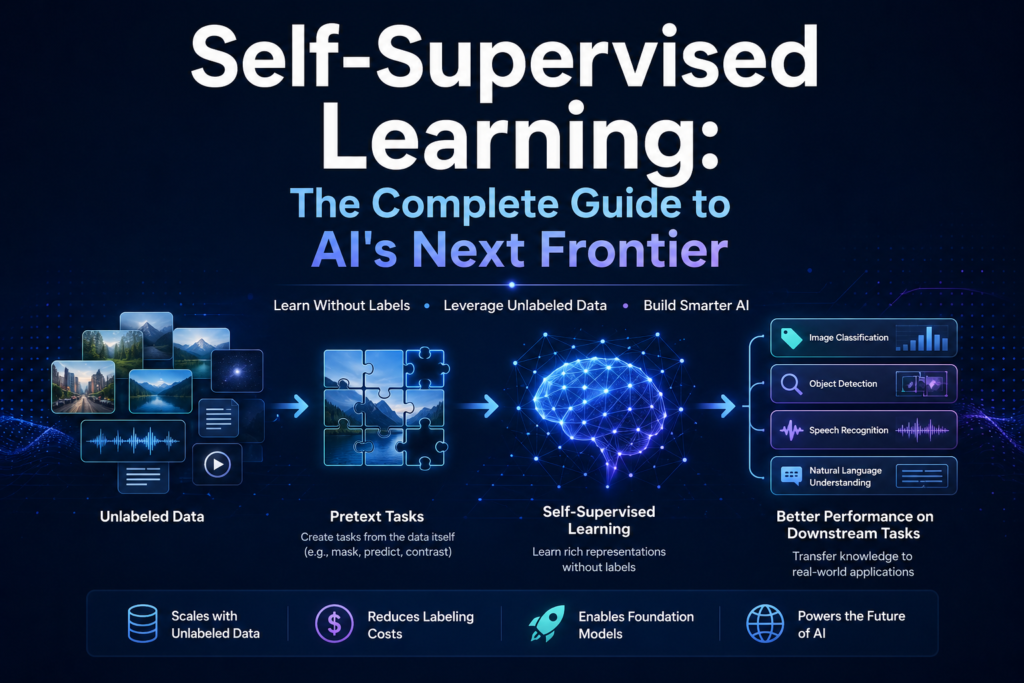
The mechanics of self-supervised learning are elegant and increasingly well understood. At its core, the approach involves designing pretext tasks that force the model to learn useful representations.
The Mechanics of Pretext Tasks
A pretext task is a prediction problem created from unlabeled data. The model must solve this task, and in doing so, it learns features that generalize to real world problems. The art of self-supervised learning lies in designing pretext tasks that require genuine understanding.
In computer vision, common pretext tasks include predicting the rotation applied to an image, solving jigsaw puzzles by rearranging shuffled patches, or coloring grayscale images. Each task forces the model to understand object structure, boundaries, and relationships.
In natural language processing, pretext tasks include predicting masked words in a sentence, determining if two sentences follow each other, or generating the next sentence in a sequence. These tasks require understanding grammar, semantics, and discourse.
Understanding Contrastive Learning and Predictive Coding
Contrastive learning techniques are among the most successful approaches in self-supervised learning. The core idea is to learn representations that pull positive pairs together while pushing negative pairs apart. Positive pairs are different views of the same data point, like two augmented versions of the same image. Negative pairs are views of different data points.
The contrastive loss function encourages the model to recognize augmented versions of the same image while distinguishing between different images. This approach has powered breakthrough models like SimCLR and MoCo.
Predictive coding takes a different approach. The model learns to predict future or missing parts of the input. In video, a model might predict future frames from past frames. In audio, it might predict missing segments. In language, it might predict the next word. Predictive coding in AI mirrors theories of how the human brain processes sensory information.
Data Augmentation and Representation Learning
Data augmentation is essential to self-supervised learning. By creating multiple views of the same data point, augmentation provides the positive pairs that contrastive methods need. Common augmentations include random cropping, color distortion, rotation, and Gaussian blur.
Representation learning algorithms benefit from augmentation because they must learn features that are invariant to these transformations. A good representation of a cat should be similar whether the cat is cropped, rotated, or slightly discolored. By learning invariance to augmentations, the model captures the underlying structure of the data.
Real-World Applications of Self-Supervised Models
Self-supervised learning has moved from research papers into production systems across industries. Its ability to learn from unlabeled data makes it invaluable where labels are scarce or expensive.
Transforming Computer Vision without Labels
Self-supervised learning computer vision has advanced rapidly. Models like DINO learn visual representations from unlabeled images that rival or exceed those learned with labels. These representations transfer to object detection, segmentation, and classification tasks with minimal fine tuning.
The impact is profound. Previously, building a high performance image classifier required millions of labeled examples. Now, self-supervised learning achieves similar results with orders of magnitude fewer labels. The incredible AI in healthcare history and evolution highlights how this approach is accelerating medical AI research by learning from unlabeled scans.
Powering Modern NLP: From BERT to GPT
Natural language processing has been transformed by self-supervised learning in NLP. The breakthrough came with masked language modeling, a pretext task where models predict randomly masked words in sentences. BERT showed that self-supervised learning on massive text corpora produced representations that achieved state of the art on nearly every NLP benchmark.
GPT took a different approach with autoregressive language modeling, predicting the next word in a sequence. The foundation models pre-training approach has scaled remarkably, with larger models and more data producing increasingly capable systems. The fascinating large language models history shows how self-supervised learning enabled the transition from task specific models to general purpose language systems.
Innovations in Robotics and Autonomous Systems
Robotics presents unique challenges for self-supervised learning. Robots must learn from interaction with the physical world, where data is expensive and labels are unavailable. Self-supervised learning enables robots to learn by predicting the consequences of their actions.
A robot might learn to predict future camera frames given current observations and planned actions. By minimizing prediction error, it learns a world model that captures physics, object permanence, and affordances. The remarkable history of artificial intelligence in autonomous vehicles demonstrates how self-supervised learning helps self driving cars learn from vast amounts of unlabeled driving data.
The Future of AI: Why SSL is the Next Frontier
Self-supervised learning is not just another technique. It represents a fundamental advance toward more capable, more efficient, and more general artificial intelligence.
Solving the Data Labeling Bottleneck
The reducing data labeling costs advantage of self-supervised learning cannot be overstated. Labeling data is expensive, time consuming, and often impossible at scale. Expert radiologists cannot label millions of scans. Linguists cannot annotate billions of sentences. Self-supervised learning bypasses this bottleneck entirely.
By learning from unlabeled data, self-supervised learning scales with data availability rather than labeling budgets. This democratizes AI, enabling applications in low resource languages, rare medical conditions, and specialized domains where experts are scarce.
Moving Toward Human-Like General Intelligence
Humans learn with astonishing efficiency. A child sees a few examples of a cat and recognizes cats forever. This efficiency comes from self-supervised learning. The brain constantly predicts what will happen next, what is missing from a scene, and how sensory inputs relate. Prediction errors drive learning.
Self-supervised learning brings AI closer to this human like learning paradigm. Models learn general purpose representations that transfer across tasks. They require fewer examples to learn new concepts. The fascinating journey of artificial general intelligence research shows how self-supervised learning is a critical step on the path to more flexible AI systems.
Frequently Asked Questions
1. What is self-supervised learning in simple terms?
Self-supervised learning is a way for AI to learn from unlabeled data by creating its own practice tasks, like predicting missing words in a sentence or solving puzzles from image patches.
2. How is self-supervised learning different from unsupervised learning?
Unsupervised learning finds patterns through clustering. Self-supervised learning creates prediction tasks that teach the model representations useful for many downstream applications.
3. What are some self-supervised learning examples?
BERT predicting masked words, SimCLR learning image representations by matching augmented views, and GPT predicting next words are classic examples.
4. Why is self-supervised learning important?
It dramatically reduces the need for labeled data, enabling AI to learn from the vast amounts of unlabeled text, images, and video available online.
5. What is contrastive learning?
Contrastive learning pulls representations of similar inputs together while pushing representations of different inputs apart, using data augmentations to create similar pairs.
6. What are foundation models?
Foundation models are large AI systems pre-trained on massive data using self-supervised learning, then adapted to many downstream tasks. BERT and GPT are foundation models.
Conclusion
Self-supervised learning represents one of the most remarkably powerful advances in artificial intelligence. By enabling models to learn from unlabeled data, it breaks the bottleneck that has constrained AI development for decades. The ability to create teaching signals from the data itself unlocks the vast oceans of information that surround us, from billions of images to endless streams of text.
The journey from supervised learning to self-supervised learning mirrors the broader evolution of AI toward greater efficiency and generality. Early systems required painstaking manual programming. Then came supervised learning with its hunger for labeled data. Now self-supervised learning offers a path beyond both, learning from raw, unstructured information in ways that echo human learning. For a deeper dive into practical implementation, explore this self supervised learning in artificial intelligence resources.
Additionally, the history of AI agents reveals how autonomous systems leverage self-supervised learning to operate in complex, unpredictable environments.
Whether you are a researcher pushing the boundaries of representation learning algorithms or a practitioner building real world applications, self-supervised learning offers a powerful framework. The field is advancing rapidly, but the core ideas are accessible. With curiosity and experimentation, anyone can contribute to this exciting frontier of artificial intelligence.