Introduction
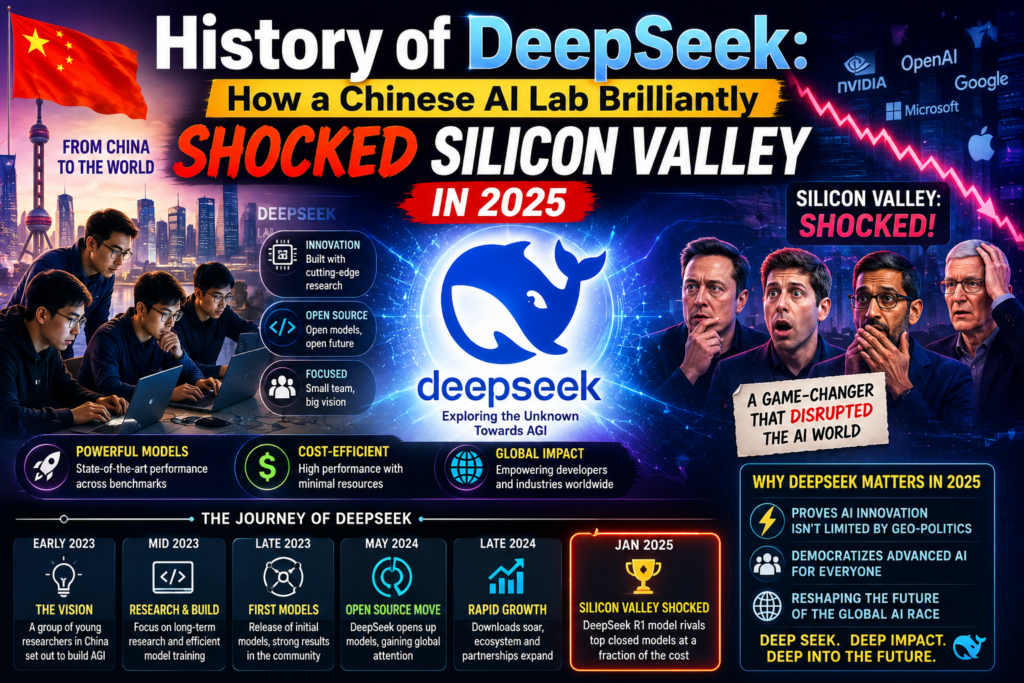
The deepseek ai history is one of the most dramatic and unexpected chapters in the entire story of modern artificial intelligence. In January 2025, a research laboratory that most people in Silicon Valley had barely heard of released a model that matched or surpassed the best AI systems in the world, at a reported training cost so far below what American competitors had spent that it sent shockwaves through financial markets, policy circles, and the technology industry simultaneously.
The deepseek ai history is a story about efficiency triumphing over scale, about a team working under significant hardware constraints producing results that well-resourced American laboratories had not achieved despite spending orders of magnitude more. It raised urgent questions about whether the assumption that frontier AI required billions of dollars and the latest Nvidia GPUs was simply wrong, and whether the global AI race had just become far more competitive than anyone had assumed.
Understanding the deepseek ai history means understanding where DeepSeek came from, what technical choices its team made, why those choices produced such surprising results, and what the emergence of a world-class Chinese AI laboratory means for the future of AI development globally.
The Origins: A Hedge Fund Builds an AI Lab (2021 – 2023)
The deepseek ai history has an unusual origin that distinguishes it from virtually every other AI laboratory story. DeepSeek was not founded by academic researchers spinning out of a university, by former employees of Google or OpenAI, or by entrepreneurs who had been working in AI for decades. It was founded by Liang Wenfeng, the co-founder and CEO of High-Flyer Capital, a Chinese quantitative hedge fund.
High-Flyer Capital had built its business on algorithmic trading and quantitative finance, domains that require sophisticated mathematical modeling and significant computational infrastructure. Liang Wenfeng had invested heavily in Nvidia GPU clustering throughout the early 2020s, accumulating a substantial cluster of A100 GPUs for High-Flyer’s trading systems at a time before the US government’s export controls had tightened significantly. When Liang decided to pivot part of High-Flyer’s resources and talent toward AI research in 2021 and 2022, he had both the capital and the existing computer infrastructure to do so seriously.
The decision to found a dedicated AI research laboratory as a subsidiary of the hedge fund reflected a specific thesis: that the techniques being developed for large language model research had deep connections to the kind of pattern recognition, optimization, and prediction that quantitative finance also depended on. The skills were transferable, and the competitive dynamics of the AI industry resembled in some ways the dynamics of financial markets, where efficiency and elegance in execution could overcome brute-force spending if applied correctly.
This background shaped the deepseek ai history from its foundation. Where American AI laboratories often competed by scaling computers aggressively, DeepSeek’s team approached model development with the mindset of a quantitative research operation: find the elegant solution, optimize ruthlessly, and do more with less. That mindset would prove decisive.
Early Models and Building Toward the Frontier (2023 – 2024)
The public deepseek ai history began in earnest in 2023 when DeepSeek started releasing models and research papers that demonstrated a capable and rapidly improving research team. The initial releases attracted limited attention outside of specialized AI research circles, but they established an important pattern: DeepSeek was publishing genuine technical contributions rather than incremental improvements, and the quality of the work was significantly higher than what most observers expected from a relatively new Chinese AI laboratory.
DeepSeek’s early models showed strong performance on coding and mathematical benchmarks, reflecting the quantitative background of much of the team. Chinese tech sector innovation in AI had produced several capable organizations by this point, including Baidu’s ERNIE models and Alibaba’s Qwen series, but none had yet produced results that genuinely competed with the frontier models from OpenAI, Google, and Anthropic. The deepseek ai history was building toward a claim on that frontier.
In late 2024, DeepSeek released DeepSeek-V2, which introduced several technical innovations that would prove central to the organization’s subsequent breakthroughs. The Multi-head Latent Attention mechanism, or MLA, was a novel approach to the attention computation that reduced the memory required during inference by compressing the key-value cache. Combined with an aggressive Mixture of Experts implementation that kept only a fraction of model parameters active for any given token, DeepSeek-V2 demonstrated that careful architectural choices could produce frontier-level performance with significantly lower computational cost than comparable dense models.
The ai scaling laws that had dominated thinking about how to improve language models suggested that more compute, more data, and more parameters would reliably produce better results. DeepSeek’s research was quietly challenging whether those scaling laws were the only path to frontier performance, or whether architectural efficiency could achieve similar results through a fundamentally different approach.
DeepSeek-V3: Frontier Performance at Shocking Cost (December 2024)
The deepseek ai history reached its first major public inflection point in December 2024 with the release of DeepSeek-V3. The model was a 671-billion-parameter mixture of experts architecture that activated approximately 37 billion parameters for any given input. Its benchmark performance was immediately striking: it matched or exceeded GPT-4o and Claude 3.5 Sonnet on a wide range of standard evaluations including coding benchmarks, mathematical reasoning, and multi-step reasoning tasks.
The DeepSeek-V3 architecture incorporated several of the technical innovations pioneered in DeepSeek-V2, including the Multi-head Latent Attention mechanism and the efficient mixture of experts implementation, along with a novel dual-pipe execution approach that improved GPU utilization during training by overlapping computation and communication more effectively than standard approaches. Token throughput optimization throughout the training pipeline allowed DeepSeek to extract more useful training signal per unit of compute than comparable efforts.
What made DeepSeek-V3’s release genuinely shocking to the AI industry was not the benchmark performance alone but the reported training cost. DeepSeek published that the model had been trained for approximately 2.8 million H800 GPU hours, which at typical cloud pricing would cost roughly six million dollars. For context, GPT-4 was widely estimated to have cost over one hundred million dollars to train, and other frontier models from Google and Anthropic were assumed to be in similar ranges. DeepSeek-V3 was achieving comparable results at what appeared to be a tiny fraction of that cost.
The hardware resource constraints that DeepSeek operated under were a significant part of this story. US export controls had restricted access to the most advanced Nvidia GPUs, including the H100, for Chinese organizations. DeepSeek was working primarily with H800 GPUs, a slightly less powerful export-controlled variant, and with older A100 clusters. Rather than treating this as an insurmountable disadvantage, the team treated it as a design constraint that demanded creative solutions. The architectural choices in DeepSeek-V3 were in part responses to working with more limited hardware than American competitors had access to.
DeepSeek-R1: The Reasoning Model That Changed Everything (January 2025)
The single most consequential moment in the deepseek ai history came on January 20, 2025, when DeepSeek released DeepSeek-R1, a reasoning-specialized model trained using reinforcement learning without supervised fine-tuning in the traditional sense. R1 was DeepSeek’s answer to OpenAI’s o1 reasoning model, which had demonstrated that training models to think through problems step by step before answering could dramatically improve performance on complex mathematical and scientific reasoning tasks.
DeepSeek-R1’s approach to inference-time scaling was notable for several reasons. The model was trained using reinforcement learning training on reasoning tasks, with the key insight that the model could develop effective reasoning strategies through this process without requiring large amounts of human-labeled chain-of-thought data. The resulting model showed strong performance on reasoning benchmarks, matching or exceeding o1 on several evaluations, and did so through a training approach that required less human annotation than comparable methods.
DeepSeek released R1 under an open-weights MIT license, making the model freely available for any use including commercial deployment. This was the decision that triggered the most dramatic immediate consequences in the deepseek ai history. Within days, DeepSeek’s iOS app became the number one downloaded free application in the United States App Store, surpassing ChatGPT. The iOS App Store chart-topper 2025 moment was visible and symbolic in a way that benchmark numbers alone could never be.
The market reaction was immediate and severe. Nvidia’s stock dropped approximately seventeen percent in a single day, erasing roughly six hundred billion dollars in market capitalization, the largest single-day market cap loss for any company in history at the time. Investors had been betting on the assumption that frontier AI required enormous quantities of the most advanced GPUs. DeepSeek-R1’s apparent success at a fraction of the expected cost challenged that assumption directly. The AI market capitalization crash triggered by DeepSeek was a stark illustration of how deeply the AI industry’s financial narrative had been built on the premise that scale spending was the primary driver of capability.
The Technical Innovations That Made It Possible
The deepseek ai history is partly a story about specific technical choices that produced outsized results. Understanding what DeepSeek did differently illuminates why the results were so surprising to the rest of the industry.
The Mixture of Experts implementation in DeepSeek’s models was more aggressive than most comparable architectures. By routing each token through only a small fraction of the total expert network, DeepSeek achieved models with enormous total parameter counts but relatively low computational costs per inference pass. This is a known technique, but DeepSeek’s specific implementation choices and the care taken in training these sparse models produced unusually strong results relative to their computational cost.
The Multi-head Latent Attention mechanism addressed a specific bottleneck in serving large language models: the memory required to store the key-value cache during inference, which grows with sequence length and limits how many simultaneous requests a given GPU can handle. By compressing this cache through learned latent representations, DeepSeek dramatically improved token throughput optimization and reduced the hardware costs associated with deploying the models at scale.
The reinforcement learning training approach used for R1 reflected insights about how to make inference-time scaling work effectively. Rather than relying primarily on imitation learning from human-generated reasoning chains, DeepSeek used reinforcement learning to let the model discover effective reasoning strategies through trial and error on problems with verifiable answers. This produced reasoning behaviors that in some cases appeared more flexible and robust than those in models trained primarily through imitation.
The gpt models history shows how American AI labs approached scaling: more parameters, more data, more compute, and more human feedback. The deepseek ai history suggests an alternative path was available all along, one focused on architectural efficiency, careful engineering, and working within constraints rather than spending through them.
The Geopolitical Dimension of DeepSeek’s Emergence
The deepseek ai history cannot be fully understood without acknowledging its geopolitical context. DeepSeek’s emergence as a frontier AI laboratory operating from China, achieving results that rivaled or exceeded the best American models, arrived at a moment of intense US-China competition over AI leadership, semiconductor access, and technological dominance.
The US government’s export controls on advanced AI chips were explicitly designed to slow Chinese AI development by limiting access to the hardware assumed necessary for frontier training runs. DeepSeek’s reported results challenged the effectiveness of that strategy. If a Chinese laboratory could achieve frontier performance with older, export-controlled hardware through architectural innovation, the premise that chip restrictions would maintain a decisive American advantage required serious reconsideration.
Policy discussions in Washington were immediately affected by the deepseek ai history. Calls for examining whether the export control strategy was achieving its intended effect, whether additional restrictions were needed, and whether American AI laboratories needed additional support to maintain their competitive position all intensified following DeepSeek-R1’s release.
The llm timeline at the point of DeepSeek’s emergence shows a competitive landscape that had been assumed to be dominated by a small number of American and European organizations suddenly looking considerably more crowded and genuinely international.
DeepSeek V4 Pro and What Comes Next (2026)
The deepseek ai history continued to develop through 2025 and into 2026. The organization released a series of follow-up models and research papers that maintained its position at the frontier of open-weight AI development. DeepSeek V4 Pro was anticipated for 2026 as the next major architectural advancement from the team, building on the innovations introduced in V3 and R1 with further improvements in reasoning capability, context length, and multimodal understanding.
The future of AI will be shaped significantly by whether DeepSeek’s efficiency-focused approach to model development can continue to produce competitive results as the frontier advances, and by how American and European AI organizations respond to the competitive pressure that DeepSeek’s emergence has created. The AI price war disruption that DeepSeek triggered in the API market, where competitors were forced to reduce pricing dramatically to remain competitive with DeepSeek’s publicly available model, will continue to have consequences for the economics of the entire industry.
The claude ai history and the deepseek ai history together represent two different responses to the same fundamental challenge: how do you build genuinely useful and safe AI when the cost and resource requirements of frontier training are enormous? Anthropic’s answer centered on safety-focused research and Constitutional AI. DeepSeek’s answer centered on architectural efficiency and working creatively within constraints. Both have produced remarkable results.
FAQs
Who founded DeepSeek and where did it come from?
DeepSeek was founded by Liang Wenfeng, the co-founder and CEO of High-Flyer Capital, a Chinese quantitative hedge fund. The organization grew out of High-Flyer’s existing computational infrastructure and quantitative research expertise, transitioning from financial modeling to large language model research between 2021 and 2023. It operates as a subsidiary of the hedge fund rather than as an independent startup.
Why did DeepSeek’s release shock the AI industry in January 2025?
DeepSeek-R1’s release in January 2025 shocked the industry because it matched or exceeded the performance of leading American models like GPT-4o and Claude 3.5 Sonnet on reasoning benchmarks, was released under a permissive open-weights MIT license freely available for any use, and was reportedly trained at a fraction of the cost of comparable American models. The combination of frontier performance, open availability, and claimed cost efficiency challenged fundamental assumptions about what frontier AI required.
What is the Mixture of Experts approach used in DeepSeek’s models?
Mixture of Experts is an architecture where the model is divided into many specialized subnetworks called experts, with a routing mechanism that selects only a small fraction of experts to process each input token. This allows the model to have a very large total parameter count while only activating a small portion of those parameters for any given computation, dramatically reducing the computational cost of both training and inference compared to a dense model of equivalent total size.
Why did Nvidia’s stock crash after DeepSeek’s release?
Nvidia’s stock dropped approximately seventeen percent in a single day following DeepSeek’s release because the company’s extraordinary market valuation was based in large part on the assumption that frontier AI required enormous quantities of the most advanced AI accelerators. DeepSeek’s reported ability to achieve frontier performance at a fraction of expected compute cost, using older export-controlled hardware, challenged that assumption and raised concerns that future demand for the most expensive Nvidia chips might be lower than analysts had projected.
Is DeepSeek open-source and can anyone use it?
DeepSeek-R1 and several of DeepSeek’s other models were released under MIT licenses, which are among the most permissive open-source licenses available and allow commercial use, modification, and redistribution with minimal restrictions. This made them immediately available for anyone to download, fine-tune, and deploy. The open-weights availability was a key factor in the rapid adoption of DeepSeek models by developers and organizations worldwide following the January 2025 release.
Conclusion
The deepseek ai history is a story about the unexpected disruption of a competitive landscape that many had assumed was settled. A laboratory founded by a hedge fund manager in China, working with hardware that American competitors would have considered insufficient for frontier training, produced models that matched the best the industry had to offer at a reported cost that defied every assumption about what frontier AI required.
Deepseek ai history will be studied for years as a case study in what happens when a technically sophisticated team applies an efficiency-first philosophy to a domain where everyone else is competing primarily on spending. The architectural innovations, the reinforcement learning training methodology, the aggressive mixture of experts implementation, and the decision to release models openly under permissive licenses all combined to produce an impact that extended far beyond benchmark scores into financial markets, geopolitical strategy, and the fundamental economic assumptions of the AI industry.
The deepseek ai history is not finished. It is, if anything, just reaching the phase where its full consequences are becoming visible. The questions it raised about efficiency versus scale, about hardware constraints as drivers of innovation, and about the global distribution of AI capability will shape the next decade of AI development regardless of how any specific model family evolves.