Introduction
The claude ai history is the story of a company born from conscience. In 2021, a group of researchers left one of the most celebrated AI laboratories in the world not because they had failed but because they were worried about where the technology they were building was heading. They founded Anthropic with a clear conviction: that making AI safe and making AI capable were not opposing goals but complementary ones, and that the field needed an organization willing to bet its entire existence on proving that point.
What followed was the claude ai history as it exists today. From a startup founded by OpenAI alumni to a company valued at tens of billions of dollars, from an API-only research product to one of the most widely used AI assistants in the world, Claude has grown into a genuine alternative to ChatGPT with a distinct character, a principled safety framework, and a technical trajectory that has repeatedly surprised the industry with the speed of its advancement.
Understanding the claude ai history means understanding not just the technical evolution of the Claude model family but the philosophy, the organizational decisions, and the research breakthroughs that shaped every version of the product from the very beginning.
The Anthropic Founding: A Breakaway Built on Principle (2021)
The claude ai history begins not with a model but with a departure. In late 2020 and early 2021, growing tensions within OpenAI over the direction and pace of AI safety research led a significant group of senior researchers to consider leaving the organization. The central concern was not that OpenAI was doing bad work. It was that the organization was moving faster toward deploying increasingly powerful AI systems than its safety research was keeping pace with.
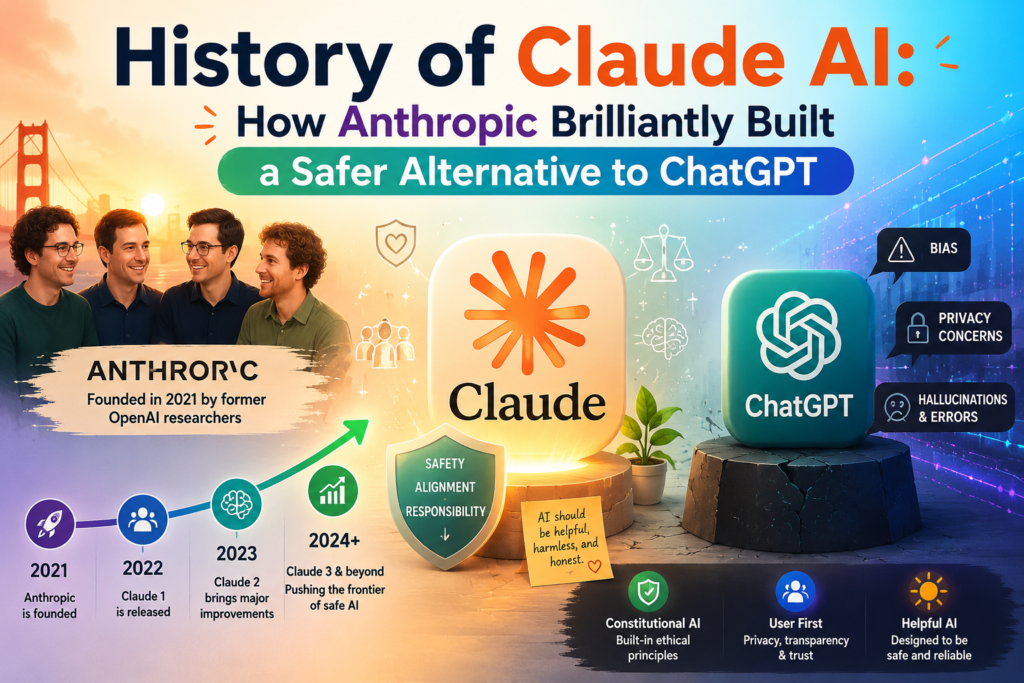
Dario Amodei, who had been VP of Research at OpenAI, and Daniela Amodei, who had been VP of Operations, led the departure. They were joined by a team of researchers and engineers, many of whom had worked on the most consequential AI systems of the prior several years. The Anthropic corporate founding in 2021 was described from the beginning as a long-term safety-focused AI research laboratory, not just another generative AI startup racing to market.
The founding team’s OpenAI breakaway team origins gave Anthropic immediate credibility in the research community. These were not outsiders making claims about AI safety. They were the people who had built the systems being discussed, who had seen firsthand how rapidly capabilities were advancing, and who had formed specific views about what responsible development required. Tech startup venture funding followed quickly, with early rounds that reflected investor confidence in the founding team’s caliber and in the market opportunity for well-aligned AI products.
Anthropic’s founding thesis rested on a core insight: the AI safety research laboratory model needed to exist at the frontier, not at the periphery. Safety research conducted on small, unrepresentative models would not generalize to the systems that would actually be deployed. To do safety research that mattered, Anthropic needed to be training and deploying models at the very edge of capability.
Constitutional AI: The Safety Framework That Defined Claude (2022)
Before the first version of Claude was released publicly, Anthropic published one of its most influential research contributions: the Constitutional AI framework. The constitutional AI framework was a novel approach to AI alignment that addressed one of the most persistent limitations of standard RLHF techniques. Standard reinforcement learning from human feedback requires large amounts of human preference data collected through expensive, slow human annotation. Constitutional AI proposed a way to supplement and partially replace human feedback with AI-generated feedback guided by a set of explicit principles.
The framework worked in two stages. In the first stage, a language model was trained using supervised learning on examples generated with a set of guiding principles, a constitution, that encoded values like helpfulness, harmlessness, and honesty. In the second stage, the model was further refined using AI-generated feedback rather than exclusively human feedback, with the AI trained to evaluate its own outputs against the constitutional principles.
The helpful harmless honest protocol that emerged from this framework became the defining characteristic of Claude’s personality. Unlike models trained purely on next-token prediction or standard RLHF, Claude was shaped from its earliest versions to reason about its own responses, to consider potential harms, and to apply value alignment principles consistently across contexts. This produced an AI assistant with a noticeably different character from ChatGPT, one that was more likely to engage thoughtfully with complex ethical questions, more consistent in applying its principles, and more transparent about its reasoning.
The what is rlhf article covers the underlying alignment technique that Constitutional AI extended and improved upon. Anthropic’s research showed that models trained with Constitutional AI were preferred by human evaluators on helpfulness and harmlessness measures compared to models trained with standard RLHF alone, establishing the framework as a genuine contribution to alignment science rather than just a marketing positioning.
Claude 1: An API-First Approach (March 2023)
The claude ai history reached its first public milestone in March 2023 when Anthropic made Claude available through its developer API platforms. Importantly, this initial release was not a consumer chatbot interface but an API-first product intended for developers and businesses building applications. This was a deliberate strategic choice that reflected Anthropic’s roots as a research organization more than a consumer product company.
Claude in this early form demonstrated several distinctive characteristics that would persist throughout the claude ai history. It was notably willing to engage with nuanced, complex, and philosophically difficult topics rather than deflecting them with boilerplate safety disclaimers. It showed strong performance on long-context tasks even in this early version, reflecting Anthropic’s investment in context window expansion history as a priority from the beginning. And it consistently applied its values in ways that felt principled rather than arbitrary, a direct result of the Constitutional AI framework.
The timing of Claude’s API release, just weeks after ChatGPT’s explosive growth had made the world aware of conversational AI, was strategically significant. Businesses and developers who were eager to build AI-powered products but had concerns about reliability, safety, or the terms of OpenAI’s API were now presented with an alternative that had been built specifically with those concerns in mind. Claude’s early enterprise adoption reflected the market’s appetite for a well-aligned, commercially viable alternative to ChatGPT.
Claude 2: The Public Launch and Context Window Breakthrough (July 2023)
The claude ai history expanded significantly in July 2023 with the Claude 2 public launch, which introduced a consumer-facing interface at claude.ai alongside continued API access. Claude 2 represented a meaningful capability upgrade from its predecessor, with particular improvements in code generation proficiency, mathematical reasoning, and the handling of long documents.
The context window expansion that Claude 2 delivered was one of its most talked-about features. With a 100,000 token context window at launch, Claude 2 could process documents of roughly 75,000 words in a single conversation, equivalent to a substantial novel or a lengthy technical report. This was dramatically larger than ChatGPT’s context window at the time and established Anthropic as the clear leader in long-context AI capability, a differentiation that proved genuinely valuable for enterprise use cases involving large codebases, legal documents, and research papers.
The context window expansion history within the claude ai history is not merely a technical footnote. It reflects a specific research philosophy at Anthropic: that genuinely useful AI assistants need to work with the full complexity of real-world documents rather than forcing users to work around context limitations. This philosophy produced one of the most practically differentiating features in the competitive landscape.
Claude 2 also introduced clearer model tier specialization through the API, with different variants offering different capability-to-cost trade-offs for developers. This approach to model tier specialization anticipated what would become the signature structure of the Claude 3 family.
Claude 3: The Family That Changed Everything (March 2024)
The most consequential moment in the claude ai history to date came in March 2024 with the release of the Claude 3 model family. For the first time, Anthropic released three simultaneous model tiers: Haiku, Sonnet, and Opus, each designed for a different combination of speed, cost, and capability. The Haiku Sonnet and Opus tiers addressed different use cases: Haiku for fast, low-cost applications; Sonnet for balanced performance; and Opus for the most demanding reasoning and analytical tasks.
Claude 3 Opus, the most capable tier at launch, achieved benchmark results that matched or exceeded GPT-4 on a wide range of evaluations, including graduate-level reasoning, mathematical problem solving, and multilingual understanding. This was a landmark moment in the claude ai history because it established Claude not just as a safer alternative to ChatGPT but as a genuinely state-of-the-art language model competitive with the best OpenAI had to offer on technical capability grounds.
The chatgpt history context helps illustrate why Claude 3’s benchmark performance was so significant. Prior to Claude 3, the narrative around Anthropic in the broader AI conversation was often focused primarily on safety rather than capability, as if safety and capability were necessarily in tension. Claude 3 Opus demonstrated that Anthropic’s safety-focused research methodology could produce models that led on both dimensions simultaneously, vindicating the founding thesis that had motivated the OpenAI breakaway team three years earlier.
Claude 3 also introduced multimodal capabilities, allowing Claude to process and reason about images alongside text for the first time. This vision capability, added through integration of visual understanding into the model alongside its strong language capabilities, expanded the range of tasks Claude could handle and placed it in competition with GPT-4V in the rapidly growing multimodal AI space.
Claude 3.5 Sonnet: The Model That Won the Internet (June 2024)
Perhaps the most striking individual moment in the claude ai history came in June 2024 with the release of Claude 3.5 Sonnet. The model achieved something remarkable: it matched or exceeded Claude 3 Opus on most benchmarks while being significantly faster and available at the lower Sonnet price tier. Claude 3.5 Sonnet popularity spread rapidly through the developer community, with many engineers and researchers declaring it their preferred model for coding tasks, technical writing, and complex analysis.
The Artifacts coding interface introduced alongside Claude 3.5 Sonnet was a product innovation that generated enormous enthusiasm. Artifacts allowed Claude to produce rendered, interactive previews of code, documents, and visual content directly within the conversation interface, transforming Claude from a text generator into something closer to a collaborative creative and technical partner. Developers could ask Claude to build a web application and immediately see a working preview, iterate on it conversationally, and export the result directly. This capability resonated strongly with the developer community and drove significant organic growth in Claude’s user base.
Claude 3.5 Sonnet’s performance on software engineering benchmarks, particularly SWE-bench, which tests AI systems’ ability to solve real GitHub issues, was notably strong and contributed to its reputation as the preferred coding assistant among professional developers.
Claude 4: The Agentic Generation (2025)
The claude ai history entered its most ambitious phase with the Claude 4 family, which represented Anthropic’s entry into the agentic AI era. Where earlier Claude models were primarily designed for conversational interaction and document analysis, Claude 4 was developed with automated system orchestration as a core design priority. This meant Claude 4 models were specifically optimized for tasks where an AI takes a sequence of actions, uses tools, browses the web, writes and executes code, and completes multi-step workflows with minimal human intervention between steps.
The agentic generation of Claude AI reflected a broader shift in how Anthropic and the industry were thinking about the most valuable applications of frontier AI. Single-turn question answering and document summarization remained important, but the highest-value use cases increasingly involved AI systems that could plan, act, verify results, and iterate toward complex goals. Claude 4’s design incorporated specific research into how to make agentic AI systems safe as well as capable, addressing the new alignment challenges that arise when AI takes consequential actions rather than merely generating text.
The model tier specialization continued in Claude 4, with different variants serving different points on the speed-capability-cost curve. Synthetic data training techniques became increasingly important in this generation as Anthropic worked to improve capabilities in domains where real-world examples were scarce or expensive to collect.
Anthropic’s Position in the AI Landscape
The claude ai history sits within a competitive context that has intensified dramatically since Anthropic’s founding. The openai history shows the organization that originally employed most of Anthropic’s founding team. The llm timeline places Claude within a broader landscape that includes GPT-4, Gemini, LLaMA, Mistral, and dozens of other competing models.
What distinguishes the claude ai history within this landscape is the consistency of Anthropic’s research philosophy across every model generation. Constitutional AI, the helpful harmless honest protocol, and the commitment to AI safety research laboratory standards have remained central to every Claude release, not as marketing language but as genuine technical and operational commitments that have shaped the products in measurable ways.
The future of AI will almost certainly see Anthropic continue building at the frontier while maintaining its safety-first research orientation. The bet that Dario and Daniela Amodei made when they left OpenAI, that you could build the most capable AI and the safest AI simultaneously, has been validated more convincingly with each successive Claude generation.
For broader context on how the industry evolved around the claude ai history, the ai arms race companies landscape shows how Anthropic’s success in building a credible safety-focused alternative helped establish that safety and commercial viability could coexist at the frontier.
Frequently Asked Questions (FAQs)
Who founded Anthropic and why did they leave OpenAI?
Anthropic was founded in 2021 by Dario Amodei and Daniela Amodei, along with a group of senior researchers who had previously worked at OpenAI. They left due to concerns about the pace of AI capability development relative to safety research, believing that a dedicated safety-focused AI research laboratory needed to exist at the frontier to ensure that alignment research kept pace with capability advances.
What is Constitutional AI and how does it make Claude different?
Constitutional AI is Anthropic’s alignment framework that trains AI models using a set of explicit principles rather than relying exclusively on human preference data. It involves the model critiquing and revising its own outputs according to a constitution of values. This approach gives Claude a more consistent and principled application of its values compared to models trained with standard RLHF alone, producing a more reliable helpful, harmless, and honest behavior profile across diverse situations.
When did Claude become publicly available?
Claude first became available to the public through Anthropic’s developer API in March 2023. A direct consumer interface at claude.ai launched with Claude 2 in July 2023. Since then, Claude has been available through both the consumer web interface and the API for developers building applications.
What made Claude 3 significant in the history of Claude AI?
Claude 3, released in March 2024, was the first time Anthropic released a simultaneous family of models at different capability tiers: Haiku, Sonnet, and Opus. Claude 3 Opus achieved benchmark results matching or exceeding GPT-4 on many evaluations, establishing Claude as a genuinely state-of-the-art frontier model rather than simply a safer but less capable alternative. Claude 3 also introduced multimodal image understanding for the first time.
How does Claude differ from ChatGPT in practice?
Claude and ChatGPT are both conversational AI assistants built on large transformer-based language models, but they differ in important ways. Claude is trained using Constitutional AI and tends to be more consistent in applying its values, more willing to engage with nuanced ethical and intellectual topics, and stronger on long-context tasks due to its historically larger context windows. ChatGPT has broader consumer recognition and a larger plugin and integration ecosystem. Professional developers often cite Claude as their preferred tool for coding and technical writing tasks.
Conclusion
The claude ai history is the story of a conviction tested against the hardest possible circumstances. Anthropic’s founders believed that the most important AI safety research had to be done at the frontier, that the most capable models and the safest models could be the same models, and that a commercial organization could be genuinely mission-driven without compromising on either the safety or the capability dimensions of its work.
Claude AI history has validated that conviction across five generations of models. From the Constitutional AI framework published before the first public model, through the context window breakthroughs of Claude 2, the benchmark-setting Claude 3 family, and the agentic ambitions of Claude 4, each chapter has added evidence that the founding thesis was not idealistic wishful thinking but a genuine and achievable research program.
The claude ai history is still being written. Anthropic continues to invest in both capability and safety research, and the competitive landscape continues to push every organization in the field to move faster. But the ground that Claude has covered from a 2021 startup founded by a group of researchers who cared deeply about getting AI right to one of the most widely used and highly regarded AI assistants in the world is extraordinary by any measure.