Introduction
The meta llama history is the story of how one bold decision by a technology giant permanently altered the power dynamics of the artificial intelligence industry. When Meta released LLaMA in February 2023, it did not just publish another language model. It handed the tools of frontier AI to researchers, developers, startups, and hobbyists around the world, fundamentally changing who could participate in the large language model revolution.
Before the meta llama history began, the dominant narrative in AI was one of concentrated power. The most capable models lived behind API paywalls, controlled by a small number of well-funded organizations. OpenAI had GPT-4. Google had PaLM and Gemini. Anthropic had Claude. Access was metered, pricing was significant, and the underlying weights were secret. The meta llama history disrupted that narrative at its foundation by demonstrating that frontier-quality models could be released openly, that the community could do extraordinary things with them, and that open-source AI was not a second-tier option but a genuine alternative to the closed model paradigm.
Understanding the meta llama history means understanding both the technical lineage of the model family and the strategic philosophy behind Meta’s approach to AI development, a philosophy that has proved more consequential for the broader industry than almost anyone predicted at the time of LLaMA’s first release.
Meta’s AI Research Foundation Before LLaMA (2016 – 2022)
The meta llama history did not emerge from nowhere. It grew from years of serious AI research investment at what was then called Facebook AI Research, later rebranded as Meta AI research lab. Meta had been one of the most productive AI research organizations in the world for years, publishing influential work on image recognition, natural language processing, and self-supervised learning.
Yann LeCun, who serves as Meta’s Chief AI Scientist, has long been one of the most prominent advocates for open-source AI development and one of the most vocal critics of the argument that releasing powerful AI capabilities openly poses unacceptable safety risks. His influence on Meta’s AI philosophy is difficult to overstate. Where Anthropic and OpenAI developed frameworks centered on caution and controlled deployment, LeCun and Meta consistently argued that open access to AI tools was better for safety, better for innovation, and better for the world than keeping powerful models behind corporate walls.
The large language models history during this period shows Meta contributing influential work on self-supervised learning for computer vision through models like DINO and on multilingual NLP through the FLORES benchmark and massively multilingual machine translation research. The PyTorch framework optimization that Meta’s teams had contributed to the open-source community had also become the dominant deep learning framework used by researchers worldwide, giving Meta deep roots in the open AI development ecosystem long before LLaMA existed.
LLaMA 1: The Research-Only Release That Leaked Everything (February 2023)
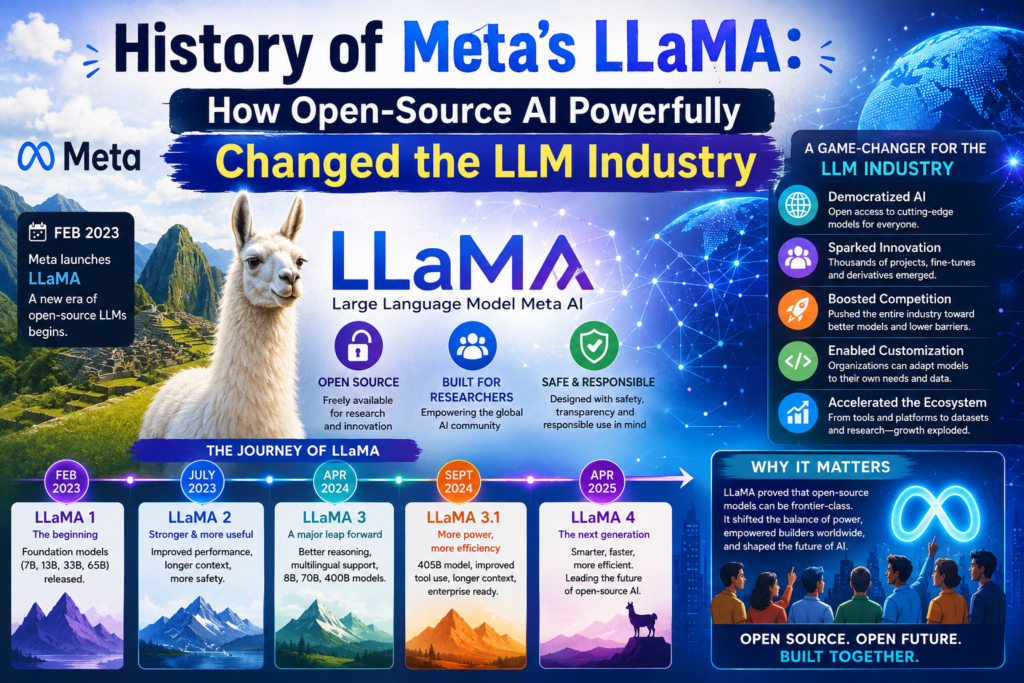
The meta llama history began publicly in February 2023 when Meta’s AI research team published the first LLaMA model under a research-only initial license. The name stood for Large Language Model Meta AI, and the release came with a paper describing how the team had trained a family of models ranging from 7 billion to 65 billion parameters using compute-optimal training principles derived from the Chinchilla scaling research.
The core technical argument of LLaMA 1 was striking: a smaller model trained on more data for longer could match or outperform a much larger model trained on less data for a shorter time. The Chinchilla compute-optimal training insight, which had been published by DeepMind in 2022, suggested that the field had been systematically training models that were too large for the amount of data they were trained on. LLaMA applied this insight rigorously, achieving GPT-3-level performance with significantly fewer parameters. Pre-training token counts for LLaMA models were set much higher relative to model size than had been standard practice.
The research-only initial license was intended to limit access to academic researchers and institutions. Meta required applicants to apply for access and agree to terms prohibiting commercial use. In practice, however, the LLaMA weights leaked onto 4chan within days of the initial controlled distribution. The leak was swift and permanent. Once the weights were publicly available on the internet, there was no realistic mechanism for restricting access, and the open-source AI community immediately began downloading, running, fine-tuning, and experimenting with the models at an extraordinary pace.
The response from the AI community was electric. Within weeks of the leak, researchers had quantized the models using quantization techniques that reduced their memory requirements dramatically, making it possible to run LLaMA on consumer hardware including standard gaming laptops and even some smartphones. The fine-tuning ecosystem that formed around LLaMA 1 was remarkable in its speed and diversity. Alpaca, Vicuna, WizardLM, and dozens of other instruction-tuned variants appeared within weeks, each demonstrating that the base LLaMA models could be adapted to follow instructions, engage in dialogue, and perform specialized tasks with relatively modest additional training.
The meta llama history was off to a start that Meta had not entirely planned but could not ignore. The community had demonstrated unmistakably what was possible when foundational base models were freely available, and the question of what Meta would do next became one of the most watched decisions in AI strategy.
LLaMA 2: The Commercial Pivot That Changed Everything (July 2023)
The most consequential strategic decision in the meta llama history came in July 2023 when Meta released LLaMA 2 with a dramatically different licensing approach. LLaMA 2 commercial licensing allowed virtually any organization with fewer than 700 million monthly active users to use, modify, and deploy the models for commercial purposes. For all but the very largest technology companies, LLaMA 2 was effectively free for commercial use.
This was a seismic shift. Suddenly, startups could build commercial AI products on a frontier-quality base model without paying API fees. Enterprises could fine-tune models on their own proprietary data and deploy them within their own infrastructure without worrying about sending sensitive data to a third-party API. Researchers in countries and institutions with limited budgets could access state-of-the-art language models without funding barriers. Generative AI democratic access had become real in a way that no prior development had achieved.
The parameter scale evolution in LLaMA 2 expanded the family to include 7 billion, 13 billion, and 70 billion parameter variants. Meta released both base models and instruction-tuned variants specifically designed for dialogue use cases, the latter trained using reinforcement learning from human feedback to follow instructions and engage helpfully in conversation.
The Hugging Face model repository became the primary distribution point for LLaMA 2, with hundreds of thousands of downloads occurring in the days and weeks following release. Hugging Face’s infrastructure, which had become the standard platform for sharing and accessing open-source AI models, was essential to the meta llama history because it provided the distribution mechanism that made LLaMA accessible to practitioners who might not have experience navigating research publication systems or setting up custom model serving infrastructure.
Mark Zuckerberg’s AI strategy in releasing LLaMA 2 openly was explicitly articulated: Meta believed that open-source AI development was better for safety because it allowed broader scrutiny, better for innovation because it accelerated the pace of research and application development, and better for Meta because it prevented any single closed competitor from gaining an unassailable advantage. The argument was sophisticated and, as subsequent events showed, prescient.
The fine tuning in ai capabilities that LLaMA 2 enabled across the community were transformative. Using techniques like LoRA and QLoRA, practitioners could fine-tune even the 70B parameter variant on a single consumer GPU in hours. This made domain-specific training accessible to medical researchers, legal technology companies, educational platforms, and countless others who could not afford to build their own frontier models from scratch.
The Open-Source Ecosystem Explosion (2023 – 2024)
The meta llama history through 2023 and into 2024 is as much the story of what the community did with LLaMA as it is the story of what Meta released. The permissive community licenses of LLaMA 2 unleashed a torrent of derivative work that demonstrated the extraordinary leverage that foundational base models provide when made freely available.
Mistral AI, a French startup founded by former DeepMind and Meta researchers, built on the LLaMA ecosystem to release highly efficient models that demonstrated competitive performance at significantly smaller parameter counts. Retrieval-Augmented Generation implementations built on LLaMA became standard components of enterprise AI stacks. Specialized medical, legal, and scientific fine-tunes appeared on Hugging Face in large numbers. The instruction-tuned variants enabled direct-to-consumer chatbot applications that companies and researchers deployed on their own infrastructure.
The meta llama history during this period also intersected with broader debates about AI safety and openness. Critics of Meta’s open-release strategy argued that making frontier model weights freely available created risks that could not be undone, since unlike a closed API, released weights cannot be taken back if safety problems emerge. Supporters, including many within the research community, argued that the demonstrated benefits in democratizing access, accelerating research, and enabling independent safety auditing outweighed the theoretical risks.
The ai arms race companies dynamic that LLaMA had partially disrupted by reducing the exclusive advantage of closed model providers continued to intensify, with each new LLaMA release resetting the baseline of what was freely available and forcing closed model providers to maintain their capability lead at an accelerating pace.
LLaMA 3: Frontier Performance at Open Weights (April 2024)
The meta llama history entered its most technically impressive phase with the release of LLaMA 3 in April 2024. The Llama 3 performance benchmarks were remarkable: the 70 billion parameter variant matched or exceeded GPT-3.5 on many standard evaluations, and the 8 billion parameter variant delivered performance that would have required a much larger model just one year earlier. Meta also announced a 400-plus billion parameter variant that would represent the largest open-weight model ever released when its training was complete.
The parameter scale evolution from LLaMA 1’s maximum of 65 billion parameters to LLaMA 3’s 405 billion parameter model represented a fundamental expansion of what open-weight AI could achieve. The 7B to 405B range covered in the full LLaMA 3 family gave the open-source ecosystem a comprehensive set of model sizes for different deployment scenarios, from edge devices and mobile applications all the way to high-performance cloud inference for the most demanding applications.
LLaMA 3 was trained on a substantially larger and more diverse dataset than its predecessors, with Meta investing heavily in data quality filtering and pre-training token counts that reflected lessons learned from compute-optimal training research. The instruction-tuned Meta-Llama-3-Instruct variants showed strong performance on conversational and task-completion evaluations, narrowing the gap with the leading closed models on dialogue benchmarks.
The Hugging Face model repository hosted LLaMA 3 downloads that numbered in the millions within weeks of release, reflecting how deeply the open-source AI community had integrated LLaMA into its standard toolkit. The meta llama history at this point had produced not just a model family but an ecosystem: a set of tools, techniques, derivative models, and community practices built around the assumption that frontier-quality base models would be freely available.
Meta LLaMA History and Its Impact on the Broader AI Landscape
The meta llama history has reshaped the AI industry in ways that extend far beyond the technical details of the models themselves. By demonstrating that capable open-weight models were commercially viable to release and technically competitive with closed alternatives, Meta established a precedent that other organizations have had to respond to.
The llm timeline shows how the meta llama history created a bifurcation in the AI industry between closed model providers and open-weight model providers, a distinction that has become one of the defining strategic choices for any organization developing large language models. Mistral AI, Stability AI, Falcon from the UAE’s Technology Innovation Institute, and many others followed the open-weight path that LLaMA had proven viable.
The future of AI will be significantly shaped by the open versus closed model debate that the meta llama history brought to the center of industry conversation. As open-weight models continue to improve and close the capability gap with closed frontier models, the strategic and economic rationale for the closed approach faces mounting pressure. The meta llama history has not resolved this tension, but it has made it impossible to ignore.
The chatgpt history and the meta llama history together represent the two dominant strategic poles of the current AI era: closed, safety-focused, commercially controlled development on one side, and open, community-driven, democratically accessible development on the other. Both approaches are producing impressive results, and the competition between them is accelerating progress across the entire field.
Frequently Asked Questions About Meta LLaMA History
What is LLaMA and why did Meta release it?
LLaMA stands for Large Language Model Meta AI. Meta released it as part of its open-source AI development strategy, reflecting the belief that broad access to foundational AI models accelerates research, improves safety through wider scrutiny, and prevents any single closed competitor from gaining an unassailable market advantage. Meta has released successive generations of LLaMA under increasingly permissive licenses.
When was LLaMA first released and what happened to the weights?
LLaMA 1 was released in February 2023 under a research-only license with controlled access. Within days of the initial restricted distribution, the model weights leaked onto the internet through file-sharing platforms. The leak made LLaMA 1 effectively publicly available and triggered an explosion of community experimentation, fine-tuning, and derivative model development that shaped the entire subsequent meta llama history.
What changed between LLaMA 1 and LLaMA 2?
The most significant change was the licensing. LLaMA 2, released in July 2023, came with a commercial license permitting organizations with fewer than 700 million monthly active users to use, modify, and deploy the models commercially. LLaMA 2 also offered improved instruction-tuned variants trained with RLHF, a larger range of model sizes, and meaningfully improved benchmark performance compared to LLaMA 1.
How does LLaMA compare to GPT-4 and Claude?
LLaMA 3 70B and the 405B variant significantly closed the capability gap with GPT-4 and Claude 3 Sonnet on many standard benchmarks. For most practical tasks, the difference in capability between the best open-weight LLaMA models and the leading closed models has become much smaller than it was at the time of LLaMA 1. LLaMA models can be fine-tuned on proprietary data and deployed in private infrastructure, which gives them significant practical advantages for enterprise use cases involving sensitive data.
Why is the open-source approach to AI controversial?
Critics argue that releasing model weights openly creates safety risks that cannot be reversed, since weights cannot be taken back once distributed. They contend that openly available frontier models could be misused to generate harmful content, create weapons of mass destruction information, or enable malicious applications at scale. Supporters argue that the benefits of broad access, accelerated research, democratic participation, and independent safety auditing outweigh these risks, and that closed models also carry risks that are less visible because fewer people can examine them.
Conclusion
The meta llama history is the story of how one open-release decision by a technology company permanently altered the landscape of AI development. By making foundational base models available to the entire world rather than restricting them behind commercial APIs, Meta created conditions for an explosion of research, application development, and capability advancement that no single organization could have achieved on its own.
From LLaMA 1’s accidental public availability through the leak that launched a thousand fine-tunes, to LLaMA 2’s deliberate commercial licensing that democratized frontier AI for startups and enterprises, to LLaMA 3’s frontier-competitive performance available to anyone with the compute to run it, the meta llama history has been a sustained argument that open AI development works and that the community given access to powerful tools will use them to push the field forward in ways that centralized control cannot anticipate.
The debate about open versus closed AI development is far from resolved, and the meta llama history sits at the center of it. What is resolved is that the question matters, that it has real consequences for who benefits from AI progress, and that Meta’s decision to release LLaMA changed the terms of that debate permanently.