When we analyze the future of large language models, it becomes clear that society stands on the cusp of a profound computational renaissance. The initial wave of generative technology introduced the world to expressive chatbots capable of synthesizing text and writing basic code. However, the subsequent eras of digital transformation demand far more than mere linguistic mimicry. The global technology landscape is transitioning away from static knowledge repositories toward highly dynamic systems capable of active thought, complex problem solving, and independent execution.
Unlocking the true potential of the future of large language models requires an absolute departure from traditional brute-force scaling methodologies. The upcoming generations of machine intelligence are no longer designed simply to predict the next logical word in a sentence. Instead, the focus has fundamentally shifted toward structural optimization, deep contextual comprehension, and the creation of systems that can seamlessly interact with the physical and digital worlds.
As corporate entities and academic research labs race past the milestones established by early foundational architectures, a new paradigm is forming. This exhaustive analysis explores the major technological shifts, hardware breakthroughs, and algorithmic innovations that are actively sculpting the next decade of computational intelligence.
Revolutionary Frameworks in the future of large language models (2026 – 2028)
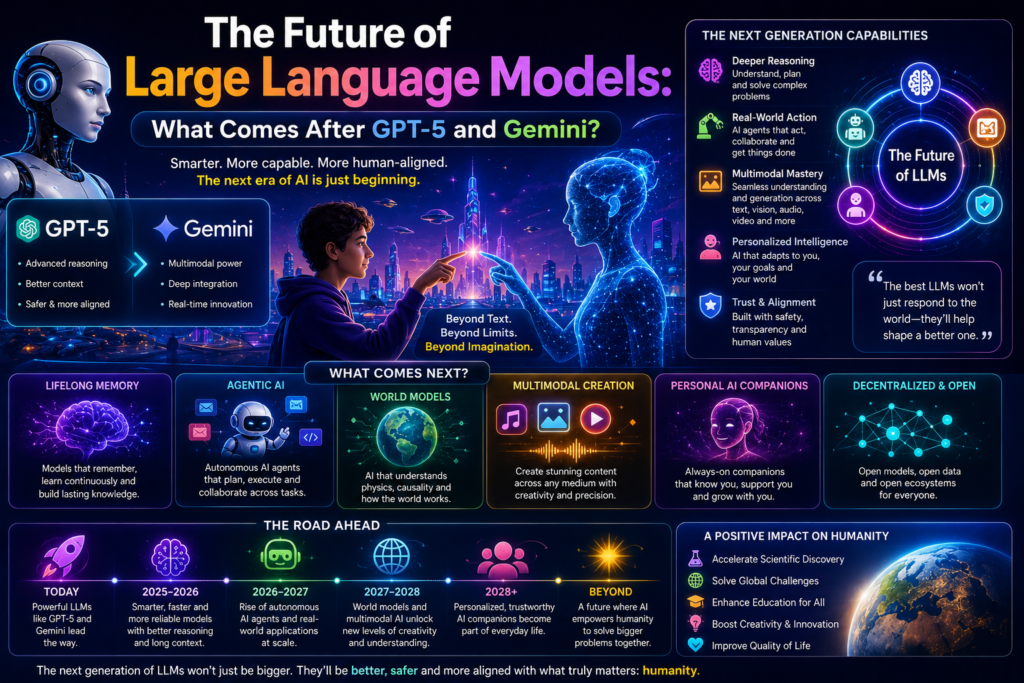
The immediate evolution of frontier systems relies heavily on the profound expansion of reasoning and planning capabilities. Early conversational tools were notoriously restricted by their inability to deliberate over complex mathematical or logical problems before generating an output. To resolve this bottleneck, modern research is deeply focused on integrating test-time compute methodologies, which allow systems to execute internal chain-of-thought processing before displaying answers to users. This strategic evolution transforms passive text prediction engines into active, analytical tools.
As industry leaders look beyond basic chat systems, the future of large language models will be defined by the widespread adoption of agentic workflows and autonomy. Instead of relying on a human user to provide continuous, iterative prompts, next-generation systems operate as independent digital workers. By understanding the core mechanics of what is ai agent engineering, developers can construct advanced software architectures that independently break down macro objectives into sequential micro-tasks. These autonomous software systems can write code, audit their own outputs, and use external APIs to achieve goals without human intervention. Furthermore, this era is characterized by an absolute mandate for comprehensive multimodal AI integration. The previous boundaries separating text, audio, video, and programmatic code have completely dissolved. Next-generation systems possess the native ability to process and generate multiple distinct data streams simultaneously. By analyzing the deep complexities of multimodal ai history, we observe that early attempts at multi-media processing were merely separate models stitched together haphazardly. Today, unified neural networks process diverse sensory inputs through a singular, cohesive cognitive architecture.
This representational harmony allows for a radical transformation in how developers conceptualize the future of large language models. A model can instantly ingest a live video stream of a mechanical engine, cross-reference the visual components with structural blueprints, diagnose a physical malfunction, and verbally guide a technician through the repair process in real time. This fluid multi-media comprehension completely redefines the boundaries of human-computer interaction.
Operational Efficiency and Sustainability (2028 – 2030)
The environmental and financial costs of massive compute infrastructure heavily influence the future of large language models. Building and maintaining massive data centers filled with thousands of power-hungry graphics processors presents severe challenges to global energy grids. Consequently, the international scientific community is aggressively shifting its focus toward parameter efficiency optimization to achieve superior cognitive performance without requiring prohibitive amounts of electrical power. This intense focus on architectural refinement ensures that model capacity grows without causing ecological strain.
To achieve true computational sustainability, software engineers are redesigning foundational networks to utilize highly advanced, energy-efficient model architectures. Technologies such as sparse Mixture-of-Experts frameworks allow models to activate only a small, highly specialized fraction of their total parameters for any given query. This targeted activation drastically reduces the raw floating-point operations required per token, allowing organizations to deploy highly sophisticated systems at a fraction of the historical energy cost.
Therefore, the future of large language models depends tightly on hardware revolutions that extend far beyond traditional silicon microchips. Major technology conglomerates are investing heavily in neuromorphic hardware acceleration, which utilizes specialized circuitry designed to mimic the physical structure and electrical efficiency of the biological human brain. Looking even further into the computational horizon, the integration of quantum computing in AI training promises to completely shatter conventional processing limits, allowing for the simulation of complex molecular and mathematical structures that are fundamentally impossible to calculate on classical supercomputers.
Simultaneously, this clean optimization wave paves the clear path for seamless edge device deployment. Rather than routing every single query through a remote, centralized cloud network, modern consumer electronics are equipped with dedicated on-chip neural processing units. This localized capability is driven by an exponential rise in small language models (SLMs) efficiency. These compact, highly distilled systems match the performance of older, gargantuan models while running entirely offline on consumer smartphones and laptops, guaranteeing absolute user privacy and instant operational latency.
Breaking Data Barriers to Feed the future of large language models
The continuous advancement of machine intelligence faces a critical hurdle: the imminent exhaustion of high-quality, human-generated text across the open internet. For over a decade, developers relied on scraping public websites, academic journals, and digital books to fuel their training pipelines. However, as frontier models consume these vast repositories, the industry requires completely novel data synthesis methods to sustain historical development trajectories.
When assessing the data pipelines required for the future of large language models, engineers face an imminent information shortage. To overcome this limitation, major development labs are shifting toward synthetic data scaling laws. This approach involves utilizing highly advanced, specialized models to generate pristine, structurally perfect training data for subsequent generations of neural networks. By designing strict filtering algorithms and using automated logic checkers, developers can produce massive synthetic datasets that are entirely free from the colloquialisms, biases, and factual errors common in human writing.
Furthermore, the technological trajectory is deeply shaped by the continuous Retrieval-Augmented Generation (RAG) evolution. Early iterations of this framework simply pulled basic text snippets from static documents to help reduce factual errors. Modern systems, however, utilize highly dynamic cognitive computing architectures that execute real-time internet browsing capabilities to continuously update their internal understanding of global events. This continuous learning methodology transforms the system from a static snapshot of past data into a living, real-time intelligence network.
This strategy serves as a core pillar ensuring the future of large language models remains unhindered by traditional training constraints. By combining deep internal parameters with external corporate knowledge bases, modern applications achieve an absolute hallucination rate reduction. Models no longer need to store billions of historical facts directly within their neural weights; instead, they act as highly intelligent reasoning engines that can securely access, analyze, and synthesize external information on demand.
Architectural Evolution and Cognitive Horizons
The structural limitations of standard, modern neural networks are forcing researchers to explore entirely new mathematical paradigms. While the historical progression outlined in gpt models history showcases the immense power of deep attention mechanisms, standard architectures still struggle with long-form temporal logic and continuous adaptation. To cross the threshold into true artificial cognition, the software industry is actively developing neuro-symbolic AI hybrids that blend the pattern-recognition strengths of neural networks with the rigid, flawless logic of symbolic computer programming.
By exploring how systems learn over time, the future of large language models transitions away from static data snapshots and moves toward true continuous learning systems. Traditional networks are completely frozen after their initial training phase, meaning they cannot retain new memories or adapt to unique user interactions without undergoing expensive retraining cycles. Next-generation cognitive frameworks utilize dynamic memory allocation systems that allow the model to organically update its internal neural weights in real time based on daily operational experiences.
This continuous adaptation is further amplified by next-gen context window expansion capabilities. Modern systems can effortlessly process millions of context tokens simultaneously, allowing an enterprise to upload an entire corporate database, a century of financial ledgers, or thousands of pages of dense legal code into the active memory of the model. By exploring the rich history of structural innovations through a comprehensive transformer architecture history lens, we can appreciate how far the industry has traveled from early models that struggled to remember a few simple sentences.
Understanding the structural mechanics of the future of large language models allows enterprises to build robust applications that deliver immense, domain-specific intelligence. Rather than relying on generic, all-purpose models, the marketplace is shifting toward networks tailored specifically for fields like genomic medicine, quantum chemistry, and macro-economic forecasting. These hyper-specialized systems possess a deep, structural understanding of niche scientific principles, moving the technology far past casual entertainment and transforming it into an essential catalyst for global human progress.
Frequently Asked Questions (FAQs)
What is the future of large language models regarding hardware requirements?
The industry is actively shifting toward a dual approach. While frontier model training will continue to rely on massive, hyper-scale data centers utilizing neuromorphic hardware acceleration and quantum computing explorations, daily execution will increasingly shift to localized edge device deployment. This is made possible by an absolute surge in small language models efficiency, allowing local devices to run powerful reasoning systems completely offline.
How will the future of large language models impact corporate automation?
The technology is moving rapidly past basic conversational text generation and entering the era of agentic workflows and autonomy. Future systems will operate as fully autonomous software workers capable of orchestrating complex multi-step projects, managing digital workflows, utilizing external software tools, and self-correcting errors without requiring continuous human prompting.
How do synthetic data scaling laws help fix the data shortage?
As high-quality, human-made text across the public internet becomes completely exhausted, development laboratories are using highly specialized AI models to generate structurally perfect synthetic data. This clean, machine-generated information is carefully verified by automated logic engines and then used to train next-generation models safely without relying on depleted human data sources.
Conclusion
The monumental progression of computational engineering makes it clear that the future of large language models is bound to fundamentally redefine our relationship with digital infrastructure. What began as an impressive display of predictive text generation has rapidly matured into a sophisticated ecosystem of reasoning engines, autonomous digital agents, and deeply integrated multimodal networks. The steady advancement along the Artificial General Intelligence (AGI) trajectory indicates that the boundary between human intent and software execution is permanently disappearing.
As we navigate this profound technological shift, the choices made by researchers, corporations, and global regulatory bodies will echo across generations. Maintaining a strong commitment to computational sustainability, operational security, and rigorous ethical alignment ensures that these powerful systems remain entirely beneficial to human society. To completely understand where this historic evolutionary journey will ultimately lead, one must closely observe the overarching, global future of ai and actively prepare for a world augmented by ubiquitous, hyper-efficient intelligence.