History of speech recognition neural networks represents one of the most important revolutions in artificial intelligence. For decades, scientists dreamed about machines that could understand human speech naturally. Early computers could process numbers and text, but understanding spoken language remained an enormous challenge because speech contains accents, background noise, emotions, timing variations, and complex linguistic structures.
Today, AI systems can transcribe speech, translate languages, power voice assistants, and generate realistic audio responses in real time. Technologies such as Whisper AI have transformed natural language audio into one of the most advanced areas of machine learning.
The journey from Hidden Markov Models to neural speech synthesis completely changed human-computer interaction forever.
The rise of history of speech recognition neural networks also influenced smartphones, accessibility tools, robotics, customer support systems, and automated translation technologies across the world.
Early Speech Recognition Experiments (1950 – 1970)
The roots of the history of speech recognition neural networks began during the 1950s when researchers first experimented with machine listening systems.
Early speech systems focused on recognizing small sets of spoken digits or isolated words.
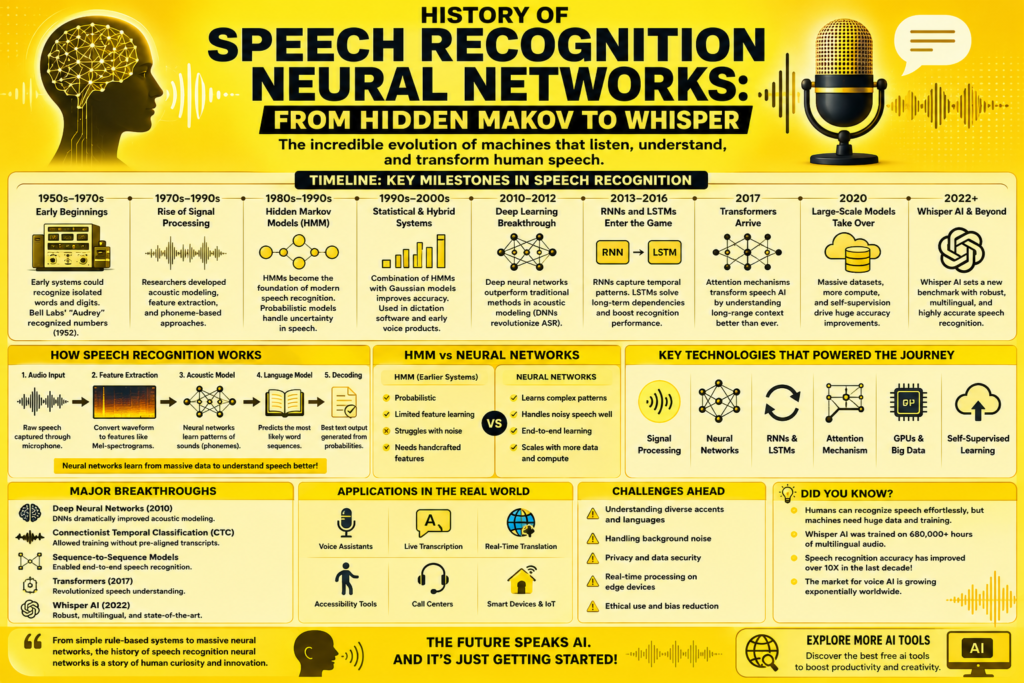
Bell Laboratories created one of the earliest speech recognition systems called Audrey in 1952.
Audrey recognized spoken numbers from a single speaker.
Although primitive, this achievement demonstrated that machines could process auditory data.
At the same time, neural computation research expanded rapidly.
The famous mcculloch and pitts neural network model inspired researchers to explore how machines might imitate biological auditory processing.
Scientists believed future AI systems could eventually recognize human speech similarly to the human brain.
However, computing limitations remained severe.
Speech recognition required enormous computational power that did not yet exist.
Signal Processing and Acoustic Modeling
The history of speech recognition neural networks became heavily connected to signal processing research.
Speech contains complex waveform patterns that must be converted into machine-readable representations.
Researchers developed techniques for:
- Waveform analysis
- Frequency extraction
- Spectrogram generation
- Acoustic feature detection
One important breakthrough involved phonemes.
Phonemes are the smallest sound units in spoken language.
For example:
- “B”
- “T”
- “K”
Speech recognition systems attempted to map sound waves into phoneme sequences.
This became the foundation of acoustic modeling.
Hidden Markov Models Changed Speech Recognition (1970 – 1990)
One of the biggest breakthroughs in the history of speech recognition neural networks arrived through Hidden Markov Models, commonly called HMMs.
HMMs became the dominant speech recognition technology for decades.
Researchers used probabilistic models to represent speech sequences mathematically.
The probability equation often looked like:
Where:
- = observed audio sequence
- = hidden phoneme states
Hidden Markov Models allowed systems to estimate likely speech patterns even when audio contained noise or uncertainty.
HMMs improved:
- Continuous speech recognition
- Audio transcription
- Word prediction
- Linguistic modeling
These systems powered many early commercial voice technologies.
Why Speech Recognition Was So Difficult
The history of speech recognition neural networks became challenging because spoken language varies enormously between speakers.
Speech systems needed to handle:
- Accents
- Speaking speed
- Background sounds
- Emotional tone
- Pronunciation differences
Unlike written text, speech is highly dynamic and continuous.
Researchers also struggled with coarticulation, where adjacent sounds influence each other.
These challenges made accurate speech-to-text evolution extremely difficult for decades.
The Rise of Neural Networks in Speech AI
The history of speech recognition neural networks accelerated dramatically after neural networks improved during the 1980s and 1990s.
Researchers discussing history of ai often identify neural speech systems as one of the major goals of artificial intelligence.
Neural networks offered several advantages over traditional HMM systems:
- Better pattern recognition
- Nonlinear learning
- Improved feature extraction
- Adaptive modeling
- Large-scale training
At the same time, advances in computational power and GPU acceleration made deeper neural architectures possible.
Geoffrey Hinton and Deep Learning Speech Models
One of the most important turning points in the history of speech recognition neural networks came through Geoffrey Hinton’s deep learning research.
Researchers discussing history of deep learning often connect Hinton’s work with modern speech recognition breakthroughs.
Around 2010, deep neural networks began outperforming traditional Hidden Markov systems.
Hinton and his collaborators demonstrated that deep learning could dramatically improve acoustic modeling.
These neural systems learned complex speech patterns automatically from massive datasets.
Deep learning transformed speech recognition forever.
Recurrent Neural Networks and Sequential Audio
The rise of recurrent neural networks became another major milestone in the history of speech recognition neural networks.
Researchers studying history of rnn discovered that RNNs could process sequential information effectively.
Speech naturally unfolds over time, making sequential modeling extremely important.
RNNs improved:
- Context tracking
- Temporal dependencies
- Audio sequence understanding
- Real-time speech prediction
However, standard RNNs struggled with long-term memory problems.
LSTM Networks Improved Speech Understanding
The history of speech recognition neural networks expanded further through Long Short-Term Memory systems, commonly called LSTMs.
Researchers discussing history of lstm often identify LSTMs as essential for modern speech recognition growth.
LSTM architectures solved major RNN limitations by improving memory retention across long audio sequences.
LSTMs became highly effective for:
- Voice recognition
- Language modeling
- Audio transcription
- Speech generation
- Real-time translation
The system used gating mechanisms such as:
These mechanisms helped preserve important contextual information.
Speech Recognition and Deep Learning Explosion
The history of speech recognition neural networks changed dramatically after the deep learning explosion around 2012.
Researchers discussing gpu history in ai often recognize GPUs as critical for large-scale speech AI training.
Deep neural systems improved:
- Accuracy
- Real-time performance
- Noise robustness
- Multi-language recognition
Technology companies rapidly adopted neural speech systems.
Voice assistants such as:
- Siri
- Alexa
- Google Assistant
became globally popular.
Speech recognition entered everyday life.
Sequence-to-Sequence Models and Speech
The rise of sequence models transformed the history of speech recognition neural networks even further.
Researchers discussing sequence to sequence models introduced encoder-decoder architectures capable of mapping speech directly into text.
Instead of separate phoneme systems, end-to-end models learned speech recognition directly.
These systems improved:
- Translation
- Audio transcription
- Speech summarization
- Language conversion
Attention mechanisms further enhanced performance.
This paved the way for transformer-based speech systems.
Transformers Revolutionized Speech AI
The history of speech recognition neural networks entered a new era after transformers appeared in 2017.
Researchers discussing transformer neural networks often identify transformers as the foundation of modern speech AI.
Transformers improved:
- Parallel processing
- Long-range dependencies
- Context understanding
- Multi-language learning
Attention mechanisms allowed systems to focus selectively on important speech regions.
Transformer architectures became central to large-scale speech recognition models.
Whisper AI and Modern Speech Recognition
One of the biggest recent breakthroughs in the history of speech recognition neural networks arrived with Whisper AI.
Developed by OpenAI, Whisper became one of the most advanced speech recognition systems ever created.
Whisper trained on massive multilingual audio datasets.
The model could perform:
- Speech transcription
- Translation
- Language detection
- Audio understanding
Whisper also handled noisy environments remarkably well.
This represented a major leap in natural language audio processing.
How Whisper Works
Whisper uses transformer-based encoder-decoder architectures.
The system converts audio waveforms into spectrogram representations.
These spectrograms are processed through neural attention layers.
Whisper learns:
- Acoustic structures
- Linguistic patterns
- Contextual relationships
- Language semantics
The architecture combines:
- Deep learning
- Sequence modeling
- Multi-modal AI
- Large-scale pretraining
This creates highly accurate speech recognition performance.
Speech Recognition Beyond Voice Assistants
The history of speech recognition neural networks now extends far beyond smartphones.
Modern applications include:
- Medical transcription
- Accessibility systems
- Real-time translation
- Video subtitles
- Robotics
- Automated customer support
Researchers discussing self driving cars and ai also explore speech interfaces for autonomous vehicle control systems.
Speech AI continues transforming human-computer interaction worldwide.
Speech Recognition and Generative AI
Modern speech systems increasingly combine recognition and generation.
Researchers studying generative neural networks now develop systems capable of:
- Voice cloning
- AI narration
- Emotional speech synthesis
- Realistic conversational AI
Speech AI has evolved from simple transcription into full conversational intelligence.
This transformation continues accelerating rapidly.
Challenges Facing Speech AI
Despite major progress, the history of speech recognition neural networks still includes important challenges.
These include:
- Rare accents
- Low-resource languages
- Background noise
- Privacy concerns
- Bias in datasets
- Real-time processing costs
Researchers continue improving multilingual and robust speech systems.
OpenAI, DeepMind, and Speech Research
Major AI companies accelerated speech recognition research dramatically.
Researchers discussing deepmind vs openai often compare their approaches to large-scale language and audio systems.
OpenAI focused heavily on:
- Whisper
- GPT integration
- Multi-modal systems
DeepMind explored:
- Speech synthesis
- Audio reasoning
- Large neural architectures
Competition between AI labs continues driving innovation rapidly.
The Future of Speech Recognition
The future of history of speech recognition neural networks looks incredibly promising.
Researchers are now exploring:
- Real-time universal translation
- Emotion-aware AI
- Fully conversational assistants
- Brain-computer audio interfaces
- Personalized voice AI
Many of today’s best free ai tools already rely heavily on speech recognition systems for accessibility, transcription, and conversational interfaces.
Speech AI may eventually become one of the most natural forms of human-computer interaction.
The Lasting Legacy of Speech Recognition AI
The history of speech recognition neural networks represents one of the greatest achievements in artificial intelligence.
From Hidden Markov Models to Whisper AI, researchers transformed machines from silent calculators into systems capable of understanding human speech naturally.
The combination of:
- Acoustic modeling
- Deep learning
- RNNs
- LSTMs
- Transformers
created powerful speech technologies used by billions of people worldwide.
The journey continues evolving rapidly.
FAQs About Speech Recognition Neural Networks
What are speech recognition neural networks?
Speech recognition neural networks are AI systems that convert spoken language into machine-readable text or commands.
What are Hidden Markov Models?
Hidden Markov Models are probabilistic systems widely used in early speech recognition technologies.
Why are LSTMs important in speech recognition?
LSTMs improve long-term memory handling in sequential audio processing tasks.
What is Whisper AI?
Whisper AI is an advanced speech recognition model developed by OpenAI for transcription and multilingual speech understanding.
How do transformers improve speech recognition?
Transformers improve contextual understanding, long-range dependency handling, and large-scale parallel audio processing.
Where is speech recognition used today?
Speech recognition powers voice assistants, subtitles, accessibility tools, automated translation, robotics, and customer support systems.
Conclusion
The story of history of speech recognition neural networks represents one of the most important revolutions in artificial intelligence history. From early Hidden Markov Models to deep learning systems and Whisper AI, speech recognition transformed machines into systems capable of understanding human language naturally.
The rise of speech AI became deeply connected to history of deep learning, history of rnn, history of lstm, sequence to sequence models, and transformer neural networks research.
Today, speech recognition powers smartphones, voice assistants, translation systems, robotics, and conversational AI worldwide.
As artificial intelligence evolves further, speech recognition neural networks will continue shaping the future of communication, accessibility, and intelligent human-computer interaction.