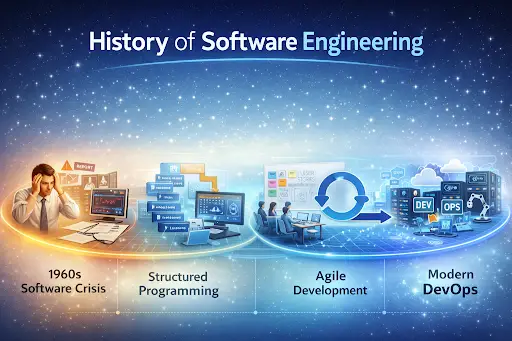
The History of Software Engineering is a story of transformation — from informal coding practices to structured methodologies that power today’s digital world. Software did not begin as an organized discipline. In the early days of computing, programming was experimental, unstructured, and often unpredictable.
As computers became more powerful and businesses increasingly relied on software systems, developers realized that writing code required more than logic. It required planning, processes, teamwork, and quality control. That realization gave birth to what we now call software engineering.
Understanding this journey helps us see how modern development practices evolved and why they matter today.
Before Software Engineering: The Era of Informal Programming
In the 1940s and 1950s, computers were massive machines used primarily for scientific and military calculations. Programs were written directly in machine language or early assembly code. There were no design documents, no version control systems, and no formal testing processes.
During this period, software development was closer to an art than an engineering discipline. Programmers often worked alone, solving problems line by line. As systems grew larger, the complexity increased rapidly.
This period closely connects with the broader History of Programming Languages, where early languages like FORTRAN and COBOL began shaping how developers approached coding problems.
However, as software projects grew in size, something unexpected happened — projects began failing.
The Software Crisis of the 1960s
By the mid-1960s, organizations faced serious challenges. Large software systems were:
- Delivered late
- Over budget
- Full of bugs
- Difficult to maintain
This period became known as the software crisis.
The demand for software was rising faster than the ability to build reliable systems. Developers realized that programming needed structured processes, documentation, and standardized practices.
In 1968, a NATO conference formally introduced the term software engineering, emphasizing that software development should follow engineering principles similar to hardware design.
This moment marked a turning point in the evolution of software engineering.
The Rise of Structured Programming (1970s)
In response to the crisis, the 1970s introduced structured programming methodologies. The goal was simple: make code more readable, maintainable, and reliable.
Concepts such as:
- Modular design
- Clear control structures
- Step-by-step documentation
became standard practice.
The Waterfall model emerged during this time, introducing a sequential development process: requirements, design, implementation, testing, deployment, and maintenance.
Although rigid, this model helped bring order to chaotic software development history.
At the same time, advancements in the History of Computer Hardware allowed systems to grow more complex, further increasing the need for disciplined software engineering.
The Object-Oriented Revolution (1980s–1990s)
As computing expanded into business and personal environments, a new paradigm emerged — object-oriented programming (OOP).
Languages such as C++ and later Java introduced concepts like:
- Encapsulation
- Inheritance
- Polymorphism
This shift changed how developers thought about system design. Instead of focusing only on procedures, programmers began modeling real-world objects in code.
The object-oriented approach improved scalability and reusability, marking a major milestone in the software engineering history timeline.
Software tools also improved during this era. Integrated development environments (IDEs), debugging tools, and version control systems made collaboration easier.
The Agile Movement (2001)
By the late 1990s, many developers felt that traditional methodologies like Waterfall were too rigid. Projects changed rapidly, and customer needs evolved during development.
In 2001, the Agile Manifesto was introduced, promoting:
- Iterative development
- Collaboration
- Customer feedback
- Flexibility
Agile transformed software engineering methodologies by focusing on adaptability rather than strict planning.
This marked another significant evolution in the History of Software Engineering, as teams shifted toward faster delivery cycles and continuous improvement.
DevOps and Modern Development Practices
As software systems expanded across networks and cloud platforms, development and operations teams needed better coordination. This led to the rise of DevOps.
DevOps integrates development, testing, deployment, and monitoring into a continuous workflow. Automation tools, continuous integration pipelines, and cloud infrastructure now define modern software engineering practices.
Today’s systems rely heavily on databases, distributed networks, and scalable architectures. The growth documented in the History of Computer Networking played a critical role in shaping these modern practices.
Software engineering is no longer just about writing code — it’s about building reliable ecosystems.
The Role of Tools and Automation
The evolution of programming tools has significantly influenced software engineering. From manual debugging to automated testing frameworks, tools now handle tasks that once required hours of human effort.
Key advancements include:
- Version control systems (Git)
- Automated testing frameworks
- Continuous integration platforms
- Cloud deployment services
These innovations have reduced human error and improved productivity.
Modern development is deeply connected to data management systems. The transformation seen in the History of Databases has allowed engineers to manage massive volumes of structured and unstructured data efficiently.
Software Engineering Today
Today, software engineering is a global profession supported by standards, certifications, and best practices.
Modern trends include:
- Microservices architecture
- Artificial Intelligence integration
- Cloud-native applications
- Low-code and no-code platforms
Unlike its early days, software engineering now emphasizes collaboration, documentation, testing, and lifecycle management.
The discipline has matured from informal coding experiments into a structured field that supports nearly every industry.
Why the History of Software Engineering Matters
Understanding the History of Software Engineering provides perspective. It shows how lessons learned from past failures shaped modern methodologies.
The software crisis taught developers the importance of planning. Structured programming introduced discipline. Agile promoted flexibility. DevOps unified teams.
Each phase built upon previous innovations, forming the strong foundation that modern software development relies on.
Without this historical evolution, today’s reliable applications, cloud services, and AI-driven platforms would not exist.
The Future of Software Engineering
Looking ahead, automation and artificial intelligence will continue transforming development practices.
Future trends may include:
- AI-assisted coding
- Autonomous testing systems
- Quantum computing integration
- Advanced cybersecurity frameworks
While technology evolves, the core principles of software engineering — planning, design, testing, and maintenance — will remain essential.
The journey from chaotic coding to structured engineering proves one thing: software development is constantly evolving.
FAQs
1. What is software engineering?
Software engineering is the systematic approach to designing, developing, testing, and maintaining software systems using engineering principles.
2. When did software engineering begin?
The term gained recognition in 1968 during a NATO conference, following the software crisis of the 1960s.
3. What was the software crisis?
The software crisis referred to widespread project failures due to increasing complexity, poor planning, and lack of structured development processes.
4. How did Agile change software engineering?
Agile introduced flexibility, iterative development, and customer collaboration, replacing rigid sequential models like Waterfall.
5. Why is understanding software engineering history important?
Studying its history helps developers understand modern practices and avoid repeating past mistakes.
Conclusion
The History of Software Engineering is more than a timeline of events. It is a reflection of how the technology industry learned from challenges and continuously improved its practices.
From the early days of informal programming to structured methodologies, from the software crisis to Agile and DevOps, each milestone shaped the discipline into what it is today.
As computing continues to evolve, software engineering will adapt, innovate, and remain at the center of digital transformation.