We live in an era where our refrigerators can order groceries, our watches can monitor our heart health, and our thermostats learn our daily routines. This seamless integration of physical objects into the digital realm is known as the Internet of Things (IoT). However, the History of the Internet of Things is not a recent phenomenon; it is a narrative that has been unfolding for decades. It is the result of the convergence between the History of Computers and the rapid expansion of global connectivity. By transforming everyday “dumb” objects into “smart” ones, IoT has fundamentally redefined the relationship between humanity and its environment.
Early Connected Device Concepts – 1980s
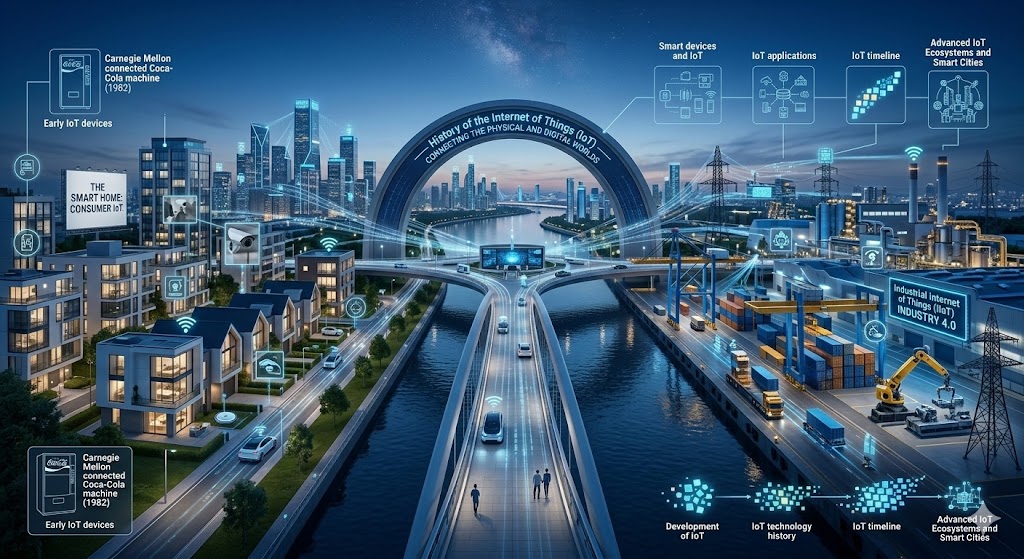
Long before the term “IoT” was popularized, early pioneers were experimenting with the idea of remote monitoring. The true origin of the Internet of Things evolution can be traced back to the early 1980s at Carnegie Mellon University. A group of programmers, tired of walking to the departmental Coca-Cola machine only to find it empty or warm, installed micro-switches inside the dispenser.
They connected these switches to the university’s local network—an early milestone in the History of Computer Networking. This allowed students to check the status of the machine from their computers. While simple, this was one of the first documented early IoT devices. It proved that any physical object, if equipped with a sensor and a network connection, could provide real-time data to a remote user. At this stage, the concept was a novelty, limited by the expensive and bulky hardware of the era.
The Birth of the Internet of Things Term – 1990s
As the History of Internet protocols transitioned from academic experiments to commercial tools in the 1990s, the potential for device connectivity grew. In 1999, Kevin Ashton, a visionary working for Procter & Gamble, officially coined the term “Internet of Things.” Ashton was working on Radio Frequency Identification (RFID) technology to help track products through the supply chain.
He argued that if all objects were tagged with sensors, computers could track and inventory them without human intervention. This marked a shift in the development of IoT from a hobbyist experiment to a corporate necessity. The 1990s also saw the introduction of the first “Internet Toaster” by John Romkey, which could be turned on and off via the web. These milestones showed that the internet was no longer just for sending emails between people; it was a platform for communication between things.
Early IoT Technologies and Research – 2000s
The turn of the millennium brought the infrastructure required for the IoT technology history to take its next leap. The 2000s were defined by the standardization of wireless protocols like Wi-Fi and Bluetooth. During this time, the “IP v6” protocol was developed, which massively expanded the number of available IP addresses. This was a critical moment in the IoT timeline because it ensured that every lightbulb, car, and sensor on the planet could have its own unique digital identity.
Research also began to focus on the Industrial Internet of Things (IIoT). Factories began using networked sensors to monitor machinery health, reducing downtime and increasing efficiency. This era relied heavily on the History of Cloud Storage, as the massive influx of data generated by these early sensors required a place to be stored and analyzed remotely. We began to see the move away from localized servers toward the centralized data processing that defines the modern smart era.
Rapid IoT Expansion and Smart Devices – 2010s
The 2010s were the decade when IoT became a household name. This expansion was fueled by the History of Mobile Technology, as the widespread adoption of smartphones gave everyone a “remote control” for the world around them. In 2010, Nest launched its smart thermostat, proving that there was a massive consumer appetite for smart devices and IoT integration.
As sensors became smaller and cheaper, IoT applications moved into every sector, from wearable fitness trackers to smart lighting. The “Smart Home” became a reality, but the growth wasn’t limited to houses. Agriculture began using IoT to monitor soil moisture, and logistics companies used it to track shipping containers in real-time across oceans. This decade cemented the idea that the “things” in the Internet of Things weren’t just computers, but any object capable of carrying a digital pulse.
Advanced IoT Ecosystems and Smart Cities – 2020s
Today, we are moving beyond individual gadgets toward advanced IoT ecosystems and the development of “Smart Cities.” In the 2020s, the focus has shifted toward 5G connectivity and Edge Computing. 5G provides the high-speed, low-latency connection required for autonomous vehicles to communicate with traffic lights and each other—a peak example of modern IoT technology.
Industrial Internet of Things (IIoT) has also evolved into “Industry 4.0,” where factories are almost entirely automated and self-correcting. We are seeing the rise of “Digital Twins,” where a virtual replica of a physical object (like a jet engine or a city’s power grid) is updated in real-time by IoT sensors to simulate different scenarios. The future of IoT technology lies in Artificial Intelligence; soon, these devices won’t just report data—they will make autonomous decisions to optimize energy use, reduce waste, and improve public safety.
Frequently Asked Questions (FAQs)
What is the difference between IoT and IIoT?
IoT (Internet of Things) generally refers to consumer-facing devices like smart watches and home appliances. IIoT (Industrial Internet of Things) refers to sensors and systems used in manufacturing, energy, and logistics to improve industrial efficiency.
Who is the father of the Internet of Things?
Kevin Ashton is credited with coining the term in 1999 while working at the Auto-ID Center at MIT, though the concept of connected devices dates back to the 1980s.
Why is 5G important for the future of IoT?
IoT devices often need to send and receive data instantly. 5G offers the high bandwidth and low latency required for critical applications like remote surgery or self-driving cars.
How do IoT devices communicate?
They use various protocols depending on the distance and power requirements, including Wi-Fi, Bluetooth, Zigbee, Cellular (4G/5G), and LoRaWAN for long-range, low-power sensing.
Is my smart home data private?
Security is a major concern in IoT. While most reputable companies use encryption, it is vital to use strong passwords and keep device firmware updated to protect your personal data.
Conclusion
The History of the Internet of Things is a journey of increasing awareness. We have moved from a world where objects were silent and disconnected to one where everything has a voice. From the Coca-Cola machine of the 1980s to the hyper-connected smart cities of the 2020s, the goal has remained the same: to use data to make our lives more efficient, safe, and convenient. As we continue to bridge the gap between the physical and digital, the Internet of Things evolution will likely be the most significant technological shift of our century. The world is no longer just a place we live in; it is a network we are a part of.