The human brain possesses an incredible, innate ability to instantly adapt past experiences to entirely new environments. If you learn how to drive a small passenger car, you do not need to relearn the foundational physics of steering, braking, and road awareness when you step inside a large delivery truck. For decades, traditional artificial intelligence systems lacked this basic fluid adaptability. Every single new task required building a massive database completely from scratch, demanding immense computation time and human annotation effort.
The transformative history of transfer learning in computer vision represents the glorious moment where scientists successfully taught machines to mimic this powerful human trait. Instead of forcing networks to start with a blank slate, engineers discovered ingenious methods to repurpose existing visual intelligence. This comprehensive guide details the evolutionary timeline of how the modern world unlocked the secret of representation reuse to accelerate the field of transfer learning in computer vision across industries.
The Theoretical Mechanics of Knowledge Recycling
To truly understand how neural networks reuse knowledge without physical visual elements, we must examine the underlying software architecture. Modern visual models are split into distinct functional segments. The earliest layers of a network act as a universal feature extraction base, recognizing simple geometric patterns. The deeper layers contain task-specific classification heads that map those patterns to distinct real-world labels.
When implementing transfer learning in computer vision, software developers leverage source domain weights that were calculated during a massive primary training phase. By applying strategic learning rate scheduling, engineers can determine exactly how much of the original knowledge base should alter when exposed to a new target data distribution. This delicate mathematical balancing act ensures the network maximizes its training velocity while maintaining structural stability.
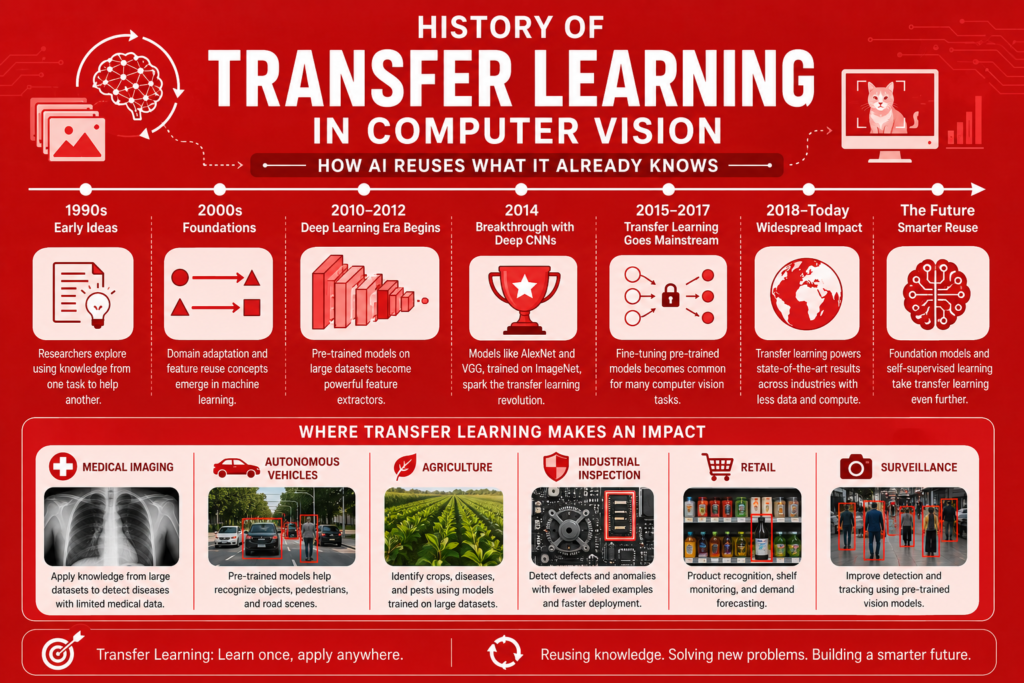
Early Visual Foundations (1990 – 2012)
Long before deep learning completely dominated the technology sector, academic researchers were passionately hunting for ways to implement the evolution of inductive transfer learning. During this initial era, the history of computer vision relied heavily on handcrafted mathematical descriptors. Engineers spent thousands of painstaking hours manually designing specialized mathematical algorithms to detect simple geometric shapes, isolated edges, and uniform gradients within digital photographs.
As the field slowly matured, early pioneers realized that the visual features extracted for one specific task, such as identifying typed letters on paper, shared a deep mathematical overlap with other visual objectives. This initial realization laid the crucial groundwork for cross domain visual knowledge transfer. However, early shallow learning models lacked the structural capacity to store abstract generalized concepts, meaning this early form of transfer learning in computer vision lacked scalability.
The early history of transfer learning in visual AI was largely limited to primitive domain adaptation techniques in computer vision, where researchers mathematically aligned the target data distribution with a slightly different source domain. These early statistical corrections helped slightly, but they simply could not scale up to handle complex, highly chaotic real-world visual environments.
The ImageNet Catalyst and Deep Era (2012 – 2015)
Everything changed in 2012 when a historic deep neural network shattered existing academic records. The history of alexnet proved to the global community that deep hierarchical networks could autonomously learn complex, layered representations directly from raw pixels without any human manual feature engineering. AlexNet learned simple edge filters in its early layers, basic textures in its middle layers, and complete object parts in its deepest structural layers.
This architectural breakthrough directly triggered the famous history of imagenet explosion. Because ImageNet contained over fourteen million carefully curated training images across thousands of diverse classes, networks trained on it developed a profoundly deep, universal understanding of visual reality. It was during this specific era that the modern history of transfer learning in computer vision truly found its footing on a global scale.
AI researchers quickly discovered an amazing phenomenon: the source domain weights acquired by training a deep network on ImageNet were highly effective when repurposed for entirely different visual challenges. This specific revelation marked the official rise of pretrained backbone networks. Instead of gathering millions of scarce pictures, an engineer could simply download a model that already knew how to see the physical world, making transfer learning in computer vision highly accessible.
Refining Techniques: Extraction vs Tuning (2015 – 2018)
As more advanced architectures emerged, including the famous history of resnet, different approaches to transfer learning in computer vision began to emerge. Researchers rapidly formalized the two primary paradigms of modern visual adaptation: feature extraction vs fine tuning transfer learning.
| Method | Core Strategy | Ideal Dataset Size | Computational Cost |
| Feature Extraction | Keep pretrained layers frozen; train only the new classification head. | Very small target datasets | Extremely Low |
| Fine-Tuning | Adapt all network weights using a highly sensitive learning rate. | Medium to large target datasets | Moderate |
When utilizing feature extraction, engineers left the early and middle layers of the pretrained model completely intact as frozen structural layers. The network acted as a fixed, robust feature generator, and only the newly attached task-specific classification heads were actively trained on the fresh target data. Using this strategy within transfer learning in computer vision prevents weight destruction when working on small, specialized datasets.
Conversely, the fine tuning convolutional neural networks history showed that for maximum performance, allowing the entire model to slowly adapt was often superior. In this setup, the pretrained parameters served as an exceptionally smart initialization point. By utilizing careful learning rate scheduling, the entire network could delicately shift its weights to align perfectly with the unique target data distribution without experiencing the devastating effects of catastrophic forgetting.
The Modern Era of Vision Transformers (2020 – Present)
In recent years, the ongoing progression of transfer learning in computer vision experienced another massive structural shift. While convolutional layers were the undisputed kings of visual processing for nearly a decade, the sudden arrival of vision transformers radically altered the architectural landscape. Borrowing concepts directly from natural language processing, modern vision networks now use massive self-attention mechanisms to map complex spatial relationships across large images.
This technological leap completely redefined out-of-domain generalization. Modern vision models are now pretrained on billions of unlabelled corporate images using self-supervised learning techniques. These massive foundational models display an unparalleled level of cross-domain adaptability, allowing them to excel at image classification finetuning with only a handful of available training examples.
By utilizing transfer learning in computer vision alongside transformers, developers have unlocked incredible performance in downstream tasks. Furthermore, modern synthetic data adaptation techniques allow models to train inside entirely virtual computer-generated worlds before seamlessly transferring their acquired intelligence directly into physical, real-world applications. This has completely accelerated related fields, such as the history of object detection, by allowing models to pre-train on virtual objects before identifying real ones.
Frequently Asked Questions
What exactly is transfer learning in computer vision?
It is a highly efficient machine learning technique where a neural network model developed for a comprehensive primary task is systematically reused as the foundational starting point for a completely separate downstream task optimization history. The primary role of transfer learning in computer vision is to maximize resource efficiency by bypassing the need for massive labeled training datasets.
What is the difference between feature extraction and fine-tuning?
Feature extraction keeps the original pretrained weights completely locked within frozen structural layers, training only the newly added task-specific classification heads. Fine-tuning allows the pretrained source domain weights to slowly adapt alongside the new classification layers using highly specialized learning rate scheduling.
Why did ImageNet play such a massive role in the history of transfer learning in computer vision?
ImageNet provided the global research community with millions of diverse, high-quality labeled images. Networks trained on this massive dataset naturally developed a highly generalized visual vocabulary, making their learned weights the absolute perfect foundation for widespread representation reuse across countless independent industries.
What is catastrophic forgetting in visual neural networks?
Catastrophic forgetting occurs when an artificial neural network completely overwrites its previously learned, generalized visual features while adapting to a new task. This harmful phenomenon causes the model to lose its original out-of-domain generalization capabilities, drastically degrading its overall performance on the new target dataset.
Conclusion
The continuous evolution and brilliant history of transfer learning in computer vision has effectively transformed artificial intelligence from a collection of isolated, rigid algorithms into fluid, deeply adaptable visual systems. By building solid frameworks that successfully preserve and reuse foundational visual knowledge, global computer scientists have unlocked unprecedented training speeds and exceptional accuracy across countless specialized fields, ranging from automated medical imaging diagnostics to real-time industrial manufacturing quality control.
As we look toward the future, the core principles of representation reuse will undoubtedly remain at the heart of next-generation computer vision technology, continuing to empower smaller datasets, fuel multi-modal model architectures, and bring human-like visual adaptability closer to everyday digital reality.