Understanding interfaces vs types is one of the most important topics in mastering TypeScript. Many developers struggle to decide when to use interfaces and when to use type aliases. If you want to write clean, scalable, and maintainable code, learning interfaces vs types is essential.
TypeScript offers both interfaces and types as ways to define object shapes and data structures. While they may look similar at first, they have key differences that can impact your development process. In this guide, we will explore interfaces vs types in depth, helping you understand when and why to use each approach.
The Evolution of Type Systems (1995 – Present)
To fully understand interfaces vs types, it is important to look at how type systems evolved. JavaScript, introduced in 1995, used dynamic typing, which allowed flexibility but often caused runtime errors.
In 2012, TypeScript was introduced by Anders Hejlsberg. It brought static typing and a structured type system to JavaScript. The typescript history shows how this innovation improved code reliability and maintainability.
This evolution highlights the importance of learning interfaces vs types for modern development.
What Are Interfaces in TypeScript?
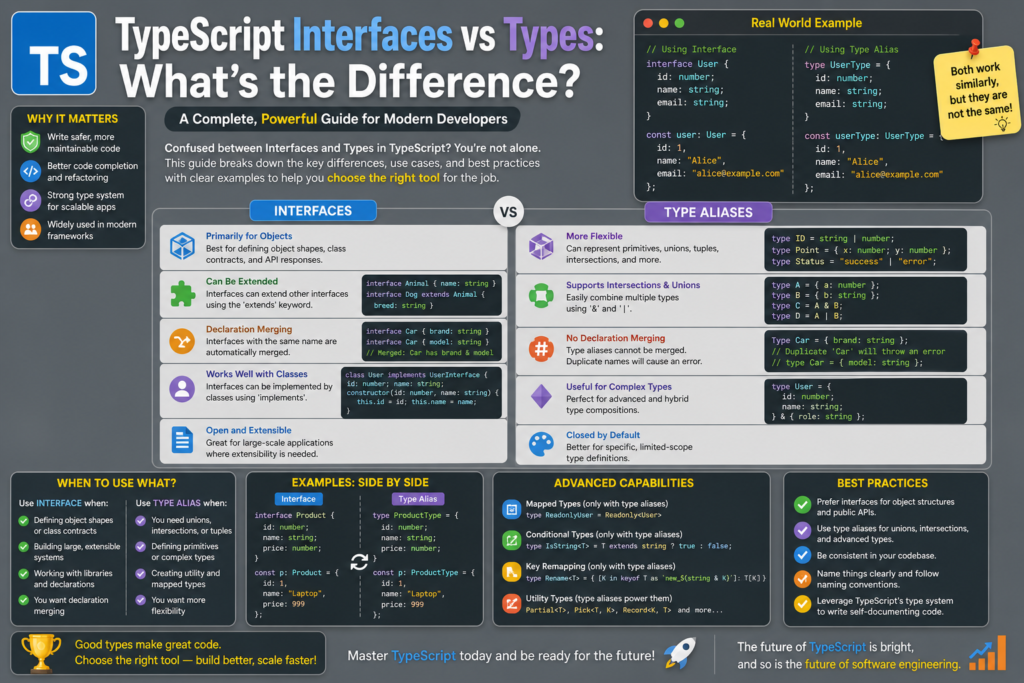
Interfaces are used to define the structure of an object. They act as a contract that specifies what properties an object should have.
When exploring interfaces vs types, interfaces are often preferred for defining object shapes and API design. They support extensibility and allow developers to build scalable systems.
Interfaces follow structural typing, meaning objects are checked based on their structure rather than their explicit type. This makes them flexible and powerful.
What Are Type Aliases?
Type aliases are another way to define types in TypeScript. They allow you to create custom types for variables, objects, and functions.
In the interfaces vs types discussion, type aliases are more flexible. They can represent primitive types, union types, intersection types, and even complex structures.
Type aliases are useful for type composition and defining polymorphic types. They provide greater flexibility compared to interfaces.
Key Differences Between Interfaces vs Types
Understanding the differences between interfaces vs types is crucial for making the right choice.
Interfaces are primarily used for defining object shapes and support declaration merging. This means you can extend an interface multiple times.
Type aliases, on the other hand, are more versatile. They can represent a wider range of types, including unions and intersections.
This distinction is central to the interfaces vs types debate.
Extending Interfaces and Inheritance
One of the strengths of interfaces is their ability to extend other interfaces. This allows you to build complex structures by combining simpler ones.
In the interfaces vs types comparison, interfaces are better suited for object oriented design. They provide a clear way to define relationships between objects.
Extending interfaces is a powerful feature for creating scalable applications.
Intersection Types and Type Composition
Type aliases support intersection types, which allow you to combine multiple types into one. This is a key advantage in the interfaces vs types discussion.
Intersection types are useful for creating complex data structures and handling advanced scenarios. They enable developers to build flexible and reusable code.
Type composition is an important concept for modern development.
Declaration Merging in Interfaces
One unique feature of interfaces is declaration merging. This allows multiple interface declarations to be combined into a single definition.
In the interfaces vs types comparison, this feature gives interfaces an advantage in certain scenarios. It is especially useful in large projects and libraries.
Declaration merging enhances code organization and extensibility.
When to Use Interfaces
Understanding when to use interfaces is key to mastering interfaces vs types. Interfaces are ideal for defining object shapes, APIs, and class structures.
They are commonly used in object oriented programming and help maintain consistency across large codebases. Interfaces also work well with typescript classes, making them a preferred choice for structured applications.
When to Use Type Aliases
Type aliases are best used when you need flexibility. In the interfaces vs types debate, they are ideal for defining unions, intersections, and complex types.
They are also useful for working with primitive types and creating reusable type definitions. Developers often use them alongside advanced typescript types to handle complex scenarios.
Interfaces vs Types in Real World Projects
In real world projects, both interfaces and types are used together. The choice depends on the specific use case.
For example, interfaces are often used for API design and object structures, while type aliases are used for complex data types.
Understanding interfaces vs types helps you make better decisions and improve code quality.
TypeScript vs JavaScript Perspective
When comparing typescript vs javascript, the concept of interfaces and types does not exist in JavaScript. This highlights the power of TypeScript’s type system.
TypeScript provides better tools for defining data structures and improving code reliability. This makes interfaces vs types an important topic for developers transitioning from JavaScript.
Common Mistakes and Best Practices
While learning interfaces vs types, developers often make mistakes such as overusing type aliases or misunderstanding interface extension.
To avoid these issues, follow best practices like using interfaces for object shapes and types for complex structures. Maintaining consistency is key to writing clean code.
Learning from mistakes will help you master interfaces vs types.
Learning Path for Beginners
If you are new to TypeScript, start with typescript for beginners resources. Learn the basics of variables, types, and functions before diving into interfaces and types.
Understanding typescript variables and basic concepts will make it easier to grasp advanced topics like interfaces vs types.
Practice regularly to build confidence and improve your skills.
Future of Interfaces and Types
The future of typescript is closely tied to its type system. Interfaces and types will continue to evolve, offering more features and flexibility.
TypeScript will play a major role in the future of software engineering, helping developers build scalable and reliable applications.
Mastering interfaces vs types will remain a valuable skill for developers.
FAQs About Interfaces vs Types
What is the main difference between interfaces and types?
Interfaces define object structures, while types provide more flexibility for complex definitions.
Can interfaces and types be used together?
Yes, they are often used together in real world projects.
Which is better interfaces or types?
It depends on the use case. Interfaces are better for object shapes, while types are more flexible.
What is declaration merging?
It is a feature that allows multiple interface definitions to be combined.
Are interfaces faster than types?
There is no significant performance difference between them.
Conclusion
Mastering interfaces vs types is essential for writing clean and scalable TypeScript code. Both interfaces and type aliases have their strengths, and understanding their differences helps you make better decisions.
Interfaces are ideal for defining object shapes and building structured applications, while type aliases offer flexibility for complex scenarios. Together, they form the backbone of TypeScript’s powerful type system.
By learning interfaces vs types, you can improve code quality, enhance maintainability, and build robust applications for the future.