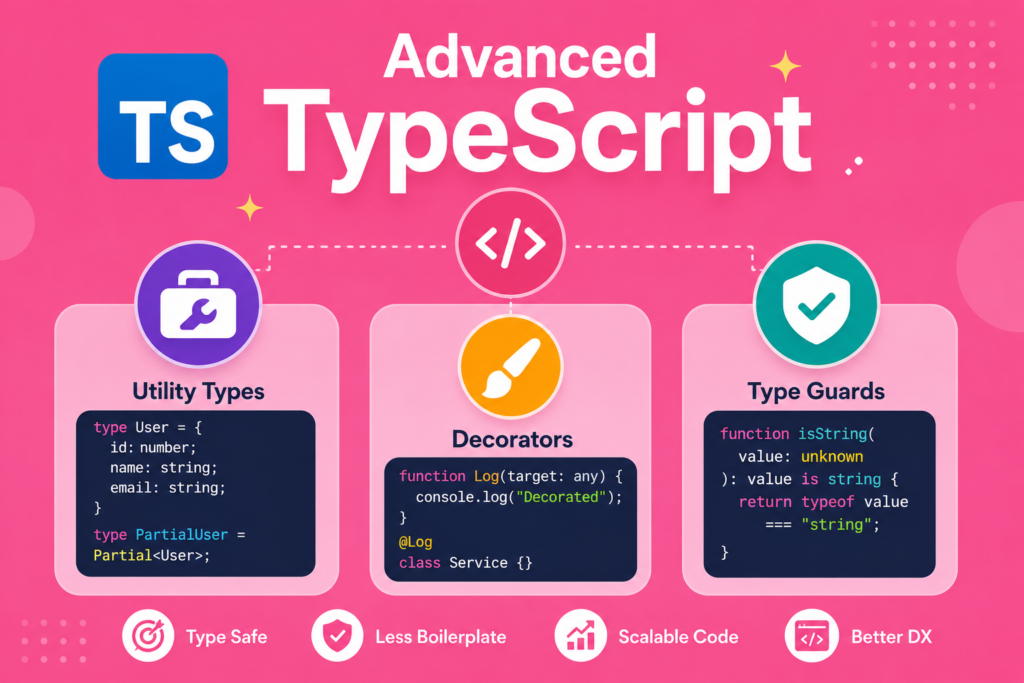
Mastering advanced typescript types is one of the biggest steps toward becoming a professional TypeScript developer. Once developers understand variables, functions, and basic typing, they eventually reach a stage where applications require more scalable and reusable type systems. This is where utility types, decorators, and type guards become incredibly important.
Modern applications rely heavily on type manipulation, advanced inference, and reusable programming patterns. Without proper understanding of advanced typescript types, maintaining large applications becomes difficult. Developers need tools that reduce boiler plate reduction, improve type checking, and simplify complex logic.
In this complete guide, you will learn everything about advanced typescript types, including utility types like Partial and Pick, custom type guards, decorators, metadata reflection, recursive types, and advanced inference techniques with practical code examples.
Evolution of Advanced Type Systems (1995 – 2026)
JavaScript introduced flexibility to web development, but it lacked strong typing and advanced software engineering tools. As applications became larger, developers needed safer ways to manage data and maintain scalable architectures.
In 2012, Anders Hejlsberg introduced TypeScript. The typescript history demonstrates how TypeScript gradually evolved into one of the most powerful type systems in modern programming.
Today, advanced typescript types are widely used in enterprise applications, frontend frameworks, backend APIs, and modern developer tooling.
What Are Advanced TypeScript Types?
At its core, advanced typescript types refers to the advanced features within TypeScript’s type system that allow developers to create reusable, scalable, and type safe applications.
If you are wondering what is typescript?, it is a strongly typed superset of JavaScript that improves software quality through compile time validation and advanced tooling.
Advanced typing features allow developers to handle metaprogramming, introspection, and reusable type programming with greater efficiency.
Understanding Utility Types
Utility types are one of the most important concepts in advanced typescript types. They help developers transform and manipulate existing types without rewriting code repeatedly.
TypeScript provides several built in utility types such as:
- Partial
- Pick
- Omit
- Record
- Required
- Readonly
These utility functions simplify complex data structures and improve maintainability.
Partial Utility Type
The Partial utility type makes all properties optional.
Example:
interface User {
  id: number;
  name: string;
  email: string;
}

type PartialUser = Partial<User>;
This is extremely useful when updating user data or handling incomplete objects.
The Partial type reduces boiler plate reduction and improves flexibility in scalable applications.
Pick Utility Type
The Pick utility type selects specific properties from an existing type.
Example:
interface Product {
  id: number;
  title: string;
  price: number;
}

type ProductPreview = Pick<Product, "title" | "price">;
This helps developers create lightweight versions of data structures without duplication.
Omit Utility Type
The Omit utility type removes specific properties from a type.
Example:
interface User {
  id: number;
  password: string;
  username: string;
}

type PublicUser = Omit<User, "password">;
This is commonly used in APIs to remove sensitive information.
Record Utility Type
The Record utility type creates an object type with predefined keys and values.
Example:
type UserRoles = Record<string, string>;

const roles: UserRoles = {
  admin: "Full Access",
  user: "Limited Access",
};
This utility type is useful for metadata storage and scalable object mapping.
Understanding Type Guards
Type guards are another essential feature of advanced typescript types. They help narrow types safely during runtime.
Example:
function isString(value: unknown): value is string {
  return typeof value === "string";
}
Type guards improve type checking and reduce runtime risks.
They are especially useful in APIs and user input validation.
Custom Type Guards Explained
Custom type guards allow developers to create reusable validation logic.
Example:
interface Car {
  brand: string;
}

function isCar(obj: any): obj is Car {
  return obj && typeof obj.brand === "string";
}
Custom type guards improve defensive programming and help manage complex logic safely.
Decorators in TypeScript
Decorators are a powerful feature in advanced typescript types that enable metaprogramming and code decoration.
A decorator is a special function that modifies classes, methods, or properties.
Example:
function Logger(target: Function) {
  console.log("Class created");
}

@Logger
class UserService {}
Decorators are widely used in frameworks like NestJS and Angular.
Metadata Reflection and Decorators
Metadata reflection allows decorators to store and retrieve additional information.
Example:
import "reflect-metadata";

Reflect.defineMetadata("role", "admin", UserService);
Metadata reflection improves introspection and supports advanced software engineering patterns.
Recursive Types Explained
Recursive types reference themselves within their definition.
Example:
type TreeNode = {
  value: string;
  children?: TreeNode[];
};
Recursive types are useful for hierarchical data structures like trees and menus.
They are heavily used in scalable applications.
Understanding the infer Keyword
The infer keyword allows developers to extract types dynamically.
Example:
type ReturnType<T> = T extends (...args: any[]) => infer R
  ? R
  : never;
This feature improves advanced inference and reusable utility creation.
Brand Types for Extra Safety
Brand types help distinguish similar primitive values.
Example:
type UserId = string & { __brand: "UserId" };

const id = "123" as UserId;
Brand types improve type safety in large applications.
Advanced Type Programming
Advanced type programming combines utility types, conditional types, and mapped types to create flexible architectures.
Example:
type Nullable<T> = {
  [K in keyof T]: T[K] | null;
};
This approach improves scalability and reduces duplication.
Advanced TypeScript with React
Frontend developers using typescript with react rely heavily on utility types and type guards for props, hooks, and state management.
Example:
type ButtonProps = {
  label: string;
};
These advanced features improve reusable components and type safe hooks.
Advanced TypeScript with Node.js
Backend developers using typescript with nodejs often use decorators, utility types, and validation systems in APIs and backend services.
Decorators are especially popular in backend frameworks like NestJS.
This demonstrates how advanced typescript types improve backend architecture and scalability.
TypeScript vs JavaScript Advanced Features
When comparing typescript vs javascript, TypeScript provides far more advanced type manipulation capabilities.
JavaScript focuses on runtime flexibility, while TypeScript improves software engineering with compile time checks and reusable type programming.
This makes advanced typescript types essential for professional development.
Best Practices for Advanced TypeScript Types
When working with advanced typescript types, developers should follow these best practices:
- Keep utility types readable
- Avoid excessive complexity
- Use decorators carefully
- Prefer strong typing over
any - Organize reusable types properly
These practices improve maintainability and software quality
Future of Advanced Type Systems
The future of typescript is closely connected to advanced type programming and scalable architecture.
As applications become more complex, developers will increasingly rely on decorators, type guards, and utility types.
TypeScript will continue shaping the future of software engineering by improving developer productivity and application reliability.
FAQs About Advanced TypeScript Types
What are advanced TypeScript types?
They are advanced features like utility types, decorators, and type guards.
Why are utility types useful?
They reduce duplication and improve reusable type programming.
What are decorators in TypeScript?
Decorators are functions that modify classes or methods.
What is a type guard?
A type guard safely narrows a type during runtime.
Is advanced TypeScript difficult to learn?
It can feel complex initially, but practice makes it much easier.
Conclusion
Mastering advanced typescript types is essential for building scalable and professional applications. Utility types, decorators, recursive types, and type guards provide powerful tools for modern software engineering.
By learning advanced typescript types, developers can improve type safety, reduce duplication, and create flexible architectures capable of handling large applications. As TypeScript continues evolving, these advanced concepts will remain critical in modern development.
Start practicing utility types, decorators, and type guards today to unlock the full potential of TypeScript.