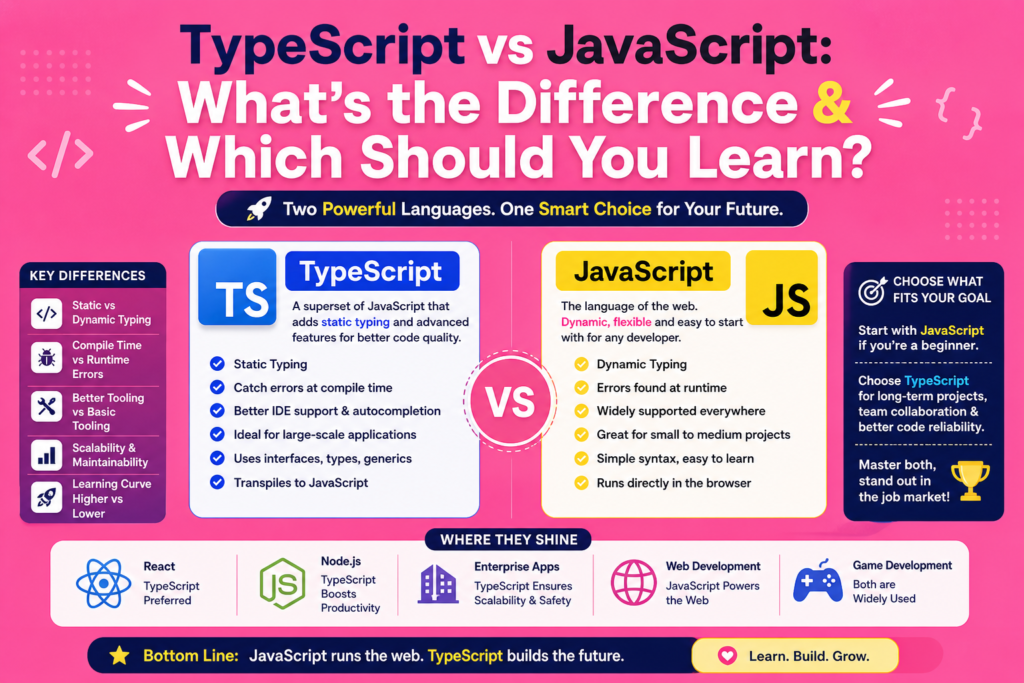
The debate around typescript vs javascript has become one of the most important discussions in modern programming. Developers, beginners, and even experienced engineers often ask which language is better and which one they should learn first. Understanding typescript vs javascript is essential because it directly impacts your coding style, productivity, and career growth.
JavaScript has been the backbone of web development for decades, while TypeScript has emerged as a powerful enhancement designed to solve its limitations. This article will explore typescript vs javascript in depth, covering their differences, benefits, and real world applications so you can make the best decision for your future.
The Origins of JavaScript and TypeScript (1995 – 2012)
JavaScript was created in 1995 and quickly became the standard language for web development. It allowed developers to build interactive websites and dynamic user interfaces. However, as applications grew in size and complexity, JavaScript began to show its limitations.
TypeScript was introduced in 2012 by Microsoft, led by Anders Hejlsberg. It was designed as a superset of JavaScript, meaning it builds on JavaScript while adding new features. The typescript history reveals that its main goal was to improve code reliability and developer productivity.
This background is important when understanding typescript vs javascript, as TypeScript was created specifically to address JavaScript’s weaknesses.
What Is JavaScript and TypeScript?
To understand typescript vs javascript, you must first understand what each language does. JavaScript is a dynamic language that runs directly in the browser. It is flexible and easy to learn, making it ideal for beginners.
TypeScript, on the other hand, is a superset of JavaScript that adds type safety and advanced features. It uses transpilation to convert TypeScript code into JavaScript, ensuring browser compatibility.
If you are wondering what is typescript?, it is essentially JavaScript with added structure and compile time checks. This difference is at the heart of the typescript vs javascript debate.
Static vs Dynamic Typing Explained
One of the biggest differences in typescript vs javascript is static vs dynamic typing. JavaScript uses dynamic typing, meaning variables can change type at runtime. While this offers flexibility, it can lead to unexpected errors.
TypeScript introduces static typing, which checks types during development. This helps catch errors early and improves software quality. Type safety is one of the main reasons developers prefer TypeScript for large projects.
This difference highlights how typescript vs javascript impacts debugging comparison and overall code reliability.
Syntax Differences and Developer Experience
When comparing typescript vs javascript, syntax differences play a major role. JavaScript has a simple and flexible syntax, while TypeScript adds additional structure.
TypeScript allows developers to define types, interfaces, and classes. These features improve code readability and maintainability. For example, understanding interfaces vs types helps developers design better applications.
The improved developer experience (DX) in TypeScript comes from better tooling support, IDE integration, and error detection. This makes it a preferred choice for professional developers.
Performance and Runtime Behavior
Performance is often discussed in the context of typescript vs javascript. JavaScript runs directly in the browser, while TypeScript must be compiled first.
However, after transpilation, TypeScript becomes JavaScript. This means there is no significant difference in runtime performance. The main advantage of TypeScript lies in compile time error detection.
When evaluating typescript vs javascript performance, it is important to focus on development efficiency rather than runtime speed.
Pros and Cons of TypeScript and JavaScript
Understanding the pros and cons is essential when comparing typescript vs javascript. JavaScript is easy to learn, flexible, and widely supported. It has a massive ecosystem and is ideal for small projects.
TypeScript offers better code reliability, improved debugging, and stronger tooling. It is especially useful for large scale applications and teams.
However, TypeScript has a learning curve and requires additional setup. Developers must also manage tooling overhead and compilation steps.
These trade offs are central to the typescript vs javascript discussion.
TypeScript vs JavaScript for Beginners
For beginners, the choice between typescript vs javascript can be challenging. JavaScript is often recommended as the starting point because of its simplicity and immediate results.
Once you understand JavaScript, you can move to TypeScript. Many developers follow this path, using resources like typescript for beginners to learn the basics.
TypeScript vs JavaScript for beginners depends on your goals. If you want quick results, start with JavaScript. If you aim for long term growth, TypeScript is a powerful option.
Use Cases and Real World Applications
The choice between typescript vs javascript often depends on the project. JavaScript is great for small projects, prototypes, and simple applications.
TypeScript is ideal for large scale software, enterprise applications, and complex systems. It improves code maintainability and reduces technical debt.
Many modern frameworks support TypeScript. Developers frequently use typescript with react and typescript with nodejs for building scalable applications.
These use cases highlight the practical differences in typescript vs javascript.
Job Market and Career Opportunities
The job market for TS vs JS is another important factor in the typescript vs javascript debate. JavaScript remains the most widely used language, with countless job opportunities.
However, TypeScript is rapidly gaining popularity. Many companies prefer developers who understand both languages. Employment trends show a growing demand for TypeScript skills.
Learning TypeScript can enhance your career roadmap and open new opportunities in software engineering.
Code Reliability and Debugging Comparison
One of the strongest advantages of TypeScript is improved code reliability. Static typing reduces runtime errors and makes debugging easier.
In the typescript vs javascript comparison, TypeScript clearly excels in large projects. It provides better tools for refactoring and maintaining code.
JavaScript, while flexible, can lead to unpredictable behavior in complex applications. This makes TypeScript a better choice for long term projects.
Learning Curve and Developer Preferences
The learning curve is an important aspect of typescript vs javascript. JavaScript is easier to start with, but TypeScript requires understanding additional concepts.
Developer preferences vary based on experience and project needs. Some prefer JavaScript’s simplicity, while others value TypeScript’s structure.
The choice ultimately depends on your goals and the type of projects you want to build.
The Future of TypeScript and JavaScript
The future of typescript looks very promising as more developers adopt it for large scale applications. Its focus on type safety and productivity makes it a valuable tool.
JavaScript will continue to evolve and remain essential for web development. Both languages will coexist, each serving different purposes.
The discussion around typescript vs javascript will continue as technology advances and developer needs change.
TypeScript will also play a key role in the future of software engineering, shaping how developers build reliable and scalable applications.
FAQs About TypeScript vs JavaScript
Which is better TypeScript or JavaScript?
It depends on your needs. TypeScript is better for large projects, while JavaScript is ideal for simple applications.
Should beginners learn TypeScript first?
Most beginners start with JavaScript and then move to TypeScript for advanced development.
Does TypeScript replace JavaScript?
No, TypeScript builds on JavaScript and compiles into it.
Is TypeScript harder than JavaScript?
TypeScript has a steeper learning curve but offers more benefits in the long run.
Is TypeScript in demand?
Yes, the demand for TypeScript developers is growing rapidly in the job market.
Conclusion
The comparison of typescript vs javascript reveals that both languages have their strengths and weaknesses. JavaScript is flexible, easy to learn, and widely used, while TypeScript offers structure, safety, and scalability.
Choosing between them depends on your goals, experience level, and project requirements. For beginners, starting with JavaScript and then learning TypeScript is a practical approach.
In the end, mastering both languages will give you a powerful advantage in the world of programming. Understanding typescript vs javascript is not just about choosing a language, it is about building a strong foundation for your future in software development.