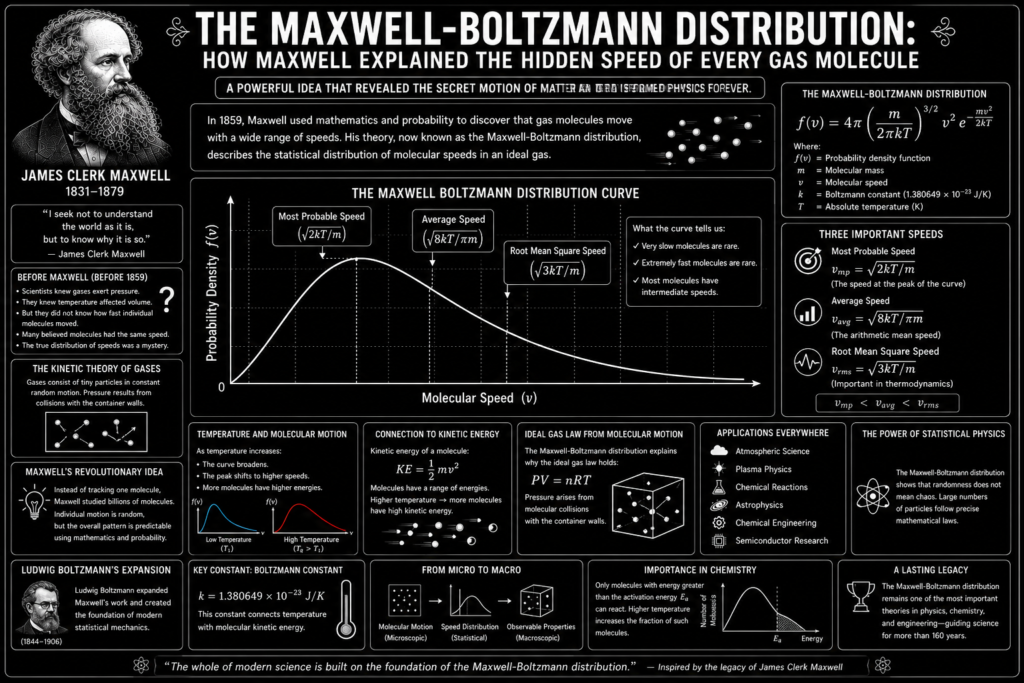
The story of the maxwell boltzmann distribution is one of the most important breakthroughs in the history of physics. Before James Clerk Maxwell developed this remarkable idea, scientists knew that gases contained countless molecules moving randomly. However, they had no clear understanding of how fast those molecules moved or how their speeds were distributed.
Maxwell changed that forever.
By applying mathematics and probability to the motion of gas particles, he discovered that molecules in a gas do not all move at the same speed. Instead, they follow a predictable statistical pattern. This insight became the foundation of modern statistical physics and transformed our understanding of thermodynamics, chemistry, and molecular science.
Today, the maxwell boltzmann distribution remains one of the most powerful tools in physics. It helps explain everything from gas pressure and temperature to chemical reactions and atmospheric science.
The Mystery of Gas Motion Before Maxwell (1800 – 1859)
Before the development of the maxwell boltzmann distribution, scientists understood some basic properties of gases.
They knew:
- Gases exert pressure.
- Gases expand when heated.
- Gases contract when cooled.
- Gas particles are constantly moving.
However, they did not know how molecular motion produced these effects.
Many researchers assumed that gas molecules moved with similar speeds.
Maxwell suspected otherwise.
He believed that probability and mathematics could reveal the hidden behavior of molecules.
The Birth of Kinetic Theory (1820 – 1860)
The foundation for the maxwell boltzmann distribution came from the kinetic theory of gases.
This theory proposed that gases consist of enormous numbers of tiny particles moving randomly.
Gas pressure results from molecular collisions with container walls.
Temperature reflects molecular motion.
The kinetic theory of gases provided a powerful framework, but one major question remained unanswered:
How are molecular speeds distributed?
Maxwell set out to solve this puzzle.
James Clerk Maxwell’s Revolutionary Idea (1859)
In 1859, James Clerk Maxwell published a groundbreaking paper on molecular motion.
Instead of asking how a single molecule behaves, he asked a different question:
How do billions of molecules behave collectively?
This shift in thinking was revolutionary.
Maxwell realized that individual molecular motions are unpredictable, but the overall pattern follows precise mathematical laws.
The result became the maxwell boltzmann distribution.
Why Molecules Cannot All Move at the Same Speed
One of Maxwell’s key insights was that gas molecules constantly collide with one another.
Every collision changes velocity.
Some molecules gain speed.
Others lose speed.
As a result:
- Very slow molecules exist.
- Very fast molecules exist.
- Most molecules move at intermediate speeds.
This creates a molecular speed distribution gas pattern rather than a single velocity.
The challenge was to describe this distribution mathematically.
The Maxwell-Boltzmann Distribution Formula
The famous maxwell boltzmann distribution is expressed as:
f(v) = 4π (m/2πkT)^(3/2) v² e^(-mv²/2kT)
Where:
- f(v) = Probability density function
- m = Molecular mass
- v = Molecular speed
- k = Boltzmann constant
- T = Absolute temperature
This equation predicts the probability of finding molecules moving at various speeds.
It remains one of the most beautiful equations in statistical physics.
Understanding the Distribution Curve
The maxwell boltzmann distribution produces a characteristic curve.
The curve begins near zero.
It rises rapidly.
It reaches a maximum value.
Then it gradually decreases.
This shape reveals several important facts:
- Very slow molecules are uncommon.
- Extremely fast molecules are uncommon.
- Most molecules cluster around intermediate speeds.
The resulting graph is known as the Maxwell Boltzmann distribution curve.
It provides a visual representation of molecular motion inside gases.
Probability and Molecular Motion
The success of the maxwell boltzmann distribution comes from probability theory.
Rather than predicting individual molecules, Maxwell predicted statistical behavior.
If a gas contains:
N = 10²³ molecules
tracking every molecule becomes impossible.
Instead, probability describes collective behavior.
The probability density function gives the likelihood that a molecule possesses a particular speed.
This statistical approach transformed physics forever.
Temperature and Molecular Motion
One of the most important consequences of the maxwell boltzmann distribution involves temperature and molecular motion.
As temperature increases:
- Molecular speeds increase.
- The distribution broadens.
- The peak shifts toward higher velocities.
This relationship explains why hot gases behave differently from cold gases.
Temperature directly influences molecular kinetic energy.
Average Velocity of Gas Molecules
The maxwell boltzmann distribution allows physicists to calculate several characteristic speeds.
Average Speed
The average velocity of gas molecules is:
v_avg = √(8kT/πm)
This value represents the arithmetic mean of molecular speeds.
Most Probable Speed
The most probable speed corresponds to the peak of the distribution curve.
v_mp = √(2kT/m)
This speed occurs more frequently than any other.
Root Mean Square Speed
Another important quantity is the Root mean square speed.
v_rms = √(3kT/m)
This value is especially important in thermodynamics.
Comparing the Three Speeds
For any ideal gas:
v_mp < v_avg < v_rms
This relationship emerges naturally from the maxwell boltzmann distribution.
Each speed provides different information about molecular behavior.
Physicists frequently use all three values when analyzing gases.
Connection to Kinetic Energy
The maxwell boltzmann distribution also explains kinetic energy distribution.
The kinetic energy of a molecule is:
KE = ½mv²
Since molecules possess different speeds, they also possess different energies.
Some molecules have low energy.
Others have high energy.
Most occupy intermediate energy levels.
This distribution helps explain many physical and chemical processes.
The Ideal Gas Law and Statistical Mechanics
One of the greatest achievements of the maxwell boltzmann distribution was connecting microscopic motion to macroscopic properties.
The ideal gas law is:
PV = nRT
Where:
- P = Pressure
- V = Volume
- n = Number of moles
- R = Gas constant
- T = Temperature
Maxwell showed that gas pressure originates from molecular collisions.
His work linked microscopic particle motion to observable properties.
This became the foundation of ideal gas law statistical mechanics.
Ludwig Boltzmann Expands Maxwell’s Work (1860 – 1890)
Although Maxwell developed the original distribution, Austrian physicist Ludwig Boltzmann greatly expanded the theory.
Boltzmann generalized Maxwell’s ideas and created a broader framework for statistical mechanics.
The resulting theory became known as the maxwell boltzmann distribution in recognition of both scientists.
Their combined contributions transformed modern physics.
Collision Frequency in Gases
The maxwell boltzmann distribution also helps explain collision frequency.
Molecules constantly collide with:
- Other molecules
- Container walls
- Impurities
Faster molecules collide more frequently.
Higher temperatures increase collision rates.
This behavior influences:
- Pressure
- Diffusion
- Chemical reactions
The theory provides quantitative predictions for all these processes.
Activation Energy and Chemical Reactions
One of the most important applications of the maxwell boltzmann distribution involves activation energy.
Chemical reactions require molecules to possess sufficient energy.
Only molecules above a certain threshold can react.
As temperature increases:
- More molecules exceed activation energy.
- Reaction rates increase.
This explains why heating often accelerates chemical reactions.
The concept remains fundamental in chemistry.
Why Statistical Physics Was Revolutionary
Before Maxwell, physics focused primarily on individual objects.
Scientists studied:
- Planets
- Pendulums
- Projectiles
The maxwell boltzmann distribution introduced a new approach.
Instead of tracking individuals, Maxwell studied populations.
This became the foundation of statistical physics.
Today, statistical methods appear throughout science, including:
- Physics
- Chemistry
- Biology
- Economics
- Artificial intelligence
James Clerk Maxwell Contributions Beyond Electromagnetism
When discussing James Clerk Maxwell Contributions, many people focus only on electricity and magnetism.
However, the maxwell boltzmann distribution ranks among his most influential achievements.
His contributions include:
- Electromagnetic theory
- Statistical mechanics
- Molecular speed distributions
- Color vision research
- Mathematical physics
Very few scientists have influenced so many different fields.
Maxwell’s Influence on Modern Science
The impact of the maxwell boltzmann distribution continues today.
Applications include:
- Atmospheric science
- Plasma physics
- Astrophysics
- Chemical engineering
- Semiconductor research
- Nuclear physics
The distribution remains essential for understanding matter at the molecular level.
Why the Maxwell-Boltzmann Distribution Still Matters
More than 160 years after its discovery, the maxwell boltzmann distribution remains one of the most important ideas in science.
It explains:
- Molecular motion
- Gas pressure
- Temperature effects
- Chemical reaction rates
- Energy distributions
Its predictive power continues guiding research and engineering.
The theory remains a masterpiece of scientific reasoning.
Maxwell’s Legacy in Statistical Mechanics
The development of the maxwell boltzmann distribution marked the beginning of modern statistical mechanics.
Maxwell demonstrated that randomness does not imply chaos.
Large collections of particles obey predictable mathematical laws.
This insight revolutionized science.
Today it remains one of the foundations of our understanding of matter and energy.
Frequently Asked Questions (FAQs)
What is the Maxwell-Boltzmann distribution?
The Maxwell-Boltzmann distribution describes how molecular speeds are distributed within a gas.
Why is the Maxwell-Boltzmann distribution important?
It explains molecular motion, temperature effects, gas pressure, and reaction rates.
What is root mean square speed?
Root mean square speed is:
v_rms = √(3kT/m)
It represents an important average measure of molecular motion.
Who developed the Maxwell-Boltzmann distribution?
James Clerk Maxwell developed the original theory, and Ludwig Boltzmann later expanded it.
How does temperature affect the distribution?
Higher temperatures increase molecular speeds and shift the distribution toward larger velocities.
Conclusion
The maxwell boltzmann distribution represents one of the greatest achievements in the history of physics. By applying probability and mathematics to molecular motion, James Clerk Maxwell revealed the hidden speed patterns governing every gas molecule.
His work transformed statistical physics, explained thermodynamics at the microscopic level, and provided tools that remain essential across science and engineering. From understanding atmospheric gases to predicting chemical reactions, the Maxwell-Boltzmann distribution continues shaping modern research.
More than a century and a half later, Maxwell’s remarkable insight still helps humanity understand the invisible molecular world that surrounds us every day.