The story of maxwell demon is one of the strangest and most fascinating mysteries in the history of physics. Unlike Maxwell’s equations, electromagnetic waves, or the speed of light, Maxwell’s demon was not a physical discovery. Instead, it was a thought experiment designed to challenge one of the most fundamental laws of nature.
For more than 150 years, the idea of maxwell demon has puzzled scientists, inspired debates, and influenced entirely new fields of research. What began as a simple imaginary creature eventually helped shape modern information theory, computer science, statistical mechanics, and our understanding of entropy itself.
The remarkable story of maxwell demon demonstrates how a purely theoretical idea can transform science just as powerfully as a laboratory experiment.
The Scientific World of Thermodynamics (1850 – 1870)
During the nineteenth century, physicists were developing the laws of thermodynamics.
These laws explained how heat, energy, and work behave in physical systems.
One principle appeared especially important:
The Second Law of Thermodynamics.
In simple terms, this law states that disorder tends to increase over time.
Scientists describe this disorder using a quantity called entropy.
Mathematically:
ΔS ≥ 0
Where:
- S = Entropy
- ΔS = Change in entropy
The equation means entropy in an isolated system generally increases or remains constant.
Most physicists considered this law universal.
Then Maxwell proposed a disturbing challenge.
James Clerk Maxwell’s Curious Question (1867)
In 1867, James Clerk Maxwell introduced a remarkable thought experiment.
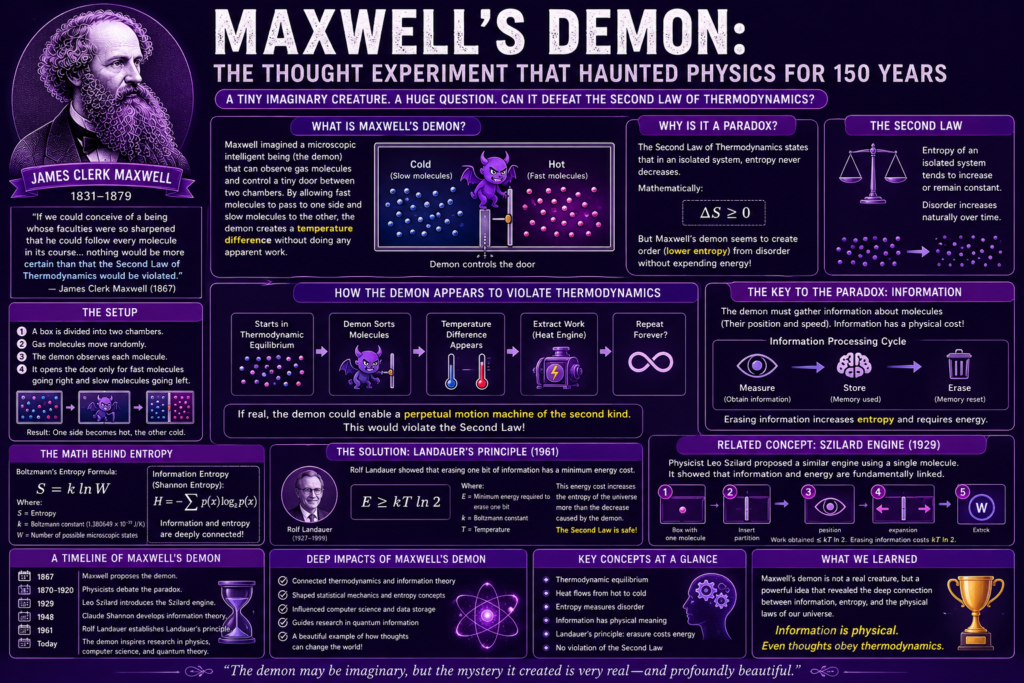
He imagined an intelligent microscopic being capable of observing individual gas molecules.
This imaginary creature became known as maxwell demon.
The demon controlled a tiny door between two gas chambers.
Its task seemed simple.
Allow fast molecules to move into one chamber.
Allow slow molecules to move into the other.
Over time:
- One side becomes hotter.
- One side becomes colder.
No external work appears necessary.
This result seemed impossible.
Understanding the Thought Experiment
The idea behind maxwell demon can be visualized easily.
Imagine a box divided into two compartments.
Each side contains gas molecules.
Initially:
Temperature Left = Temperature Right
Entropy is balanced.
The demon watches every molecule.
When a fast molecule approaches from the left:
Door opens.
When a slow molecule approaches from the right:
Door opens.
All other molecules are blocked.
Eventually:
Hot Side → Fast molecules
Cold Side → Slow molecules
A temperature difference appears spontaneously.
Why This Seemed Impossible
The Second Law of Thermodynamics predicts that systems naturally move toward thermodynamic equilibrium.
Heat normally flows from hot regions toward cold regions.
The demon appeared to reverse this process.
Without expending energy, it seemed capable of decreasing entropy.
This created a potential second law of thermodynamics violation.
The paradox shocked physicists.
If the demon worked, one of science’s most important laws might be wrong.
Entropy and Disorder
To understand maxwell demon, we must understand entropy.
Entropy is often described as a measure of disorder.
Boltzmann’s famous entropy equation is:
S = k ln W
Where:
- S = Entropy
- k = Boltzmann constant
- W = Number of possible microscopic states
Higher entropy means greater disorder.
Lower entropy means greater order.
The demon appeared capable of creating order from randomness.
This directly challenged conventional thermodynamics.
The Connection to Statistical Mechanics
The paradox of maxwell demon emerged partly because thermodynamics is statistical.
The laws of thermodynamics describe large collections of particles.
They do not track individual molecules.
This idea originated from the maxwell boltzmann distribution and later developments in statistical mechanics.
Maxwell realized that entropy is not an absolute law.
Instead, it arises from probability.
This insight made the thought experiment even more intriguing.
Kinetic Theory of Gases and Maxwell’s Demon
The behavior of maxwell demon depends heavily on the kinetic theory of gases.
According to kinetic theory:
- Molecules move randomly.
- Molecules possess different speeds.
- Collisions constantly occur.
The demon exploits this randomness.
By selectively sorting molecules, it creates order from molecular chaos.
The challenge was understanding whether such sorting was physically possible.
A Statistical Mechanics Paradox
Many physicists viewed maxwell demon as a statistical mechanics paradox.
The Second Law of Thermodynamics does not absolutely forbid entropy decreases.
Instead, it states that entropy decreases are overwhelmingly unlikely.
The demon appears to make unlikely events happen deliberately.
This raised profound questions.
Could intelligence somehow overcome thermodynamic limitations?
Could information influence physical laws?
These questions would dominate scientific discussions for decades.
The Demon as a Molecular Gatekeeper
Scientists often describe maxwell demon as a molecular gatekeeper.
Its ability depends on three actions:
- Observe molecules.
- Measure molecular speeds.
- Open and close the gate selectively.
These operations appear harmless.
Yet together they seem capable of creating usable energy.
The consequences would be enormous.
A functioning demon could potentially create a perpetual motion machine.
The Threat of Perpetual Motion
If maxwell demon could generate temperature differences freely, then heat engines could extract work endlessly.
This would violate fundamental thermodynamic principles.
A perpetual motion machine of the second kind would become possible.
Physicists considered this unacceptable because countless experiments supported thermodynamics.
The challenge became finding exactly where the demon failed.
Early Attempts to Solve the Paradox (1870 – 1920)
For decades, scientists debated maxwell demon without reaching a consensus.
Some argued the demon required energy to operate.
Others believed measurement itself consumed work.
However, no complete solution emerged.
The paradox continued haunting physics.
Even Maxwell himself did not provide a definitive answer.
The problem remained unresolved.
Leo Szilard and the Information Revolution (1929)
A major breakthrough came from physicist Leo Szilard.
Szilard developed the famous Szilard engine.
This simplified version of maxwell demon used only one molecule.
The Szilard engine demonstrated that information plays a fundamental role in thermodynamics.
The realization was revolutionary.
Information could no longer be viewed as purely abstract.
It possessed physical significance.
Information Theory Entropy
The study of maxwell demon eventually influenced information theory entropy.
In 1948, Claude Shannon introduced information entropy:
H = − Σ p(x) log₂ p(x)
Where:
- H = Information entropy
- p(x) = Probability of an event
The similarity between Shannon’s equation and thermodynamic entropy was striking.
Scientists began recognizing deep connections between information and physics.
Landauer’s Principle (1961)
The modern solution to maxwell demon emerged through the work of Rolf Landauer.
Landauer discovered a crucial principle.
Erasure of information requires energy.
Mathematically:
E ≥ kT ln 2
Where:
- E = Minimum energy cost
- k = Boltzmann constant
- T = Temperature
This became known as Landauer’s principle.
The result transformed understanding of the demon.
Why Information Erasure Matters
The demon must continuously record molecular information.
Eventually, its memory becomes full.
To continue operating, information must be erased.
According to Landauer’s principle:
Erasure of information increases entropy.
This entropy increase exactly compensates for the entropy reduction created by molecular sorting.
The Second Law survives.
The paradox is resolved.
Maxwell Demon and Modern Computing
The study of maxwell demon profoundly influenced computer science.
Modern computers process enormous amounts of information.
Every logical operation has thermodynamic consequences.
Researchers studying low energy computing frequently reference Maxwell’s demon.
The thought experiment helped establish that information is a physical quantity.
This insight remains central to modern technology.
Connection to Quantum Physics
The influence of maxwell demon extends into quantum mechanics.
Quantum versions of the demon continue fascinating researchers.
Scientists investigate:
- Quantum measurement
- Quantum information
- Quantum thermodynamics
- Quantum computing
The original paradox remains relevant even in the twenty first century.
James Clerk Maxwell Contributions Beyond Electromagnetism
When discussing James Clerk Maxwell Contributions, most people focus on electromagnetism.
However, maxwell demon represents another remarkable contribution.
His achievements include:
- Electromagnetic theory
- Statistical mechanics
- Molecular physics
- Color vision theory
- Thermodynamic thought experiments
Few scientists have influenced such diverse areas of knowledge.
From Maxwell to Einstein
The intellectual journey from maxwell to einstein transformed modern physics.
Maxwell’s ideas influenced relativity, statistical mechanics, and information theory.
The connection between einstein hero maxwell remains one of science’s most celebrated relationships.
Even Einstein admired Maxwell’s extraordinary ability to uncover hidden truths about nature.
Why Maxwell’s Demon Still Matters
More than 150 years later, maxwell demon remains important because it teaches a profound lesson.
The paradox revealed that:
- Information has physical meaning.
- Measurement matters.
- Computation consumes energy.
- Entropy and information are deeply connected.
These insights continue shaping modern science.
The Legacy of Maxwell’s Demon
The story of maxwell demon demonstrates the power of thought experiments.
No actual demon exists.
Yet the idea transformed thermodynamics, information theory, and computing.
A simple imaginary creature forced scientists to rethink fundamental assumptions about reality.
Few thought experiments have ever had such lasting influence.
Frequently Asked Questions (FAQs)
What is Maxwell’s demon?
Maxwell’s demon is a thought experiment involving an imaginary creature that sorts fast and slow gas molecules to reduce entropy.
Why is Maxwell’s demon important?
It challenged the Second Law of Thermodynamics and helped establish connections between information and physics.
Did Maxwell’s demon violate thermodynamics?
No. Modern physics shows that information processing and memory erasure generate entropy, preserving thermodynamic laws.
What is Landauer’s principle?
Landauer’s principle states that erasing information requires energy and increases entropy.
How does Maxwell’s demon relate to computers?
The thought experiment helped scientists understand that information processing has physical and thermodynamic consequences.
Conclusion
The story of maxwell demon is one of the most fascinating intellectual adventures in scientific history. What began as a simple thought experiment evolved into a profound investigation of entropy, information, and the foundations of reality.
For more than 150 years, Maxwell’s demon challenged physicists to explain how information interacts with physical laws. The eventual solution revealed that information itself is physical, leading to breakthroughs in thermodynamics, computer science, and quantum physics.
Today, Maxwell’s demon remains a powerful reminder that even imaginary ideas can transform our understanding of the universe and inspire entirely new branches of science.