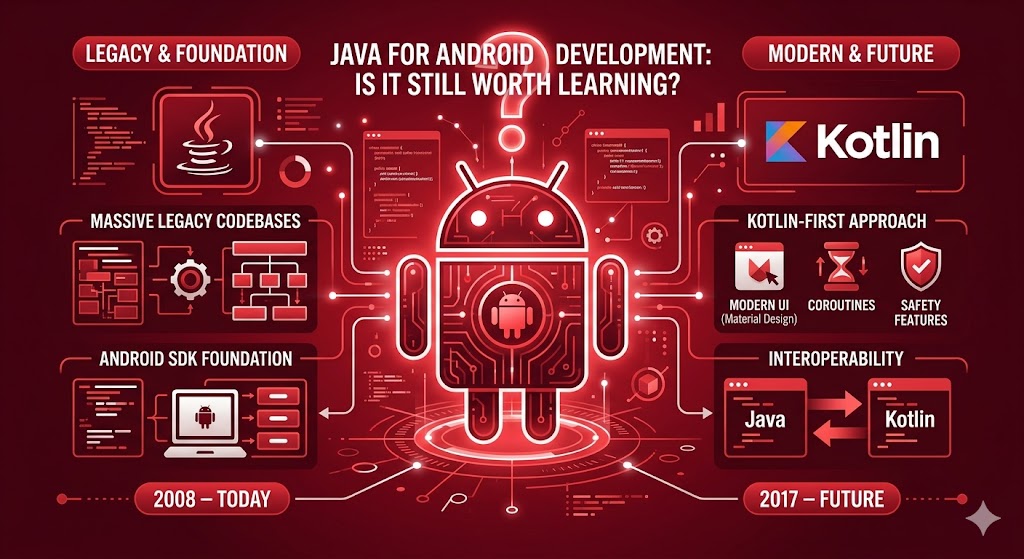
The mobile application marketplace is shifting at a breakneck pace, forcing engineers to constantly re-evaluate their technical toolsets. For over a decade, utilizing java for android development was considered the absolute industry standard for constructing native mobile applications. However, since Google declared Kotlin as a preferred alternative, a massive wave of speculation has swept through the programming community. Many engineers wonder whether dedicating time to the classic object-oriented titan remains a strategic career choice or if it has morphed into an outdated path.
This comprehensive guide breaks down the structural, economic, and practical realities of learning mobile engineering systems today. Understanding these distinct realities is essential for anyone plotting a career in mobile application engineering, as the choices you make today will ripple through your relationship with the future of software engineering.
The Historical Dominance of Java on Mobile Platforms (2008 – 2017)
When Google first unveiled the Android operating system to the world in 2008, it needed a highly mature, reliable, and globally adopted language to attract software developers. The choice landed squarely on Java. By relying on a custom virtual machine architecture, Google enabled mobile apps to run securely across a massive array of fragmented physical smartphones, regardless of variations in local underlying hardware microchips. This approach allowed developers to write application code once and count on predictable performance across competing consumer mobile devices.
During this foundational era, the Android SDK toolkit was built entirely around Java standards. Entire generations of mobile utility programs, mobile UI programming Java modules, and complex corporate software relied completely on Java libraries. Millions of software projects populated the global application ecosystem, establishing a massive baseline of open source repositories and documentation.
For developers interested in exploring how this architectural system compared to desktop or early web networks during this formative time period, reading our historical review on java history: 1991 to today provides valuable contextual insight into its rapid rise across global platforms.
The Structural Rise of Kotlin and the Changing Mobile Landscape
In 2017, the Android engineering ecosystem experienced a major shift when Google officially announced first class support for Kotlin. Two years later, the tech giant officially transitioned to a Kotlin-first approach for mobile engineering. This strategic evolution was designed to address structural pain points inherent to early Java setups, such as the notorious NullPointerException, heavy syntax boilerplate, and asynchronous thread blocks.
Kotlin introduced absolute null safety protections directly into its compiler type engine, which dramatically reduced random runtime crashes in production environments. It also provided full runtime API compatibility with existing Java files, meaning developers could mix both languages inside a singular app container without breaking the execution flow.
Despite this aggressive push toward modern mobile app patterns, Java did not disappear. Instead, it moved into a specialized, highly critical role focused on structural platform architecture, backend system communication layers, and long term infrastructure management.
Kotlin vs Java for Android: Architectural Code Comparison
To see the practical syntax differences between Kotlin vs Java for Android, let us look at a standard production requirement: creating a data object that holds user profile information, updates fields, and logs a completion message. For a solid grasp of basic programming layout before jumping into mobile specific structures, consider exploring our comprehensive java syntax & data types guide.
The Classic Java Mobile Pattern
The traditional Java approach requires explicit declaration of fields, constructor parameters, accessor methods, and string formatting variables, which creates a highly structured but verbose file.
Java
package com.techhistorylab.userprofile;

// Traditional java for android development structure
public class MobileUser {
    private String username;
    private int accountLevel;

    public MobileUser(String username, int accountLevel) {
        this.username = username;
        this.accountLevel = accountLevel;
    }

    public String getUsername() { return username; }
    public void setUsername(String username) { this.username = username; }

    public int getAccountLevel() { return accountLevel; }
    public void setAccountLevel(int level) { this.accountLevel = level; }

    public void logUserProfile() {
        // Utilizing clear logging structures
        System.out.println("Active Mobile User Account: " + username + " | Level: " + accountLevel);
    }
}
The Modern Kotlin Pattern
Kotlin streamlines this process by using data class definitions to generate getters, setters, and constructors automatically behind the scenes.
Kotlin
package com.techhistorylab.userprofile

// Modern concise mobile structure featuring built-in null-safety
data class MobileUser(var username: String, var accountLevel: Int) {
    fun logUserProfile() {
        println("Active Mobile User Account: $username | Level: $accountLevel")
    }
}
While Kotlin reduces total physical source code lines, the fundamental object layout rules remain identical. A developer who understands standard java oop concepts explained paradigms can easily read, modify, and master Kotlin syntax inside an Android Studio environment within days.
The Massive Reality of Legacy Android Apps Codebase Realities
A major reason why java for android development remains a highly vital skill in 2026 is the sheer volume of legacy Android apps codebase architectures powering major global enterprises. Multinational banks, e-commerce giants, and massive healthcare platforms built their custom mobile infrastructures during Java’s peak dominance. These production applications contain millions of lines of complex, deeply tested platform legacy source code that cannot simply be deleted or rewritten overnight.
Completely rewriting an enterprise mobile application in a newer language introduces massive financial risks, extensive debugging loops, and potential regression errors that can damage user trust. Instead, modern corporations opt for a gradual optimization strategy. They maintain their core structural data pipelines using Java while writing new customer-facing screens in Kotlin.
Consequently, engineering teams require specialists who can read, debug, and optimize older code blocks seamlessly. This ensures long term demand for developers who specialize in maintaining stable core operations.
Interacting with the Core Android SDK Toolkit and Build Tools
Even when you write mobile applications using newer programming frameworks, your software continues to rely on Google developer infrastructure components built on Java foundations. The Android SDK toolkit utilizes extensive application programming interfaces that trace back to standard Java paradigms. Furthermore, native mobile development language operations require compilation pipelines managed by heavy system engines.
The Android compilation ecosystem relies heavily on Gradle software build management environments. Gradle utilizes a Java Virtual Machine backend to compile code assets, assemble resource directories, compress image files, and generate optimized installation bundles.
+-------------------------------------------------------------------------+
|                        ANDROID COMPILATION PIPELINE                     |
|                                                                         |
|  [Java Source] ----+                                                    |
|                    |--> [Gradle Build System] --> [Optimized APK/AAB]  |
|  [Kotlin Source] --+       (JVM-Powered)                                |
+-------------------------------------------------------------------------+
Understanding how memory limits, compilation parameters, and garbage collection behaviors function within this system allows developers to build smooth apps that avoid hitting device memory constraints. If you want to see how advanced applications manage text data pipelines before sending them through build systems, take a look at our java file handling explained tutorial.
Cross-Platform Development Alternatives vs Native Mobile Engineering
When researching whether you should learn Java for mobile apps, it helps to weigh native options against modern cross-platform app alternatives. Many modern tech firms use cross-platform frameworks like Flutter or React Native to ship applications to both iOS and Android from a single shared code source.
                  +-----------------------------------+
                  |      MOBILE APP ARCHITECTURES     |
                  +-----------------------------------+
                                    |
            +-----------------------+-----------------------+
            |                                               |
            v                                               v
  [Native Engineering]                           [Cross-Platform Tools]
  - Java / Kotlin for Android                    - Flutter (Dart)
  - Objective-C / Swift for iOS                  - React Native (JavaScript)
  - Direct hardware control                      - Shared multi-platform codebase
However, cross-platform app alternatives often struggle when an application requires direct hardware control, advanced bluetooth communication, or low-level background processing. When an application needs to access complex local device sensors, maximize battery usage efficiency, or bypass heavy cross platform bridges, companies turn back to a native mobile development language.
Additionally, large scale corporations often choose to keep their mobile UI elements independent while utilizing a shared, high performance mobile app backend Java framework to process data securely across external cloud grids.
Career Realities: Should I Learn Java for Mobile Apps?
For newcomers entering the tech field, mapping out a step by step educational path requires balancing short term project goals with long term job market stability. If your goal is to build simple consumer apps quickly, focusing directly on an Android Studio Java tutorial can provide a solid foundation before you transition into modern mobile app patterns.
If you are trying to decide whether to learn Java or an alternative language, looking into data science landscapes can offer extra perspective on how programming languages scale across different industries. You can explore these trends in our guide, java vs python: which to learn.
Ultimately, mastering java for android development does not lock you into mobile app engineering forever. The core object handling principles, type interfaces, and concurrency rules you learn translate directly into enterprise backend system development, cloud microservice management, and software backward support planning across thousands of major technology companies.
The Future of Java on Android Systems
Looking closely at the future of Java on Android indicates that the language will maintain strong software backward support for many years to come. Google remains deeply committed to keeping its development ecosystem accessible to millions of enterprise engineers. This means that even as Kotlin receives new syntax additions, the underlying Android framework will maintain full runtime API compatibility with Java files.
Furthermore, Java is progressing with its own modernization cycles. Modern updates introduce cleaner record definitions, pattern matching capabilities, and virtual threads designed to improve memory allocation efficiency. As these enhancements integrate into the Google developer infrastructure, native mobile development language specialists will be well equipped to build fast, responsive mobile applications that handle concurrent processes without lagging.
To learn how applications handle concurrent tasks and background threads smoothly without locking up the user interface, read our deep dive on java multithreading explained.
Frequently Asked Questions (FAQs)
Can I build a modern Android application entirely using Java?
Yes, you can build a complete native mobile application using Java, as the Android SDK toolkit maintains full software backward support for it. However, for completely new software projects, Google recommends using Kotlin for UI layout tasks while using Java for stable core logic and backend utility configurations.
Is it difficult to switch to Kotlin if I learn Java for Android development first?
Not at all. Kotlin and Java are fully interoperable and run on the exact same virtual machine architecture. Learning Java first gives you a deep understanding of explicit typing, object orientation, and system memory limits, making Kotlin’s simplified syntax incredibly easy to pick up.
Why do large enterprise systems avoid rewriting their old Java code in Kotlin?
Rewriting a massive production application from scratch introduces a high risk of new bugs, requires extensive testing cycles, and takes developer focus away from building new features. Most corporations choose a hybrid model, keeping their core platform legacy source code intact while writing new additions in Kotlin.
Do cross-platform app alternatives completely eliminate the need for native Java knowledge?
No. Even when building apps with tools like Flutter or React Native, you will frequently need to write custom native bridges to access advanced device features, update older plugins, or configure complex build files inside the Android Studio ecosystem.
Conclusion
When evaluating java for android development in today’s tech market, it is clear that the language remains a powerful, highly relevant skill. While Kotlin has become the go-to choice for writing clean UI layers, Java remains a key structural foundation for platform SDKs, build systems, and millions of lines of enterprise production code.
Rather than choosing one language over the other, the most successful developers approach the ecosystem with a hybrid mindset. Learning Java provides a deep understanding of core programming principles, memory control, and enterprise patterns. This foundation allows you to write stable code and easily adapt to new mobile tools as the industry evolves. Invest time into mastering these fundamentals to build a resilient mobile engineering career with total confidence.