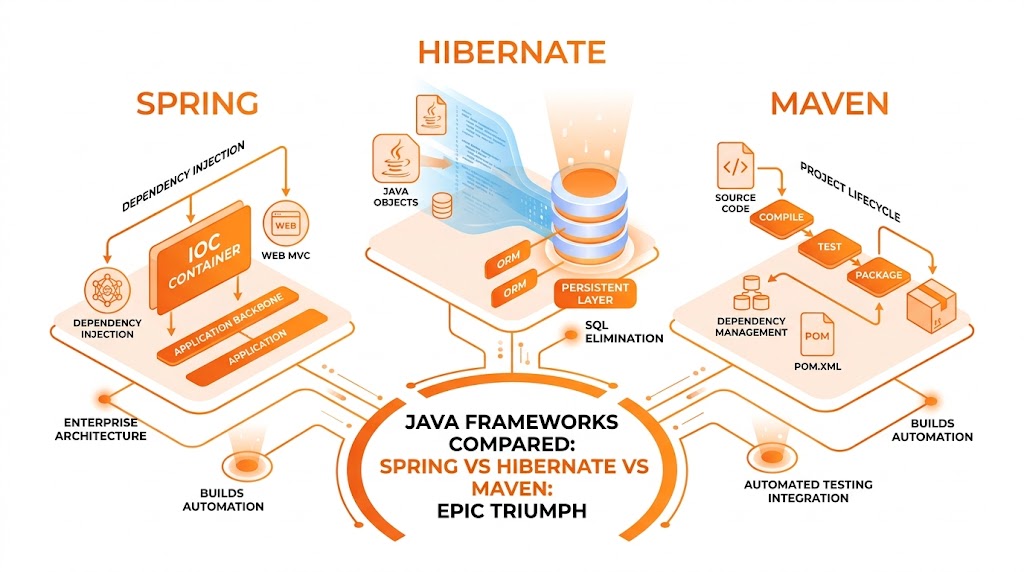
Navigating the ecosystem of enterprise software development can feel incredibly overwhelming due to the sheer volume of production tools available. When developers look across the landscape of Java backend development tools, three names consistently dominate architectural discussions: Spring, Hibernate, and Maven. However, comparing these three resources is often confusing for beginners because they serve completely different purposes in the development lifecycle. This comprehensive best java frameworks compared analysis will break down their distinct responsibilities, internal mechanics, and structural configurations to help you construct pristine, enterprise grade application architectures.
Understanding how these systems interact rather than seeing them as direct competitors is essential for your technical progression. To excel in corporate software production, engineering teams do not choose between these platforms; instead, they integrate them into a singular unified stack. Mastering this integration is crucial for anyone striving to capture the absolute highest standards in the future of software engineering.
Historical Context and Structural Evolution (2001 – 2026)
To understand the core purpose of these tools, we must look at the problematic state of early enterprise Java programming. In the early 2000s, building heavy corporate applications required Enterprise JavaBeans (EJB). The early EJB specifications were notoriously complex, requiring extensive boilerplate code, heavy configuration files, and sluggish runtime environment structures. This friction triggered an open-source revolution, leading to the creation of modular, lightweight options designed to simplify enterprise application architecture.
Maven emerged around 2004 to overhaul the chaotic world of custom project compilation and manual library tracking. Before its introduction, managing project compilation steps across different developer machines was an administrative nightmare. Shortly after, Hibernate gained massive popularity as a premier Object-Relational Mapping (ORM) solution, replacing complex SQL queries written directly into raw code paths. Simultaneously, the Spring ecosystem arrived to dismantle the rigid constraints of early application servers.
As we progress through 2026, these top Java frameworks have evolved from experimental libraries into foundational pillars of global business software, constantly adapting to support cloud native microservices and ultra fast automated testing integration.
Deconstructing the Trio: Core Architectural Purposes
Before we examine configuration code files, we must clarify what each tool actually does. A frequent error among new developers reading a best java frameworks compared article is assuming these three tools compete for the same space. In reality, they coordinate different layers of an enterprise application.
Maven: The Build Automation Foundation
Maven is not a framework for writing application logic; it is a build automation software Java developers use for project configuration management. Its job starts the moment you create your project and finishes when your application compiles into an executable file. Maven handles your dependency management guide protocols, ensuring that if your application requires a specific version of an external tool, it downloads the correct package files from remote servers automatically.
Spring: The Application Backbone
The Spring ecosystem serves as the ultimate structural framework for managing your core application layers. It is widely praised for its rich Spring framework features, which include security frameworks, transaction handling, and web routing modules. It acts as the glue holding your entire business application logic together, utilizing unique design patterns to minimize coupling between your different software components.
Hibernate: The Database Translator
Hibernate is dedicated exclusively to the persistent layer mapping of your software system. It acts as a bridge between the object-oriented code of Java and the tabular database structures of a relational database management system. Instead of writing raw database commands by hand, you use Hibernate to convert database tables directly into standard Java objects, drastically reducing data access layout complexity.
Maven Architecture and the Lifecycle Workflow
Maven simplifies compilation by introducing a unified layout template for all software projects. At the core of this system is the project object model, defined within a structured XML build scripts configuration layout. This file acts as the single source of truth for your entire build process.
The pom xml structure lists every external dependency your application requires. When you run a compilation script, Maven reviews this file, evaluates transitive dependencies, and builds an internal dependency graph to prevent library version conflicts.
+-----------------------------------------------------------------------+
|                         MAVEN BUILD LIFECYCLE                         |
|                                                                       |
|  [Validate] ----> [Compile] ----> [Test] ----> [Package] ----> [Deploy] |
+-----------------------------------------------------------------------+
Here is a standard example of a Maven configuration script establishing dependencies for both Spring and Hibernate within a unified best java frameworks compared ecosystem design:
XML
<project xmlns="http://maven.apache.org/POM/4.0.0"
         xmlns:xsi="http://www.w3.org/2001/XMLSchema-instance"
         xsi:schemaLocation="http://maven.apache.org/POM/4.0.0 http://maven.apache.org/xsd/maven-4.0.0.xsd">
    <modelVersion>4.0.0</modelVersion>

    <groupId>com.techhistorylab</groupId>
    <artifactId>framework-demo</artifactId>
    <version>1.0.0</version>

    <dependencies>
        <dependency>
            <groupId>org.springframework.boot</groupId>
            <artifactId>spring-boot-starter-web</artifactId>
            <version>3.2.4</version>
        </dependency>

        <dependency>
            <groupId>org.hibernate.orm</groupId>
            <artifactId>hibernate-core</artifactId>
            <version>6.4.4.Final</version>
        </dependency>
    </dependencies>
</project>
Beyond dependency tracking, Maven enforces structured project lifecycle phases (such as validate, compile, test, package, and deploy). Running a single command like mvn clean package tells the engine to clear previous build fragments, compile the source code, execute automated testing integration tasks, and package the final application into a deployable bundle. To understand how basic system arrays fit into these build cycles, you can reference our java arrays & collections guide.
Spring Architecture: Inversion of Control and Dependency Injection
When exploring the core capabilities of top Java frameworks, Spring stands out because of its foundational Dependency Injection (DI) mechanism. In traditional programming, if a specific service requires a database repository component, the service instantiates that repository object directly using the new keyword. This creates a tightly coupled dependency that is incredibly difficult to test or modify.
Spring solves this through a bean inversion of control configuration pattern. Instead of your custom application objects creating their own dependencies, the Spring application context instantiates, configures, and manages these objects as reusable components known as beans.
传统耦合架构:
[CustomerService] --强耦合直接创建--> [CustomerRepository]

Spring IOC 注入架构:
[Spring IOC Container (Context)]
       |------------注入 Bean-----------> [CustomerService]
       |------------注入 Bean-----------> [CustomerRepository]
When a component requires an external reference, Spring injects the dependency automatically at runtime. Let us review this cleanly written example of modern Spring framework features in action:
Java
import org.springframework.beans.factory.annotation.Autowired;
import org.springframework.stereotype.Service;

@Service
public class CustomerService {

    private final CustomerRepository customerRepository;

    // The Dependency Injection (DI) mechanism delivers the bean automatically
    @Autowired
    public CustomerService(CustomerRepository customerRepository) {
        this.customerRepository = customerRepository;
    }

    public String fetchCustomerStatus(Long id) {
        return customerRepository.findStatusById(id);
    }
}
By removing object creation logic from your business workflows, your code becomes incredibly modular. This modular architecture makes it easy for developers to swap real database connections with lightweight mock components during testing cycles, establishing Spring as a vital component within the full stack Java ecosystem. For developers just starting out with class architectures, it is helpful to review a foundational java oop concepts explained manual to master these relationships.
Hibernate Architecture: Eliminating SQL Boilerplate
Hibernate addresses a completely different challenge known as the object-relational paradigm mismatch. Java objects use inheritance, encapsulation, and strict object references, whereas relational database management tools store data in flat, disconnected tabular rows. Bridge processing without an explicit abstraction framework requires writing extensive JDBC boilerplate code to parse query results line by line.
Hibernate functions as one of the premier Java ORM solutions by completely abstracting these low level translation tasks. It maps your object oriented classes directly to database rows using explicit annotations, allowing you to execute database operations using clean, high-level object methods.
Java
import jakarta.persistence.*;

@Entity
@Table(name = "customers")
public class Customer {

    @Id
    @GeneratedValue(strategy = GenerationType.IDENTITY)
    private Long id;

    @Column(name = "account_status")
    private String accountStatus;

    // Standard constructor required for the persistent layer mapping engine
    public Customer() {}

    public Long getId() { return id; }
    public String getAccountStatus() { return accountStatus; }
    public void setAccountStatus(String status) { this.accountStatus = status; }
}
When you save a Customer object using Hibernate, the engine reads your entity mappings, generates the appropriate SQL instructions for your specific target database dialect, and manages connection tracking automatically. This eliminates the risk of SQL syntax errors while ensuring your backend database engine can switch from MySQL to PostgreSQL without rewriting your core data layers. If your app handles large log storage schemas alongside database mappings, look over our java file handling explained resource for efficient storage workflows.
Spring Boot vs Hibernate: Clearing the Integration Confusion
A common point of confusion among developers exploring this best java frameworks compared review is the exact line separating Spring Boot vs Hibernate. This confusion arises because modern Spring systems include an exceptionally popular module called Spring Data JPA.
- Hibernate provides the raw engine that implements Object-Relational Mapping (ORM) specifications, tracking persistent states and communicating directly with database drivers.
- Spring Boot acts as an all-inclusive system wrapper. It automatically configures Hibernate parameters, sets up connection pooling variables, and exposes clean repository interfaces to your application layer.
In a production environment, developers use both simultaneously. Hibernate handles the complex object translation layers, while Spring manages the lifecycle of the transaction boundaries and delivers web routing features via model view controller frameworks.
Synergizing Spring, Hibernate, and Maven in Enterprise Development
To fully appreciate why this setup represents the gold standard of contemporary development, we must look at how these three components combine into a unified, high performance ecosystem.
When an enterprise application handles a web request, Maven ensures that every required library file is compiled and present within the runtime environment. The incoming web connection hit arrives at a web layer managed by Spring’s model view controller frameworks. Spring validates the incoming payload, initiates a secure transaction boundary, and hands processing over to a custom business service bean.
This service bean then utilizes Hibernate to fetch or save database records using clean object methods, completely ignoring raw SQL generation tasks. Once the database changes complete, Spring commits the transaction, closes the resources safely, and returns a clean response to the client.
+--------------------------------------------------------------------------+
|                     ENTERPRISE APPLICATION EXECUTION FLOW                |
|                                                                          |
|  [Client Request]                                                        |
|         |                                                                |
|         v                                                                |
|  [Spring MVC Layer] --------> [Spring Service Bean] (Business Logic)     |
|                                       |                                  |
|                                       v                                  |
|                               [Hibernate ORM] (Data Mapping)             |
|                                       |                                  |
|                                       v                                  |
|                               [Relational Database]                      |
|                                                                          |
|  * Entire project lifecycle & dependency structure managed by MAVEN      |
+--------------------------------------------------------------------------+
This clean separation of concerns ensures that a failure inside a database mapping configuration does not disrupt your web layout protocols, making your codebase highly adaptable and easy to maintain over multi-year production life cycles. For teams building sophisticated cloud infrastructures, reviewing an advanced java concepts guide will ensure your unified framework stack handles high traffic scaling gracefully.
Frequently Asked Questions (FAQs)
Can I build a production enterprise Java application without using Maven?
Yes, you can use alternative build engines like Gradle, or manually download and link project JAR files inside your IDE. However, manual tracking is highly prone to errors and version mismatches, which is why Maven remains an industry standard tool for enterprise project configuration management.
Is Hibernate the only Object-Relational Mapping solution available for Java?
No, there are several alternative Java ORM solutions, such as EclipseLink or MyBatis. However, Hibernate is by far the most widely adopted framework in the industry, and it serves as the default underlying engine for Spring Data JPA implementations.
What is Maven used for if my IDE already compiles my Java code automatically?
While modern IDEs compile code locally for development testing, they rely on system configurations unique to your local machine. Maven provides a completely platform independent build process, ensuring that your software packages compile identically whether they are running on a local machine, a shared server, or an automated continuous deployment cloud pipeline.
Why do companies prefer using Spring Boot instead of core Spring?
Core Spring requires developers to write extensive XML or Java based configuration scripts to connect components. Spring Boot streamlines this process by using auto configuration logic, analyzing your project dependencies, and instantly activating sensible default configurations to help you launch applications faster.
Conclusion
When analyzing the best java frameworks compared in this guide, it is clear that Spring, Hibernate, and Maven do not compete with one another; instead, they complement each other perfectly to form a robust, modern development stack. Maven provides the build architecture and clean tracking tools required to organize your project libraries. Spring establishes the core design foundation and inversion of control patterns needed to manage your business services. Hibernate removes raw SQL complexity, bridging your object logic smoothly into relational databases.
Mastering the distinct boundary lines and interaction points between these three enterprise pillars will enable you to design clean, highly maintainable, and infinitely scalable applications that stand the test of time in any enterprise production environment. Use this integrated framework design in your next project to build reliable architecture with total confidence.