The debate about neural networks vs human brain has become one of the most fascinating topics in artificial intelligence and neuroscience. Modern AI systems can recognize images, generate text, understand speech, and solve complex problems, but many people still wonder whether machines truly think like humans.
The comparison between neural networks vs human brain is important because artificial intelligence was originally inspired by biology. Scientists tried to imitate how neurons communicate, learn, and store information inside the human brain.
Today, artificial neural networks are used in robotics, speech recognition, medicine, predictive modeling, and generative AI. However, despite incredible technological progress, the human brain remains vastly more complex and energy-efficient than modern AI systems.
The story of neural networks vs human brain combines neurophysiology, cognitive modeling, brain-inspired computing, and machine learning research. It explores how biological inspiration helped researchers create intelligent systems and why true human-level AI remains difficult to achieve.
In this article, we will deeply explore neural networks vs human brain, including their similarities, differences, strengths, weaknesses, and future possibilities.
The Human Brain: Nature’s Ultimate Computing Machine
To understand neural networks vs human brain, we must first understand the human brain itself.
The human brain contains approximately 86 billion neurons connected through trillions of synapses. These neurons communicate using electrical and chemical signals called neural impulses.
A biological neuron contains:
- Dendrites
- Axons
- Synapses
- Cell body
Dendrites receive information, while axons transmit signals to other neurons.
This incredible network enables:
- Learning
- Memory storage
- Creativity
- Emotion
- Reasoning
- Consciousness
The brain operates through synaptic plasticity, meaning neural connections strengthen or weaken through experience.
Unlike AI systems, the human brain can learn continuously from very small amounts of information.
This biological plausibility makes the brain one of the greatest mysteries in science.
How Artificial Neural Networks Work
Artificial neural networks were directly inspired by biological neurons.
The entire field of AI development began with mcculloch and pitts neural network research in 1943.
Artificial neural systems contain:
- Input layer
- Hidden layers
- Output layer
- Weighted connections
- Activation functions
These systems process information mathematically instead of chemically.
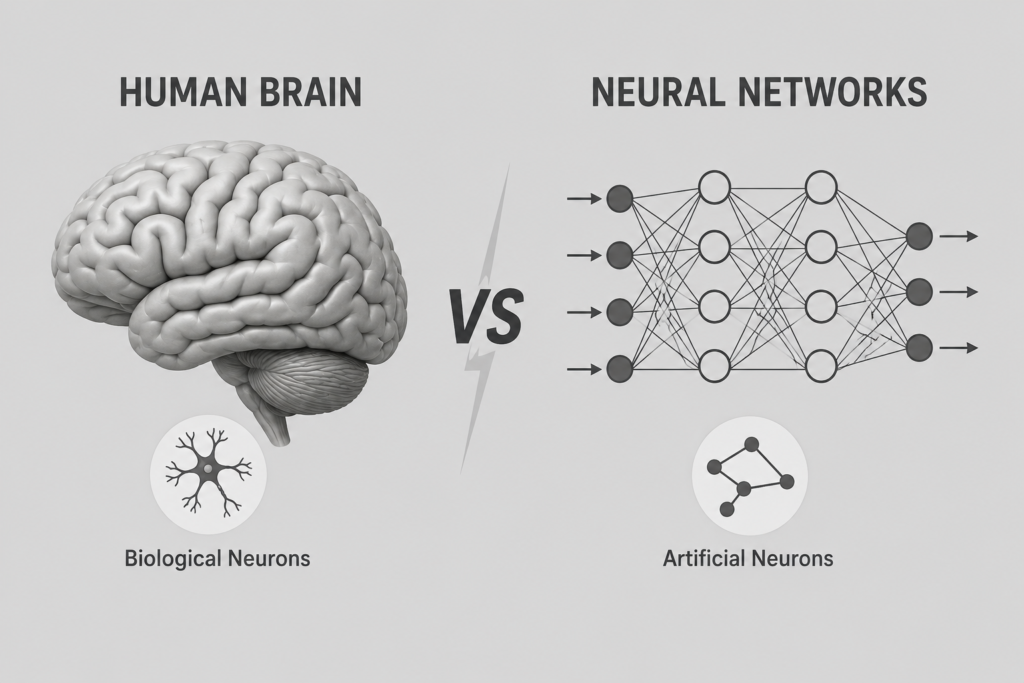
The comparison between neural networks vs human brain becomes clear when observing structural similarity between biological neurons and artificial neurons.
Artificial neurons receive inputs, multiply them by weights, and generate outputs.
A simple neural equation:
Where:
- = input signals
- = weights
- = bias
- = activation function
This simplified model imitates neural signal processing inside biological brains.
The development of artificial neurons became central to neural network history and modern AI breakthroughs.
Similarities Between Neural Networks and the Human Brain
The debate surrounding neural networks vs human brain often focuses on their similarities.
Learning Through Experience
Both biological brains and artificial networks learn through repeated exposure.
Humans strengthen neural pathways through practice, while AI systems adjust internal weights during training.
This concept was heavily influenced by the hebb learning rule.
Pattern Recognition
Both systems excel at recognizing patterns.
Humans identify faces, sounds, and language naturally. Neural networks perform similar tasks using large datasets and training algorithms.
Layered Processing
The brain processes information hierarchically through cortical regions. Neural networks use layered architectures for feature extraction and abstraction.
Adaptation
Both systems adapt over time based on feedback and experience.
The similarities between neural networks vs human brain helped researchers create modern machine learning systems.
Major Differences Between Neural Networks and the Human Brain
Despite similarities, the differences between neural networks vs human brain are enormous.
Energy Efficiency
The human brain uses roughly 20 watts of energy.
Modern AI training systems require massive hardware accelerators and enormous electricity consumption.
This difference makes neuromorphic hardware research extremely important.
Data Requirements
Humans can learn from very few examples.
AI systems often require millions of training samples.
This remains one of the biggest limitations in modern machine intelligence.
Consciousness and Emotion
Humans possess emotions, self-awareness, intuition, and consciousness.
Artificial neural networks do not truly understand meaning or emotion.
They process patterns mathematically without subjective experience.
Flexibility
The human brain can adapt to entirely new situations quickly.
AI systems remain specialized and task-specific.
These functional differences remain major barriers to human-level AI.
Biological Neurons vs Artificial Neurons
One of the biggest topics in neural networks vs human brain research involves comparing biological vs artificial neurons.
Biological Neurons
Biological neurons communicate using:
- Neurotransmitters
- Electrical impulses
- Chemical signaling
- Synaptic adaptation
They continuously reorganize themselves through synaptic plasticity.
Artificial Neurons
Artificial neurons use:
- Mathematical equations
- Weighted sums
- Activation functions
- Numerical optimization
Artificial systems lack the complexity of biological wetware.
This comparison between wetware vs software remains central in neuroscience and AI research.
The Rise of Deep Learning (2012 – 2026)
Modern deep learning dramatically accelerated the conversation around neural networks vs human brain.
Researchers developed systems capable of:
- Speech recognition
- Image generation
- Language translation
- Autonomous driving
This breakthrough connects strongly with:
Deep learning systems use multiple hidden layers to process increasingly abstract information.
The architecture was inspired partly by visual processing inside the human cortex.
Scientists like Geoffrey Hinton, Yann LeCun, and Yoshua Bengio helped lead this AI revolution.
Their work transformed computer engineering and cognitive modeling forever.
Can AI Truly Think Like Humans?
One of the most controversial questions in neural networks vs human brain research is whether AI can eventually achieve true intelligence.
Current neural systems are excellent at:
- Prediction
- Classification
- Optimization
- Language generation
However, they still struggle with:
- Common sense reasoning
- Emotional understanding
- Self-awareness
- General intelligence
Humans possess intuition and flexible learning mechanisms that AI systems still cannot fully replicate.
Many experts believe artificial general intelligence may eventually emerge, while others remain skeptical.
The future of neural networks vs human brain research depends heavily on advances in neuroscience and brain-inspired computing.
Neuromorphic Hardware and Brain-Inspired AI
Scientists are now building neuromorphic hardware designed to imitate biological neural systems more efficiently.
These systems attempt to copy:
- Synaptic communication
- Neural spikes
- Energy efficiency
- Brain-like computation
This research strongly connects with spiking neural networks development.
Neuromorphic systems may eventually bridge the gap between biological intelligence and artificial intelligence.
Researchers hope future AI systems will become more adaptive, flexible, and energy-efficient.
AI Applications Inspired by the Human Brain
The comparison between neural networks vs human brain directly influenced many modern technologies.
Speech Recognition
Speech systems imitate how humans process sound patterns.
This area relates to speech recognition neural networks.
Medical AI
Brain-inspired systems assist doctors with diagnostics and imaging.
This field connects with ai in medicine history.
Robotics
Robots increasingly use neural learning systems for movement and decision-making.
Self Driving Vehicles
Autonomous cars process visual information similarly to biological perception systems.
This technology strongly relates to self driving cars and ai innovation.
Today, even best free ai tools rely heavily on neural architectures inspired by the brain.
Will AI Ever Surpass the Human Brain?
The future of neural networks vs human brain remains uncertain.
Some researchers believe AI may eventually exceed human intelligence in many specialized tasks.
Others argue consciousness and biological cognition cannot be replicated mathematically.
The brain remains superior in:
- Creativity
- Adaptability
- Energy efficiency
- Emotional reasoning
- General understanding
However, AI continues improving at an astonishing pace.
Future breakthroughs in quantum computing, neuromorphic chips, and advanced neural systems may dramatically reshape the future of machine intelligence.
Frequently Asked Questions (FAQs)
What is the difference between neural networks and the human brain?
The human brain uses biological neurons and chemical signaling, while neural networks use mathematical computations and artificial neurons.
Why are neural networks inspired by the brain?
Scientists modeled neural networks after the structure of biological neurons to imitate learning and pattern recognition.
Can AI become conscious like humans?
Current AI systems do not possess self-awareness or true consciousness, although researchers continue exploring this possibility.
What are spiking neural networks?
Spiking neural networks are brain-inspired AI systems that imitate biological neural impulses more realistically.
Why is the human brain more efficient than AI?
The brain uses very little energy while performing extremely complex tasks, unlike modern AI systems requiring massive computing power.
Conclusion
The comparison between neural networks vs human brain reveals both the incredible progress of artificial intelligence and the extraordinary complexity of biological intelligence. Artificial neural systems successfully imitate some aspects of learning, pattern recognition, and information processing, but they still remain far simpler than the human brain.
Researchers continue exploring cognitive modeling, neurophysiology, and brain-inspired computing to create more advanced machine intelligence systems. From speech recognition and robotics to generative AI and medical imaging, neural networks already influence nearly every modern industry.
As technology evolves beyond 2026, the relationship between artificial intelligence and human cognition may become even more important. Whether AI eventually reaches human-level intelligence or remains a powerful tool inspired by biology, the study of neural networks vs human brain will continue shaping the future of science and technology.