The question who invented neural networks has fascinated computer scientists, historians, and AI researchers for decades. Neural networks are now at the center of modern artificial intelligence, powering chatbots, image generators, recommendation systems, robotics, and predictive modeling tools.
But the journey behind who invented neural networks is not the story of one person alone. It is the story of visionary scientists, mathematicians, engineers, and pioneers of connectionism who spent decades building the foundations of machine intelligence.
From early theories about artificial neurons in the 1940s to the Deep Learning revolution in the 2010s, the history of neural networks reflects scientific leadership, academic collaboration, and groundbreaking peer-reviewed research.
Today, neural systems shape industries around the world. Modern AI technologies rely heavily on the discoveries made by the scientists behind who invented neural networks and their revolutionary ideas.
In this article, we will explore the complete story of who invented neural networks, the researchers who transformed AI forever, and the breakthroughs that changed the world.
The Earliest Ideas Before Neural Networks (1930 – 1943)
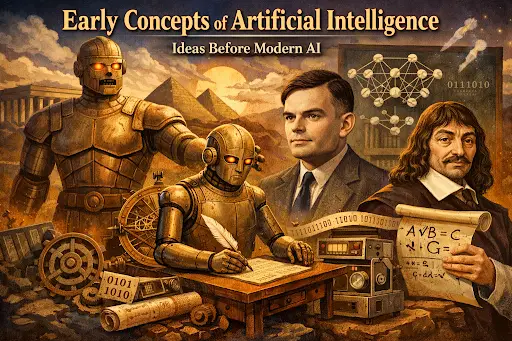
Before understanding who invented neural networks, it is important to understand the scientific environment of the early twentieth century.
Researchers were exploring:
- Brain function
- Logical reasoning
- Mathematical computation
- Biological neurons
- Machine intelligence
Scientists wanted to discover whether machines could imitate human thought processes.
This period strongly influenced computer science history and interdisciplinary science research.
One of the most influential thinkers was Alan Turing. Turing proposed that machines could eventually simulate human intelligence through computational systems.
His work later became central to the broader history of ai and machine learning development.
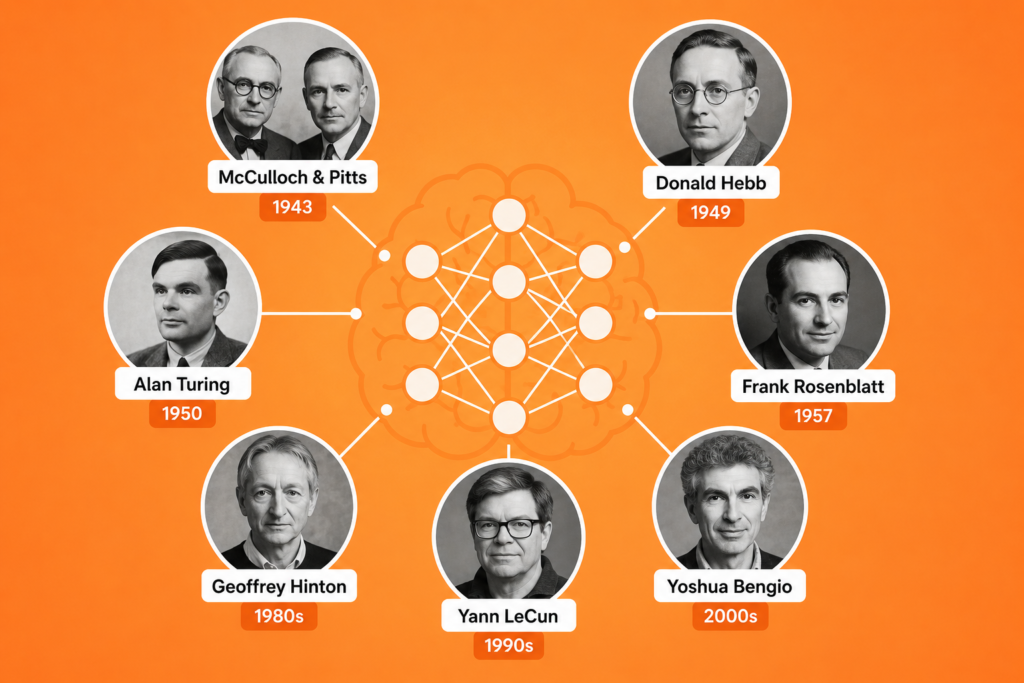
Warren McCulloch and Walter Pitts (1943)
The real breakthrough in who invented neural networks happened in 1943.
Warren McCulloch and Walter Pitts introduced the first mathematical model of artificial neurons.
Their system became known as the McCulloch-Pitts neuron.
The model simulated simple brain-like computation using binary logic.
Their research introduced:
- Artificial neurons
- Logical activation
- Input-output systems
- Computational reasoning
The McCulloch-Pitts model became the foundation of modern neural architecture and connectionism.
This breakthrough is strongly linked to mcculloch and pitts neural network research and the entire future of artificial intelligence.
For many historians, McCulloch and Pitts are the strongest answer to the question who invented neural networks.
Their work proved that machines could theoretically process information similarly to biological brains.
Donald Hebb and Learning Theory (1949)
Another critical figure in who invented neural networks history was Donald Hebb.
In 1949, Hebb introduced a revolutionary learning principle:
“Neurons that fire together wire together.”
This became the foundation of the hebb learning rule.
Hebbian learning explained how neural connections strengthen through repeated activation.
The theory influenced:
- Learning algorithms
- Synaptic adaptation
- Neural optimization
- Pattern recognition
Hebb’s research became one of the most influential contributions to neural learning systems.
Without Hebbian learning, the future of machine learning and deep learning architecture would have developed much more slowly.
Frank Rosenblatt and the Perceptron Era (1957 – 1969)
The next giant breakthrough in who invented neural networks came from Frank Rosenblatt.
In 1957, Rosenblatt created the Perceptron, one of the first trainable machine learning systems.
The Perceptron could learn patterns from examples using adjustable weights.
The mathematical formula:
This invention became a major milestone in the broader neural network history.
Rosenblatt’s work generated enormous excitement in the scientific community.
Many researchers believed intelligent machines might soon become reality.
This era strongly connects to:
Rosenblatt became one of the most important pioneers of deep learning and neural computation.
Marvin Minsky and the AI Criticism Era (1969 – 1980)
The story of who invented neural networks also includes setbacks and controversies.
Marvin Minsky and Seymour Papert criticized perceptrons in their famous book Perceptrons.
They demonstrated that single-layer perceptrons could not solve certain logical problems.
This criticism contributed to the first AI winter, a period when AI funding and research slowed dramatically.
Although controversial, Minsky’s work pushed scientists toward more advanced neural architectures.
The debate between symbolic AI and connectionism became one of the most important intellectual battles in computer engineering and AI history.
Geoffrey Hinton and the Deep Learning Revival (1980 – 2012)
One of the most important answers to who invented neural networks in the modern era is Geoffrey Hinton.
Hinton became one of the biggest pioneers of connectionism and deep learning.
During the 1980s, Hinton helped revive neural network research through backpropagation and multi-layer neural systems.
Backpropagation allowed networks to adjust internal weights efficiently during training.
The formula:
This breakthrough changed artificial intelligence forever.
Hinton’s research became central to:
- Deep learning architecture
- Speech recognition
- Image recognition
- Generative AI systems
This era strongly relates to:
Hinton later received global recognition as one of the Godfathers of Deep Learning.
His institutional research and scientific leadership transformed modern AI.
Yann LeCun and Convolutional Neural Networks
Another major figure in who invented neural networks history is Yann LeCun.
LeCun developed convolutional neural networks (CNNs), systems designed for image processing and computer vision.
CNNs introduced:
- Feature extraction
- Shared weights
- Pooling layers
- Visual pattern recognition
LeNet became one of the first successful CNN systems.
LeCun’s work transformed:
- Facial recognition
- Medical imaging
- Autonomous driving
- Computer vision
This period is closely linked with:
LeCun became one of the most respected neural network architects in AI research.
Yoshua Bengio and Modern Deep Learning
Yoshua Bengio also played a critical role in answering who invented neural networks.
Bengio contributed heavily to:
- Language modeling
- Representation learning
- Generative systems
- Neural optimization
His research helped modern AI systems process language more naturally.
Alongside Geoffrey Hinton and Yann LeCun, Bengio became one of the famous Godfathers of Deep Learning.
Their collaborative influence shaped the Deep Learning era and modern machine intelligence.
The Rise of Transformers and Generative AI (2017 – 2026)
The story of who invented neural networks continues evolving today.
In 2017, researchers at Google introduced transformer neural networks through the paper “Attention Is All You Need.”
Transformers revolutionized AI through self-attention mechanisms.
Modern generative AI systems now power:
- AI chatbots
- Language generation
- Coding assistants
- Image generation
- Speech systems
This new era strongly connects to:
Companies such as OpenAI and Google DeepMind continue accelerating neural innovation.
Today, even best free ai tools rely heavily on neural network systems created through decades of scientific discovery.
The question who invented neural networks now includes entire generations of innovative researchers and Nobel-level scientific contributions.
Why Neural Network Inventors Changed the World
The pioneers behind who invented neural networks completely transformed human civilization.
Their work enabled:
- Machine learning
- Medical AI
- Speech recognition
- Self-driving vehicles
- Robotics
- Scientific prediction
- Generative AI
Neural systems now influence almost every modern industry.
The legacy of AI founders continues shaping the future of technology.
These researchers combined neuroscience, mathematics, psychology, and computer engineering into one revolutionary scientific movement.
Their discoveries became some of the greatest AI milestones in human history.
Frequently Asked Questions (FAQs)
Who invented neural networks first?
Warren McCulloch and Walter Pitts introduced one of the first artificial neuron models in 1943.
Why is Frank Rosenblatt important?
Frank Rosenblatt invented the Perceptron, one of the earliest trainable neural network systems.
Who are the Godfathers of Deep Learning?
Geoffrey Hinton, Yann LeCun, and Yoshua Bengio are widely called the Godfathers of Deep Learning.
Why are neural networks important today?
Neural networks power AI systems used in healthcare, robotics, finance, language processing, and image recognition.
What is the difference between early neural networks and modern AI?
Early neural networks were simple mathematical models, while modern systems contain billions of parameters capable of advanced learning and reasoning.
Conclusion
The story of who invented neural networks is one of the greatest scientific journeys in modern history. From McCulloch and Pitts in 1943 to the Deep Learning pioneers of today, neural network research has transformed how machines process information and learn from data.
Scientists like Donald Hebb, Frank Rosenblatt, Geoffrey Hinton, Yann LeCun, and Yoshua Bengio built the foundations of modern artificial intelligence through decades of peer-reviewed research, institutional collaboration, and scientific innovation.
Their discoveries changed computer science, robotics, healthcare, language processing, and generative AI forever. As artificial intelligence continues advancing beyond 2026, the legacy of the inventors behind neural networks will remain one of the most important achievements in technological history.