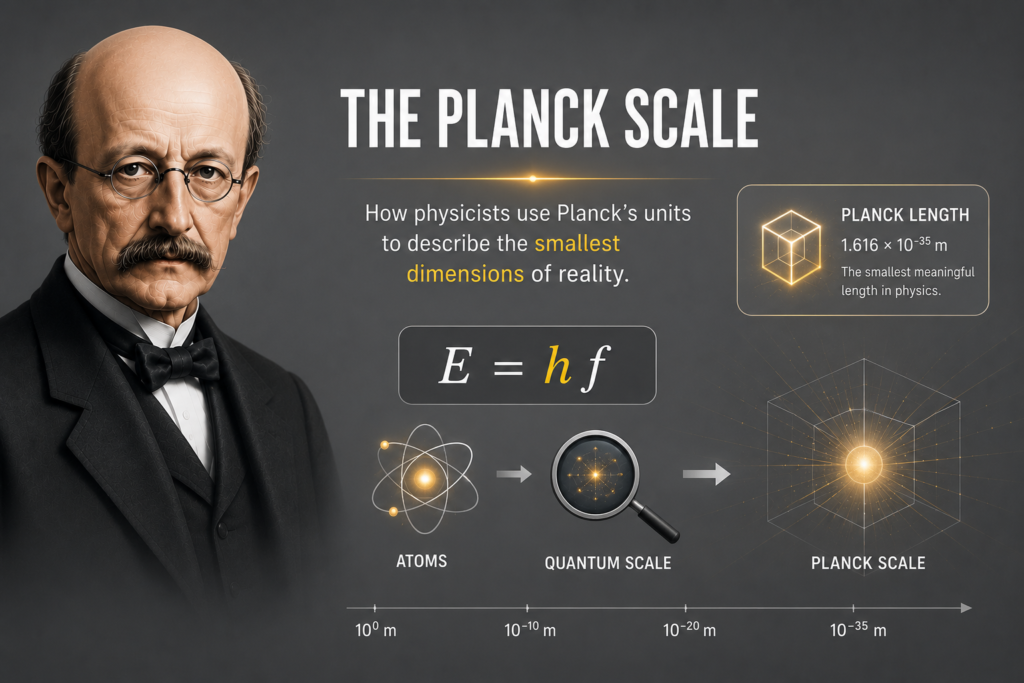
There exists a boundary in physics so small, so extreme, that our current understanding of the universe simply stops working. Physicists call this boundary the planck scale, a set of natural units marking the smallest meaningful dimensions of space, time, and energy that our theories can currently describe. Beyond this threshold, the very fabric of reality becomes something physicists can only theorize about, since our best tools, general relativity and quantum mechanics, break down entirely.
Understanding the planck scale means confronting the very edge of scientific knowledge itself, a place where quantum gravity remains unsolved and where some of the deepest mysteries in physics still await answers.
What Is the Planck Scale?
The planck scale refers to a natural units system derived entirely from three fundamental physical constants, first identified by Max Planck himself in 1899, even before his famous quantum hypothesis the following year. These constants include planck’s constant, the speed of light, and the gravitational constant G.
By combining these three fundamental values in specific mathematical ways, physicists can derive natural, universal units of length, time, and mass that do not depend on arbitrary human conventions like meters or seconds. This planck scale system provides physicists with a truly fundamental way of measuring the universe, based purely on nature’s own constants rather than historical or cultural measurement standards.
The Planck Length: The Smallest Possible Distance
The most famous unit within the planck scale is the planck length, representing the smallest meaningful unit of distance in physics. It is calculated using the formula:
l_P = √(ħG / c³)
Here, ħ (h-bar) represents the reduced planck’s constant, G is the gravitational constant, and c is the speed of light. When calculated, this planck length size equals approximately 1.6 × 10⁻³⁵ meters, an almost incomprehensibly small distance, far smaller than anything directly observable using current or foreseeable experimental technology.
To put this in perspective, if an atom were scaled up to the size of the observable universe, the planck length would still be smaller than a single grain of sand within that unimaginably vast atom. This staggering scale illustrates just how deeply theoretical the planck scale truly is.
Planck Time: The Smallest Meaningful Duration
Closely related to planck length is planck time definition, representing the smallest meaningful interval of time physicists can currently theorize about. It is calculated using the formula:
t_P = l_P / c
This calculation yields an incredibly brief duration, approximately 5.4 × 10⁻⁴⁴ seconds. Many physicists believe that below this threshold, the very concept of time itself may lose meaning entirely, since our current physical theories provide no reliable framework for describing anything happening at intervals shorter than planck time.
This concept becomes especially significant when physicists discuss the big bang singularity, the theoretical starting point of our universe. Many cosmologists believe that during the earliest planck time interval following the Big Bang, the known laws of physics simply did not yet apply in any way we currently understand.
Planck Mass: Bridging Gravity and Quantum Mechanics
The third key component of the planck scale is planck mass cosmology, representing the mass at which quantum effects and gravitational effects become equally significant. Calculated using the formula:
m_P = √(ħc / G)
This value works out to approximately 2.18 × 10⁻⁸ kilograms, an amount that, while tiny by everyday standards, represents an enormous mass when concentrated within a space as small as the planck length. At this specific combination of mass and distance, both quantum mechanics and general relativity theoretically become equally important, precisely the extreme condition where physicists expect our current theories to break down entirely.
Why the Planck Scale Marks the Limits of Physics
The fundamental importance of the planck scale lies in what it represents: the theoretical boundary where our two most successful physical theories, quantum mechanics and general relativity, come into direct conflict. This general relativity conflict emerges because gravity, as described by Einstein’s equations, assumes smooth, continuous spacetime, while quantum mechanics, rooted in Planck’s original insight into birth of quantum mechanics, assumes discrete, quantized behavior at small scales.
At the extreme conditions defined by the planck scale, these two frameworks produce contradictory, nonsensical predictions when applied together. This unresolved conflict represents one of the greatest unsolved problems in modern high energy physics, motivating decades of research into potential solutions.
Quantum Gravity: Searching for a Unified Theory
Resolving the contradictions that emerge at the planck scale requires a theory of quantum gravity, a unified framework capable of describing gravity using the same quantum principles that successfully explain electromagnetic, weak, and strong nuclear forces. Unfortunately, despite decades of dedicated research, physicists have not yet developed a complete, experimentally verified theory of quantum gravity.
Several theoretical approaches have been proposed, including string theory, which suggests that fundamental particles are actually tiny vibrating strings existing at scales close to the planck length. While mathematically elegant, string theory remains extremely difficult to test experimentally, given that the planck scale lies far beyond what any current or foreseeable particle accelerator technology could directly probe.
The Planck Scale and Cosmology
The planck scale also plays a crucial theoretical role in cosmology, particularly regarding the earliest moments following the Big Bang. Physicists believe that during the initial planck time interval, the universe existed in a state so extreme that concepts like space, time, and even the cosmological constant may have behaved in ways completely alien to our current understanding.
Some researchers even suggest that quantum fluctuations occurring at the planck scale during this earliest cosmic period may have seeded the large scale structure we now observe throughout the universe, connecting this seemingly abstract theoretical concept directly to the actual formation of galaxies, stars, and ultimately life itself.
Why We May Never Directly Observe the Planck Scale
Given the almost unimaginably small planck length size and correspondingly brief planck time definition, many physicists believe that directly observing phenomena at the planck scale may remain permanently beyond human technological capability. Even the most powerful particle accelerators currently available, or realistically foreseeable, operate at energy scales vastly lower than what would be required to probe planck scale physics directly.
This limitation has not stopped theoretical physicists from continuing to explore the planck scale mathematically, since even indirect theoretical insights into this extreme regime could potentially help resolve the persistent conflict between quantum mechanics and general relativity.
The Legacy: Max Planck Quantum Universe
The concept of the planck scale represents perhaps the most extreme theoretical extension of what has become known as the Max Planck Quantum Universe, a reality where discrete, quantized principles first introduced through wave-particle duality and Planck’s original quantum hypothesis now extend all the way down to the very fabric of space and time itself. Planck’s legacy in modern physics continues shaping this ongoing search for a unified theory capable of finally resolving one of science’s most persistent and profound mysteries.
Frequently Asked Questions
What is the planck scale in simple terms?
The planck scale refers to the smallest meaningful units of length, time, and mass in physics, derived from fundamental constants including planck’s constant, the speed of light, and the gravitational constant.
How small is the planck length?
The planck length is approximately 1.6 × 10⁻³⁵ meters, an almost incomprehensibly small distance far beyond what any current technology can directly measure or observe.
Why does physics break down at the planck scale?
At the planck scale, quantum mechanics and general relativity produce contradictory predictions, since gravity assumes smooth spacetime while quantum theory assumes discrete, quantized behavior.
What is quantum gravity and how does it relate to the planck scale?
Quantum gravity refers to a theoretical framework attempting to unify gravity with quantum mechanics, a solution physicists believe would resolve the conflicts that emerge specifically at the planck scale.
Can scientists directly observe the planck scale?
Currently, no. The planck scale lies far beyond the capabilities of any existing or realistically foreseeable particle accelerator technology, making direct observation essentially impossible with current methods.
Conclusion
The planck scale represents one of the most fascinating and humbling boundaries in all of physics, a threshold where our best scientific theories simply stop providing reliable answers. From the almost unimaginably small planck length to the fleeting brevity of planck time, this natural units system continues challenging physicists to develop a unified theory capable of describing quantum gravity successfully. More than a century after Max Planck first identified these fundamental units, the planck scale remains a powerful reminder that even our most successful scientific theories have limits, and that the smallest dimensions of reality still hold some of the universe’s deepest unsolved mysteries.