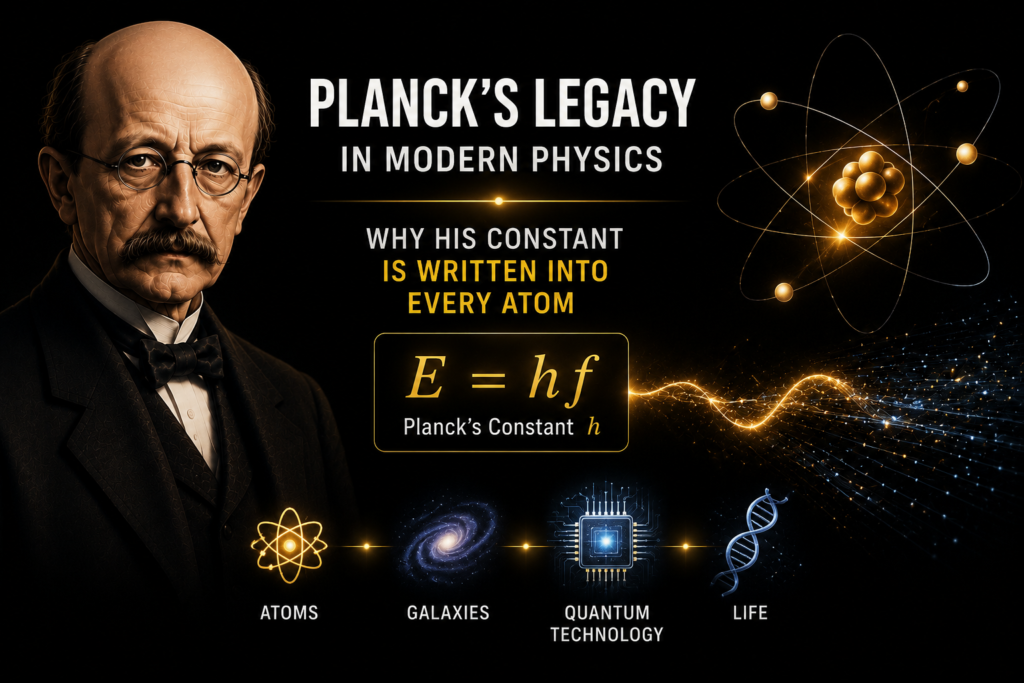
More than a century has passed since Max Planck first proposed his radical idea about discrete energy packets, yet planck’s legacy in modern physics remains as relevant today as it was in 1900. His constant is not simply a historical artifact confined to textbooks. It is quite literally written into the structure of every atom, every chemical bond, and every particle interaction that physicists study today.
Understanding planck’s legacy in modern physics means recognizing just how deeply one nineteenth century breakthrough continues shaping our understanding of reality, from the stability of atoms to the cutting edge research being conducted at facilities like the cern particle accelerator.
Where It All Began: The Quantum Hypothesis (1900)
To appreciate planck’s legacy in modern physics, you have to return to its origin. In December 1900, Planck proposed his quantum hypothesis while attempting to solve the blackbody radiation problem, suggesting that energy is exchanged only in fixed, discrete quantities rather than flowing continuously. This idea was captured in his now famous equation:
E = hν
Here, E represents energy, ν (nu) is frequency, and h is planck’s constant, approximately 6.626 × 10⁻³⁴ joule seconds. This single, small number would go on to become one of the most important fundamental constants in all of physics, appearing in equations far beyond anything Planck himself could have originally anticipated.
Why Atoms Don’t Collapse: Planck’s Constant and Atomic Stability
One of the most profound aspects of planck’s legacy in modern physics involves something we rarely think about: why atoms exist at all in stable form. Classical physics actually predicted that electrons orbiting a nucleus should continuously radiate energy and spiral inward, causing atomic collapse within a fraction of a second.
Quantum mechanics, built directly on Planck’s original insight, resolved this contradiction by showing that electrons can only occupy specific, quantized energy levels rather than any arbitrary orbit. This quantization, governed fundamentally by planck’s constant, is precisely why atomic stability exists at all, ensuring that every atom in every object throughout the universe remains structurally intact rather than collapsing instantly.
Quantum Electrodynamics: Planck’s Constant in Action
Perhaps nowhere is planck’s legacy in modern physics more precisely expressed than within quantum electrodynamics, the highly successful theory describing how light and matter interact at the quantum level. This theory, which earned its developers the Nobel Prize, relies fundamentally on planck’s constant to calculate the probability of photon emission, absorption, and interaction with charged particles like electrons.
Quantum electrodynamics has been tested with extraordinary precision, matching experimental predictions to within astonishing accuracy, a testament to just how fundamentally correct Planck’s original quantization concept truly was, even though he himself never imagined it would extend this far.
The Fine Structure Constant and Fundamental Forces
Planck’s constant also appears prominently within the fine structure constant, a dimensionless number that characterizes the strength of electromagnetic interactions between charged particles. This constant, closely related to planck’s constant, the speed of light, and the charge of the electron, plays a crucial role in determining atomic spectra and the behavior of fundamental force carriers throughout physics.
Physicists consider the fine structure constant one of the most mysterious numbers in all of science, precisely because its specific value seems to determine so much about how our universe behaves, from chemical bonding patterns to the very possibility of complex structures like stars and living organisms.
Planck’s Constant Within the Standard Model
The standard model of physics, which describes all known fundamental particles and three of the four fundamental forces, relies extensively on quantum mechanical principles rooted directly in planck’s constant. Every calculation involving particle interactions, decay rates, and force carrier behavior within this framework ultimately traces back to the same quantization principle Planck introduced over a century ago.
Researchers at facilities like the cern particle accelerator continue testing predictions derived from the standard model, searching for new particles and interactions that might extend or challenge our current understanding, yet even these cutting edge experiments remain firmly grounded in the quantum framework Planck’s original hypothesis made possible.
Quantum Chemistry: Understanding Molecular Bonds
Beyond particle physics, planck’s legacy in modern physics extends directly into quantum chemistry, the field explaining how atoms bond together to form molecules. The specific, quantized energy levels available to electrons within atoms, governed by principles Planck helped establish, determine exactly how atoms interact, share electrons, and form the chemical bonds responsible for every molecule in existence.
Without quantum theory’s explanation of discrete atomic energy levels, chemistry as a predictive science would be impossible, since classical physics alone cannot explain why atoms bond in the specific, consistent patterns observed throughout chemical reactions.
The Rydberg Constant and Atomic Spectra
Another important connection within planck’s legacy in modern physics involves the rydberg constant, a fundamental physical constant used to calculate the wavelengths of light emitted or absorbed by hydrogen atoms as electrons transition between quantized energy levels. This constant, closely tied to planck’s constant, allows physicists to predict atomic spectra with remarkable precision, providing yet another practical demonstration of how deeply quantization governs atomic behavior.
From Planck and Einstein to Modern Quantum Field Theory
The theoretical journey from Planck’s original hypothesis to modern quantum field theory basics involved crucial contributions from numerous physicists, including Albert Einstein, whose relationship with planck and einstein helped establish the reality of quantum principles through his explanation of the photoelectric effect. Quantum field theory, which combines quantum mechanics with special relativity, now serves as the mathematical foundation for describing fundamental particles and forces throughout modern physics.
This theoretical framework, built upon decades of refinement following Planck’s original insight, represents perhaps the most sophisticated expression of planck’s legacy in modern physics currently available to scientists.
Practical Technologies Built on Planck’s Foundation
Beyond pure theoretical physics, planck’s legacy in modern physics extends into countless practical technologies shaping daily life. Semiconductors, lasers, medical imaging devices, and emerging fields like planck and quantum computing all trace their theoretical foundation directly back to the same quantization principle Planck introduced over a century ago while solving an obscure radiation problem.
This remarkable practical impact demonstrates how a single theoretical insight, developed to solve one narrow scientific puzzle, can eventually reshape virtually every aspect of modern technology and scientific understanding.
Why Planck Matters More Than Ever Today
As physics continues pushing into increasingly complex territory, exploring questions about quantum gravity, dark matter, and the fundamental nature of reality itself, planck’s legacy in modern physics remains as essential as ever. Every new theoretical development within particle physics, cosmology, or quantum computing continues building upon the same fundamental quantization principle Planck first introduced in 1900.
The Legacy: Max Planck Quantum Universe
The lasting influence of planck’s legacy in modern physics finds its clearest expression within what has become known as the Max Planck Quantum Universe, a reality where discrete, quantized principles govern everything from atomic stability to fundamental particle interactions. More than a century after his original discovery, this quantum universe continues expanding as physicists uncover ever deeper layers of reality, all built upon the same foundational insight Planck reluctantly introduced.
Frequently Asked Questions
Why is Planck’s constant still important today?
Planck’s constant remains fundamental to quantum mechanics, quantum electrodynamics, and the standard model of physics, governing atomic stability and particle interactions throughout modern science.
How does Planck’s legacy relate to atomic stability?
Planck’s quantization principle explains why electrons occupy specific, discrete energy levels rather than continuously radiating energy, preventing atomic collapse and ensuring atoms remain stable.
What is quantum electrodynamics and how does it relate to Planck?
Quantum electrodynamics describes how light and matter interact at the quantum level, relying fundamentally on Planck’s constant to calculate photon behavior with extraordinary precision.
How does Planck’s work influence modern chemistry?
Planck’s quantization principles explain the discrete energy levels available to electrons within atoms, directly determining how atoms bond together to form molecules in quantum chemistry.
What modern technologies rely on Planck’s discoveries?
Semiconductors, lasers, medical imaging devices, and quantum computing all trace their theoretical foundations back to Planck’s original quantization principle introduced in 1900.
Conclusion
Planck’s legacy in modern physics extends far beyond a single historical discovery confined to nineteenth century textbooks. His constant is woven directly into the stability of every atom, the behavior of every fundamental particle, and the chemical bonds that make life itself possible. From quantum electrodynamics to the standard model, from quantum chemistry to emerging quantum computing technology, planck’s legacy in modern physics continues shaping scientific understanding well over a century after his reluctant discovery first challenged the foundations of classical physics.