Imagine discovering that no matter how fast you chase a beam of light, it always races away from you at exactly the same speed. This is not science fiction. It is one of the strangest, most thoroughly proven facts in all of physics. The speed of light is constant, an idea so counterintuitive that it took a young patent clerk to finally accept it seriously, while an entire generation of trained physicists struggled to make sense of it.
Understanding why the speed of light is constant means understanding one of the most revolutionary shifts in scientific history, a moment when Newtonian physics vs relativity finally came to a head, and classical certainty gave way to a stranger, more beautiful description of reality.
The Classical Assumption That Seemed Obvious
Before the twentieth century, physicists assumed velocities simply added together in predictable ways, a principle known as Galilean relativity. If you threw a ball forward while running, its speed relative to the ground would equal your running speed plus the ball’s thrown speed. This assumption worked perfectly for everyday objects and seemed like basic common sense.
Naturally, physicists assumed the same simple addition should apply to light as well. If light traveled through some invisible medium, later called luminiferous ether myth, then an observer moving through that medium should measure different light speeds depending on their own motion, much like sound waves behave differently depending on wind direction.
The Experiment That Broke Everything (1887)
This comfortable assumption collapsed entirely following the famous Michelson Morley experiment conducted in 1887. Using an incredibly precise instrument called an interferometer experiment, physicists Albert Michelson and Edward Morley attempted to detect variations in light speed caused by Earth’s motion through the supposed aether medium.
The experiment, despite extraordinary precision, found absolutely no variation whatsoever. Light traveled at exactly the same speed regardless of direction or Earth’s motion through space, a result that made no sense within existing classical physics breakdown. Scientists proposed various explanations, including an aether drift hypothesis suggesting the ether was somehow dragged along with Earth, but none of these patches fully resolved the underlying contradiction.
Einstein’s Radical Solution (1905)
Rather than trying to save the aether concept through increasingly complicated explanations, Einstein took a completely different approach during his celebrated miracle year of 1905. He proposed something almost audacious in its simplicity, that the speed of light is constant for every observer, regardless of their own motion or the motion of the light source itself.
This became one of two foundational postulates behind special relativity explained, alongside the principle that physical laws remain identical across all inertial reference frames. Rather than treating the Michelson Morley result as a puzzling anomaly requiring an increasingly complex fix, Einstein simply accepted light speed invariant behavior as a fundamental fact of nature.
Why This Idea Seemed So Radical
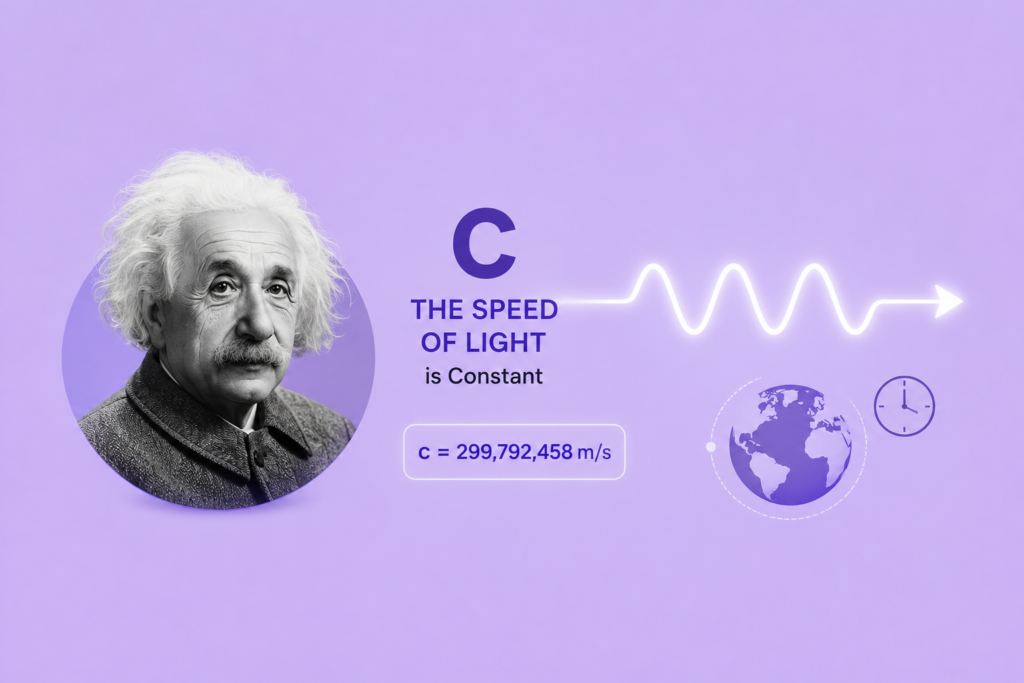
To understand just how revolutionary this was, consider the observer independence this principle demands. If you are standing still and I am moving toward you at half the speed of light while shining a flashlight, classical physics would predict that you should measure the combined speed of my motion plus the light itself. Instead, both of us measure exactly the same speed of light, precisely 299792458 meters per second, regardless of our relative motion.
This absolute speed limit represents a genuine cosmic speed limit built directly into the fabric of the universe itself, not merely a technological limitation waiting to be overcome through better engineering or faster spacecraft.
The Mathematics Behind Light Speed Constancy
Einstein’s insight required abandoning simple Galilean velocity addition entirely, replacing it with more sophisticated Lorentz transformations. These equations describe precisely how space and time measurements change between different observers, while ensuring that speed of light in a vacuum always remains constant regardless of relative motion.
One striking mathematical consequence involves time dilation explained through the equation:
t’ = t / √(1 − v²/c²)
Here, t’ represents the time interval measured by a moving observer, t represents time measured by a stationary observer, v represents relative velocity, and c represents the invariant speed of light itself. This equation only makes physical sense if we accept that light propagation speed remains fixed, forcing time and space measurements themselves to change instead.
Why the Speed of Light Cannot Be Exceeded
According to special relativity, as an object’s velocity approaches the speed of light, the energy required to accelerate it further increases dramatically, approaching infinity as velocity approaches light speed. This mathematical relationship explains why the speed of light functions as an information speed limit, ensuring that no signal, object, or causal connection speed can ever exceed this fundamental boundary.
This restriction preserves causality throughout the universe, preventing paradoxes where effects could theoretically occur before their causes, a fundamental requirement for maintaining logical consistency within physical laws.
Maxwell’s Equations and the Hidden Clue
Interestingly, the mathematical seeds explaining why the speed of light is constant had existed for decades before Einstein’s insight, hidden within Maxwell’s electromagnetic theory. James Clerk Maxwell’s equations, describing electromagnetic wave propagation, predicted a fixed universal constant c, derived directly from vacuum permittivity and vacuum permeability values, fundamental properties of empty space itself.
Maxwell’s equations suggested that electromagnetic radiation speed should remain constant regardless of the source’s motion, a conclusion physicists had largely overlooked or dismissed until Einstein recognized its full, radical implications for space and time themselves.
Connecting to Quantum Theory Through Planck
The principle that the speed of light is constant also connects historically to quantum theory through the relationship between einstein and planck. Just as Planck’s quantum hypothesis revealed that energy exists in discrete photon invariant speed packets, Einstein’s relativity revealed that these same photons in vacuum always travel at exactly the same fixed speed, regardless of the reference frame from which they are observed, uniting two of the most transformative ideas in early twentieth century physics.
Experimental Confirmation Across Decades
Since 1905, the principle that the speed of light is constant has been confirmed repeatedly through increasingly precise experiments. Modern particle accelerators consistently demonstrate that particles approaching light speed require exponentially increasing energy, never quite reaching c itself. Precise light pulse measurement techniques using modern laser technology continue confirming light speed invariance to extraordinary degrees of accuracy.
This principle also connects directly to mass-energy equivalence, expressed through Einstein’s famous E=mc² explained relationship, since the speed of light squared appears as the fundamental conversion factor linking mass and energy throughout the universe.
Why This Discovery Still Matters Today
Beyond pure theoretical physics, the recognition that the speed of light is constant underlies essential modern technologies, including GPS satellite systems, which require precise relativistic corrections to maintain accurate positioning. Understanding this principle also remains fundamental to particle physics research, astrophysics, and ongoing exploration of fundamental physics constants throughout the universe.
The broader Albert Einstein legacy surrounding this single insight demonstrates how questioning even our most basic, seemingly obvious assumptions about reality can lead to discoveries that reshape science and technology for generations to come.
Frequently Asked Questions
Why is the speed of light considered constant?
Experiments consistently show that light travels at the same speed regardless of the observer’s motion or the light source’s motion, a principle first proposed by Einstein in 1905.
What experiment first suggested the speed of light is constant?
The Michelson Morley experiment conducted in 1887 found no variation in light speed despite Earth’s motion, providing crucial evidence that eventually supported Einstein’s theory.
Can anything travel faster than the speed of light?
No, according to special relativity, the speed of light represents an absolute cosmic speed limit that no object, signal, or information can exceed.
How does the constant speed of light affect time?
Because light speed remains fixed for all observers, time itself must adjust between different reference frames, resulting in the phenomenon known as time dilation.
Why did Maxwell’s equations hint at a constant speed of light before Einstein?
Maxwell’s electromagnetic theory predicted a fixed universal constant for electromagnetic wave propagation, though its full implications for space and time were not recognized until Einstein’s work in 1905.
Conclusion
The discovery that the speed of light is constant stands as one of the most revolutionary principles in the history of science, a simple sounding idea that completely dismantled centuries of Newtonian assumptions about space, time, and motion. From the puzzling results of the Michelson Morley experiment to Einstein’s bold theoretical leap in 1905, this principle continues to shape modern physics, technology, and our fundamental understanding of the universe. More than a century later, the constancy of light speed remains one of nature’s most reliable, thoroughly tested, and genuinely astonishing truths.