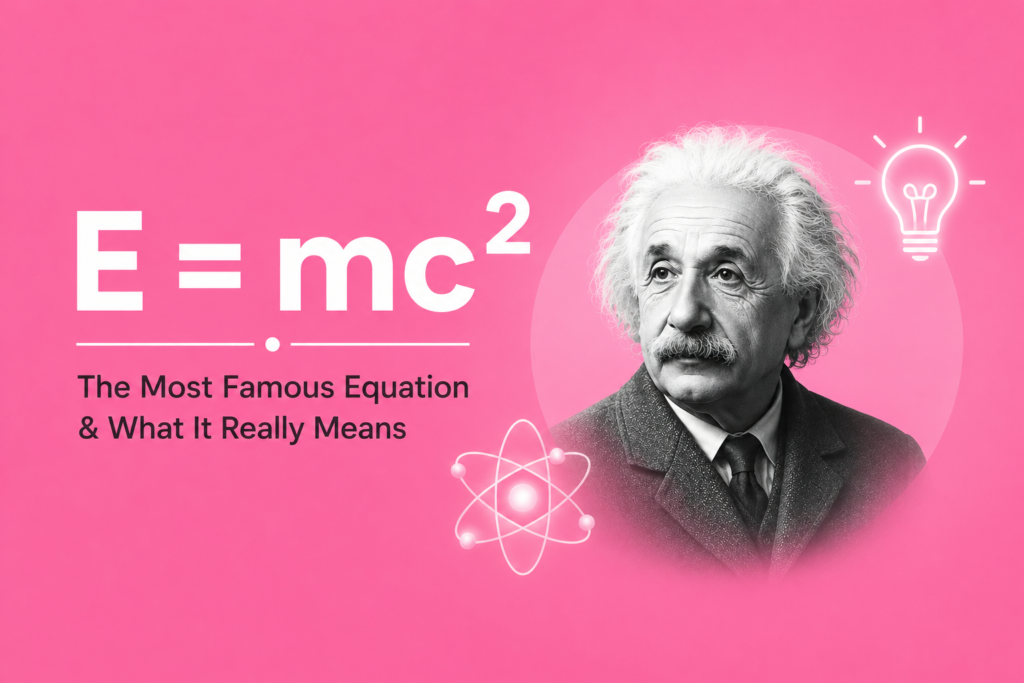
Ask almost anyone on the street to name a scientific equation, and there is a good chance they will say E equals mc squared, even if they cannot explain what it actually means. Few formulas in history have achieved this level of cultural recognition, yet E = mc² explained properly reveals something far deeper than a famous symbol on a t-shirt. It describes one of the most profound truths ever discovered about the physical universe, that mass and energy are fundamentally the same thing, expressed in different forms.
Understanding E = mc² explained clearly means going beyond the popular image and exploring exactly where this formula came from, what each symbol represents, and why it continues to power everything from stars to nuclear reactors.
Where This Famous Formula Came From (1905)
The story of E = mc² explained begins during Einstein’s remarkable miracle year of 1905, when he published several groundbreaking papers within Annalen der Physik. Alongside his introduction of special relativity explained, which redefined how physicists understood space and time, Einstein derived a striking mathematical consequence involving mass and energy.
This was not initially framed as a headline discovery. It appeared almost as a footnote within Einstein’s broader relativity work, a short follow up paper exploring the physics most famous formula that would eventually become far more recognized than the theory that produced it.
Breaking Down the Formula: What Each Symbol Means
To truly understand E = mc² explained, you need to examine each individual component. The equation itself reads:
E = mc²
Here, E represents energy, typically measured in joules. The letter m represents mass, measured in kilograms, specifically referring to rest mass energy, the energy an object possesses simply by existing, even while completely stationary. Finally, c represents the speed of light constant, approximately 299,792,458 meters per second, and in this equation it appears squared, meaning multiplied by itself.
This last detail matters enormously. Speed of light squared is an almost unimaginably large number, which explains why even a tiny amount of mass corresponds to an absolutely staggering amount of energy once converted according to this formula.
Why the Formula Reveals Something Astonishing
Before Einstein, physicists treated mass and energy as entirely separate physical properties, governed by two completely independent principles, the conservation of mass and the law of conservation of energy. E = mc² explained shattered this separation entirely, revealing instead that mass and energy exist along a single unified spectrum, capable of transforming into one another under the right physical conditions.
This mass energy equivalence means that matter itself can be understood as an incredibly concentrated form of energy, an idea that seemed almost philosophically absurd to many physicists initially, yet has since been confirmed repeatedly through direct experimental observation.
A Simple Derivation of the Formula
While Einstein’s original derivation of Emc2 involved considerably more advanced mathematics, a simplified version helps illustrate the underlying logic. Starting from special relativity’s description of relativistic mass vs rest mass, Einstein considered how an object’s total energy changes as its velocity increases.
At rest, an object still possesses inherent energy purely due to its mass, expressed simply as E = mc². As velocity increases, additional kinetic energy must be added, requiring a more complete relativistic formula. However, the famous simplified version specifically describes rest mass energy equivalent, the baseline energy contained within matter itself, independent of any motion whatsoever.
Why a Small Amount of Mass Contains Enormous Energy
Because speed of light squared is such an enormous number, roughly 9 times 10 to the sixteenth power in metric units, converting even tiny amounts of mass into energy yields staggering results. This mass to energy conversion explains why nuclear reactions, which convert only a minuscule fraction of an atom’s total mass, release such extraordinarily powerful amounts of energy compared to ordinary chemical reactions.
This principle underlies both nuclear fission mass defect processes, where heavy atomic nuclei split apart, and nuclear fusion energy processes, where light nuclei combine together, both of which power everything from nuclear reactors to the nuclear reaction occurring continuously within our own sun’s stellar core energy production.
Mass Defect and Nuclear Binding Energy
Within atomic nuclei, protons and neutrons are held together through powerful nuclear forces, and the combined mass of these bound particles is actually slightly less than the sum of their individual masses when separated. This difference, known as mass defect or mass deficiency, represents energy that was released when the nucleus originally formed, following the binding energy curve that determines nuclear stability across different elements.
This missing mass has not disappeared. It has simply been converted into energy according toE = mc² explained, released as gamma ray photon emission or other forms of energy during the nucleus’s original formation, explaining why atomic nucleus stability varies so dramatically across different elements throughout the periodic table.
Matter Into Energy: Annihilation Reactions
Perhaps the most dramatic demonstration of this formula occurs during annihilation particle physics events, where matter and antimatter particles collide and completely convert their entire mass into pure energy. When a positron electron collision occurs, for example, both particles vanish entirely, their combined mass transformed completely into energetic photons, representing a perfect, complete demonstration of E = mc² explained without any residual matter remaining afterward.
Connecting Einstein’s Work to Planck’s Quantum Theory
Interestingly, E = mc² explained also connects indirectly to quantum theory through the relationship between einstein and planck. Just as Planck’s quantum hypothesis revealed that energy exists in discrete packets, Einstein’s mass energy relationship revealed that this same energy could be derived directly from matter itself, uniting two of the most important theoretical breakthroughs of the early twentieth century within a shared conceptual framework regarding the fundamental nature of energy.
From Theory to the Atomic Age
Although Einstein derived this equation purely from theoretical relativity considerations in 1905, its practical implications became devastatingly clear decades later. Understanding around einstein and nuclear energy applications directly connects to this formula, since nuclear reactors and, more darkly, nuclear weapons both rely fundamentally on converting small amounts of nuclear mass into enormous quantities of usable or destructive energy.
This connection places E = mc² explained at the very center of some of the twentieth century’s most consequential technological and ethical developments, from peaceful energy production to the terrifying power unleashed during wartime.
Why This Equation Still Matters Today
Beyond nuclear applications, E = mc² explained continues influencing modern physics research, astrophysics, and even medical technology, including certain forms of radiation therapy that rely on understanding mass to energy conversion at the atomic level. The Albert Einstein legacy surrounding this single formula demonstrates how one theoretical insight, developed purely through mathematical reasoning, can eventually reshape energy production, warfare, medicine, and our fundamental understanding of the physical universe simultaneously.
Frequently Asked Questions
What does E equals mc squared actually mean?
E = mc² explained means that energy and mass are equivalent and interchangeable, with even small amounts of mass capable of converting into enormous quantities of energy due to the speed of light squared factor.
Why is the speed of light squared in this equation?
The speed of light squared represents an enormous conversion factor, explaining why even tiny amounts of mass correspond to extremely large amounts of energy when converted according to this formula.
How is E = mc² related to nuclear energy?
Nuclear reactors and nuclear weapons both rely on converting small amounts of atomic mass into large amounts of energy, directly demonstrating the principles behind E = mc² explained.
Did Einstein discover this formula accidentally?
No, Einstein derived this equation intentionally as a mathematical consequence of his 1905 special relativity theory, though its full practical implications became apparent only decades later.
Is E = mc² still relevant in modern physics?
Yes, this formula remains fundamental to nuclear physics, astrophysics, and particle physics, continuing to explain phenomena ranging from stellar energy production to particle annihilation.
Conclusion
E = mc² explained reveals far more than a famous symbol recognized around the world. It represents one of the most profound insights in the history of physics, that mass and energy are fundamentally interchangeable expressions of the same underlying physical reality. Born from Einstein’s theoretical reasoning during his remarkable 1905 miracle year, this simple looking equation eventually reshaped nuclear physics, energy production, and humanity’s understanding of matter itself. More than a century later, E = mc² explained continues powering both scientific research and practical technology, standing as perhaps the most consequential six characters ever written in the history of science.