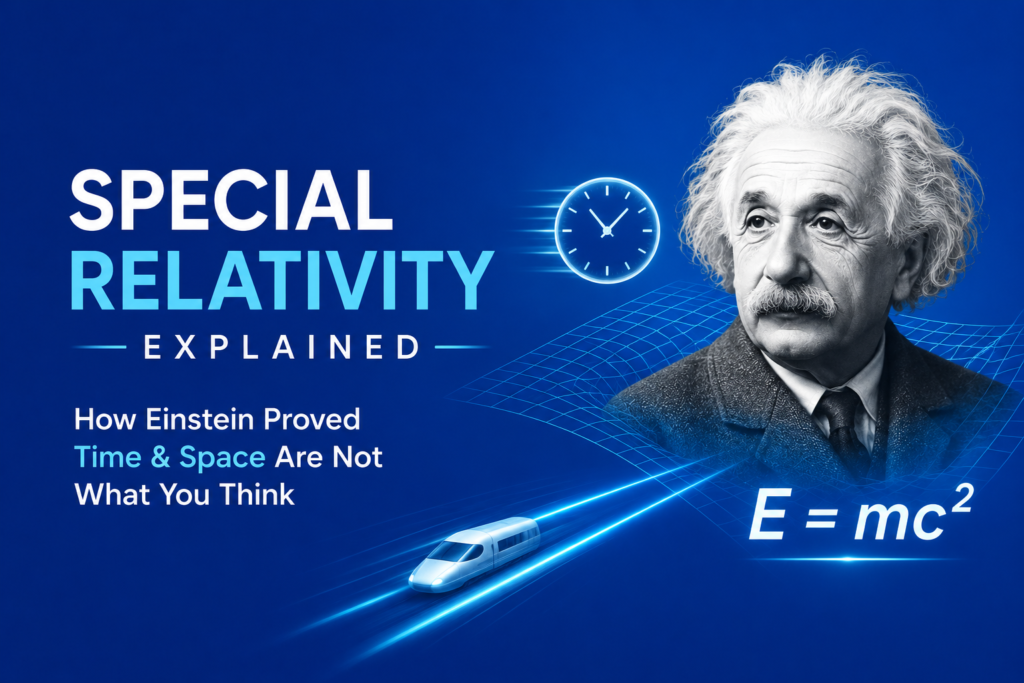
For over two hundred years, physicists assumed that time ticked forward at the same steady rate everywhere in the universe, and that space itself was a fixed, unchanging stage upon which events simply played out. Then, in 1905, a young patent clerk in Switzerland shattered that comfortable assumption entirely. Special relativity explained something almost unbelievable: time and space are not absolute at all. They bend, stretch, and shift depending entirely on how fast you are moving.
Understanding special relativity explained means confronting one of the most counterintuitive yet thoroughly confirmed ideas in the history of science, a theory that redefined space time unified as a single interconnected fabric rather than two separate, independent concepts.
The World Before Einstein: Absolute Space Myth
Before diving into special relativity explained, it helps to understand the classical worldview it replaced. Isaac Newton’s physics assumed the existence of absolute space and absolute time, fixed backdrops against which all motion could be measured objectively. This assumption, sometimes now referred to as the absolute space myth, seemed self-evidently true based on everyday human experience.
However, cracks began appearing in this classical mechanics breakdown during the late nineteenth century, particularly regarding light and electromagnetism. James Clerk Maxwell’s equations describing electromagnetic waves suggested that light travels at a fixed, unchanging speed, a conclusion that seemed to directly contradict Newtonian physics limits regarding how velocities should combine.
The Experiment That Broke Classical Physics (1887)
The most direct challenge to classical assumptions came through the famous Michelson-Morley experiment conducted in 1887. Scientists at the time believed light must travel through an invisible medium called the ether, and they expected to detect variations in light’s speed depending on Earth’s motion through this ether, sometimes described as an ether wind experiment.
Remarkably, the experiment found no such variation whatsoever. Light’s speed remained stubbornly constant regardless of direction or Earth’s motion, a result that made no sense within existing physics reference frames. This unexpected finding sat unresolved for nearly two decades until Einstein finally provided an explanation.
Einstein’s Bold Postulates (1905)
In his groundbreaking 1905 special relativity paper, published within Annalen der Physik during his celebrated miracle year, Einstein proposed two deceptively simple postulates that would resolve this lingering mystery entirely. First, the laws of physics remain identical within all inertial frames of reference, meaning non-accelerating reference frames moving at constant velocity relative to one another.
Second, and far more radical, Einstein proposed light speed constancy, stating that the speed of light remains exactly the same for every observer, regardless of their own motion or the motion of the light’s source. This second postulate directly explained the null result of the Michelson-Morley experiment, though it required abandoning centuries of assumptions about how velocities should combine.
Time Dilation: The Astonishing Consequence
From these two postulates, Einstein derived a series of genuinely astonishing consequences regarding the relativity of space and time. Perhaps the most famous is time dilation explained through the equation:
t’ = t / √(1 − v²/c²)
Here, t’ represents the time interval measured by a moving observer, t represents the time interval measured by a stationary observer, v is the relative velocity between observers, and c is speed of light constant, approximately 299,792,458 meters per second. This equation reveals that as an object’s velocity approaches the speed of light, time itself appears to slow down relative to a stationary observer, a genuine relativistic effect rather than a simple illusion or measurement error.
This concept introduces the important distinction between proper time, the time experienced by an observer within their own reference frame, and the dilated time measured by an outside observer watching that same event unfold.
Length Contraction and Proper Length
Alongside time dilation, special relativity explained also predicts that objects moving at high velocity appear contracted along their direction of motion, a phenomenon related to the concept of proper length, the length of an object as measured within its own rest frame. This length contraction, combined with time dilation, forms two sides of the same underlying relativistic mechanics governing how observers in different reference frames perceive identical physical events differently.
The Lorentz Transformations: The Mathematical Foundation
The mathematical framework underlying special relativity explained relies on what are known as Lorentz transformations, equations that describe precisely how measurements of space and time coordinates change between different inertial frames of reference. These transformations replace the simpler, but ultimately incorrect, classical assumptions about coordinate system transformation that Newtonian physics had relied upon for centuries.
Crucially, the Lorentz transformations preserve something called the invariant interval, a specific mathematical combination of space and time measurements that remains constant regardless of which inertial observer performs the calculation, providing a deeper mathematical consistency underlying the seemingly strange predictions of relativity.
Simultaneity Is Relative
One of the most philosophically challenging aspects of special relativity explained involves simultaneity relativity, the surprising discovery that two events occurring simultaneously for one observer may not appear simultaneous at all to another observer moving at a different velocity. This directly contradicts the classical, intuitive assumption that “now” means the same universal moment for everyone throughout the universe.
This concept becomes easier to visualize using Hermann Minkowski’s later mathematical framework, known as Minkowski space, which combines three dimensions of space with time into a single four dimensional spacetime continuum, allowing physicists to represent an object’s complete history as a single world line traced through this unified geometric structure.
Light Cones and Causality
Within Minkowski space, physicists use the concept of a light cone to illustrate which events can possibly influence, or be influenced by, a given point in spacetime. Events falling within what is called a timelike interval can be causally connected, while those separated by a spacelike interval cannot influence one another at all, since doing so would require exceeding the causality speed limit, the maximum subluminal speed restriction implied by relativity’s second postulate regarding invariance of c.
This framework elegantly preserves cause and effect relationships throughout the universe, ensuring that no signal or influence can travel faster than light itself.
E equals mc squared: Mass and Energy United
Perhaps the most famous consequence of special relativity explained is the equation:
E = mc²
This E=mc² explained relationship, revealing mass-energy equivalence, demonstrates that mass and energy are fundamentally interchangeable properties of matter. This discovery, building directly on einstein and planck‘s combined contributions to early quantum and relativistic physics, would later prove essential to understanding nuclear reactions and stellar energy production.
Confirming Relativity Through Experiment
Since 1905, numerous experiments have confirmed special relativity explained with extraordinary precision. Modern particle accelerators routinely observe unstable particles surviving longer than expected due to relativistic time dilation, while GPS satellite systems must continuously correct for relativistic effects to maintain accurate positioning data here on Earth, a practical, everyday demonstration of Einstein’s theoretical predictions.
Why Special Relativity Still Matters Today
The theory Einstein introduced during his 1905 special relativity paper did far more than solve an obscure experimental puzzle. It fundamentally reshaped modern physics foundation, influencing everything from nuclear energy production to the precise timing systems embedded within modern technology. The broader Albert Einstein legacy continues expanding through ongoing research building directly upon these original relativistic principles.
Frequently Asked Questions
What is special relativity explained simply?
Special relativity explains how measurements of time and space depend on relative motion between observers, based on the principle that the speed of light remains constant for everyone.
Why is the speed of light considered a universal constant?
Experiments consistently show that light travels at the same speed regardless of the observer’s motion, a foundational postulate that led Einstein to develop special relativity.
What is time dilation in simple terms?
Time dilation refers to the phenomenon where time passes more slowly for an object moving at high velocity relative to a stationary observer, a genuine effect confirmed through experiments.
How is E equals mc squared related to special relativity?
This equation emerged directly from special relativity, demonstrating that mass and energy are equivalent and interchangeable properties of matter.
Has special relativity been proven experimentally?
Yes, special relativity has been confirmed repeatedly through particle accelerator experiments and everyday technologies like GPS satellites that require relativistic corrections.
Conclusion
Special relativity explained stands as one of the most profound intellectual achievements in scientific history, a theory that shattered centuries of assumptions about the fixed, absolute nature of space and time. Born from Einstein’s careful reasoning about light and motion during his remarkable 1905 miracle year, this theory revealed a universe far stranger and more interconnected than classical physics had ever imagined. More than a century later, special relativity continues shaping our understanding of the cosmos while quietly powering the everyday technology we rely upon without a second thought.