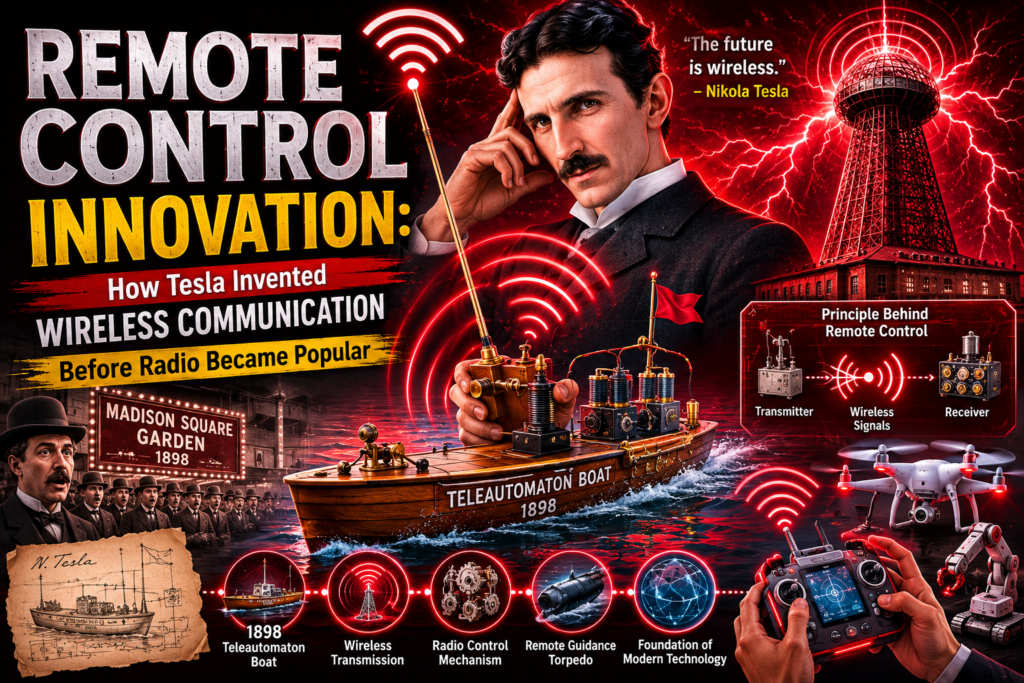
Remote control innovation is often associated with modern televisions, drones, smart devices, and automated machines. However, the foundations of this technology were established long before remote controls became a part of everyday life. More than a century ago, Nikola Tesla visionary inventor introduced a revolutionary concept that changed the future of wireless technology forever.
In 1898, Tesla publicly demonstrated a radio controlled boat that could receive commands without physical wires. At a time when many scientists were still debating the possibilities of wireless communication, Tesla showcased a practical system capable of controlling a machine from a distance. This remarkable achievement became one of the earliest examples of remote control innovation and laid the groundwork for robotics, military drones, automated vehicles, and wireless communication systems.
Today, historians recognize Tesla’s invention as a turning point in engineering history because it combined radio transmission, automation, and intelligent control into a single working system.
The World Before Remote Control Innovation (1880 – 1898)
Before remote control innovation, machines required direct human operation. Mechanical systems depended on physical contact through switches, levers, cables, or operators.
During the late nineteenth century, electrical technology was rapidly advancing. Tesla had already transformed the power industry through tesla alternating current, which enabled efficient transmission of electricity over long distances.
At the same time, researchers were exploring wireless communication, electromagnetic waves, and radio signaling. Tesla believed these technologies could be combined to control machines remotely.
His vision extended far beyond simple communication. He imagined machines capable of receiving instructions and responding automatically without direct human contact.
Tesla’s Vision of Wireless Communication
Tesla saw wireless technology as more than a method of sending messages.
He believed wireless systems could:
- Control machines
- Operate vehicles remotely
- Improve industrial automation
- Enhance military operations
- Enable intelligent mechanical systems
These ideas became central to his work in remote control innovation.
Many of his predictions later appeared in technologies associated with robotics, autonomous vehicles, and wireless networks.
The Madison Square Garden Demonstration (1898)
One of the most significant events in engineering history occurred during Tesla’s famous madison square garden demonstration in 1898.
Tesla unveiled a small boat that could be controlled remotely using wireless signals.
The invention became known as the teleautomaton boat 1898.
Spectators were amazed as Tesla operated the vessel without touching it.
The boat responded to commands such as:
- Moving forward
- Turning left
- Turning right
- Stopping
- Activating onboard mechanisms
For many observers, the demonstration seemed almost magical.
Some audience members even suspected hidden operators or supernatural forces because the concept was so far ahead of its time.
This event firmly established Tesla’s place in the history of remote control innovation.
What Was the Teleautomaton Boat?
The teleautomaton boat 1898 was a radio controlled vessel equipped with electronic and mechanical components capable of receiving wireless instructions.
The system included:
- Radio remote control transmitter
- Wireless signal receiver
- Antenna system
- Battery power source
- Mechanical relay mechanisms
- Control logic circuits
Tesla referred to this invention as a “teleautomaton,” meaning a machine controlled from a distance.
Today, historians often describe it as one of the earliest examples of wireless robotics history.
How Tesla’s Remote Control System Worked
The foundation of remote control innovation involved transmitting radio signals from a handheld control unit to a receiver inside the boat.
The basic process worked as follows:
- Tesla operated a transmitter.
- Wireless command signals were sent through radio waves.
- The boat received the signals.
- Internal mechanisms interpreted the commands.
- Motors and actuate mechanisms performed the requested actions.
This created a functional transmitter receiver link capable of controlling a machine remotely.
The principle remains similar to many modern remote control systems.
The Mathematics of Radio Wave Transmission
Radio communication depends on the relationship between frequency, wavelength, and the speed of electromagnetic waves.
The fundamental equation is:
c = fλ
Where:
- c = Speed of light (3 × 10⁸ m/s)
- f = Frequency (Hz)
- λ = Wavelength (m)
Example:
If a transmitter operates at:
f = 1,000,000 Hz
Then:
λ = c ÷ f
λ = (3 × 10⁸) ÷ (1 × 10⁶)
λ = 300 meters
This relationship remains essential in wireless communication engineering today.
Tesla understood that carefully selected operational frequency values could improve wireless performance and control accuracy.
Radio Frequency Triggers and Wireless Commands
Tesla’s invention relied on radio frequency triggers that activated specific actions inside the boat.
Each signal transmitted a unique instruction.
The receiver identified the signal and triggered a corresponding mechanical response.
This approach allowed:
- Wireless manipulation
- Remote vehicle navigation
- Secure communication channels
- Physical automation
Modern remote systems still use similar concepts, although digital electronics have dramatically increased complexity and reliability.
The Role of Coherer Technology
One of the key components in early wireless systems was coherer technology.
A coherer functioned as an early radio detector.
When radio waves reached the receiver, the coherer changed its electrical resistance, allowing a circuit to activate.
Tesla incorporated advanced receiving methods that enabled reliable signal detection and machine control.
This helped make his remote control innovation practical and effective.
Logic Gate Precursor and Control Logic
Tesla’s teleautomaton included systems that resembled early forms of decision making circuitry.
Some historians consider these mechanisms a logic gate precursor because they processed incoming signals and determined specific responses.
The boat was not merely receiving power.
It was interpreting instructions.
This distinction is important because it moved technology closer to modern automation and robotics.
The concept of control logic later became a cornerstone of computing and artificial intelligence.
Wireless Robotics History and Early Cybernetics
Many experts view Tesla’s work as a major milestone in wireless robotics history.
His invention introduced several concepts that would later become fundamental to robotics:
- Remote operation
- Signal processing
- Autonomous responses
- Electronic control systems
- Communication networks
These ideas also contributed to the development of early cybernetics, the study of communication and control in machines.
Long before modern robotics emerged, Tesla had already demonstrated many of its foundational principles.
Secure Communication Channels
Tesla recognized the importance of preventing unwanted interference.
He proposed techniques involving:
- Frequency selection
- Signal coding
- Secure modulation
- Multiple channel communication
These methods improved reliability and reduced accidental activation.
Today, secure communication channels remain essential for military systems, satellites, drones, and industrial automation.
Tesla’s understanding of wireless security was remarkably advanced for his era.
Military Applications of Remote Control Innovation
Tesla believed remote controlled systems could reduce human casualties during warfare.
He envisioned:
- Remote guidance torpedo systems
- Automated machines
- Unmanned naval vessels
- Wireless weapon platforms
Although these ideas were initially dismissed by many military leaders, they eventually became reality.
Modern military drones and autonomous defense systems trace part of their conceptual heritage to Tesla’s remote control innovation.
For this reason, some historians refer to his teleautomaton as a military drone ancestor.
Marine Engineering and Remote Navigation
Tesla’s boat represented an important achievement in marine engineering.
The vessel demonstrated that wireless signals could guide movement across water without physical connections.
This breakthrough inspired future developments involving:
- Remote vehicle navigation
- Autonomous ships
- Underwater vehicles
- Ocean monitoring systems
Today, many marine technologies continue using principles similar to those demonstrated by Tesla in 1898.
Tesla and the Development of Radio Technology
The history of radio remains closely connected to Tesla’s work.
His contributions are often discussed alongside tesla and marconi radio invention debates concerning the development of wireless communication systems.
Tesla held numerous patents covering radio technology and wireless transmission concepts before radio became widely adopted.
These innovations played an important role in supporting his remote control innovation experiments.
Patents and Intellectual Contributions
Tesla secured important patents protecting his wireless inventions.
Many of these inventions appear within collections of nikola tesla patents that continue to be studied by engineers and historians.
His patents covered:
- Radio signaling
- Wireless control systems
- Communication technology
- Automated machinery
These documents provide valuable evidence of Tesla’s pioneering work in remote operation technology.
Connection to Tesla’s Broader Research
Tesla’s achievements in remote control innovation did not occur in isolation.
His research was supported by earlier discoveries involving tesla coil explained principles and advanced wireless experiments.
He also explored topics related to tesla wireless power transmission, believing future technologies would combine communication and energy transfer into integrated systems.
These interconnected ideas demonstrate the extraordinary scope of Tesla’s vision.
Why Remote Control Innovation Was Ahead of Its Time
Several factors explain why Tesla’s invention astonished audiences.
Limited Understanding of Radio
Most people had never seen wireless communication in action.
Lack of Comparable Technology
No widely known system could remotely operate a vehicle.
Advanced Automation Concepts
The boat demonstrated intelligent behavior through mechanical and electrical systems.
Future Oriented Thinking
Tesla anticipated technologies that would not become common for decades.
As a result, remote control innovation appeared almost futuristic in the late nineteenth century.
Influence on Modern Technology
The impact of remote control innovation can be seen across countless industries today.
Examples include:
- Television remotes
- Drones
- Industrial robots
- Smart vehicles
- Military systems
- Aerospace technology
- Autonomous machines
Modern robotic autonomy owes much to Tesla’s pioneering experiments.
His concepts continue influencing engineers more than a century after their introduction.
Frequently Asked Questions
What did Tesla invent in 1898?
Tesla demonstrated the teleautomaton boat 1898, one of the first successful radio controlled machines.
Was Tesla’s boat the first remote controlled vehicle?
It is widely recognized as one of the earliest practical examples of radio remote control technology.
How did Tesla control the boat?
He transmitted wireless command signals through radio waves to a receiver inside the vessel.
Why is Tesla important to robotics?
His teleautomaton introduced concepts such as wireless control, automation, and machine responsiveness that later became essential in robotics.
Did Tesla influence modern drones?
Yes. Many historians consider his radio controlled boat a military drone ancestor and an important step toward modern unmanned systems.
Conclusion
Remote control innovation stands among Nikola Tesla’s most remarkable achievements. Through the teleautomaton boat demonstrated in Madison Square Garden in 1898, Tesla proved that machines could be controlled wirelessly long before radio communication became widespread.
His invention combined wireless communication, automation, control systems, and intelligent machine behavior into a single working platform. These concepts later evolved into robotics, drones, autonomous vehicles, and countless modern technologies.
More than a century later, Tesla’s pioneering work continues to inspire engineers, scientists, and innovators around the world. His vision of remotely controlled machines transformed technological thinking and established the foundation for many of the wireless systems that shape modern life today.