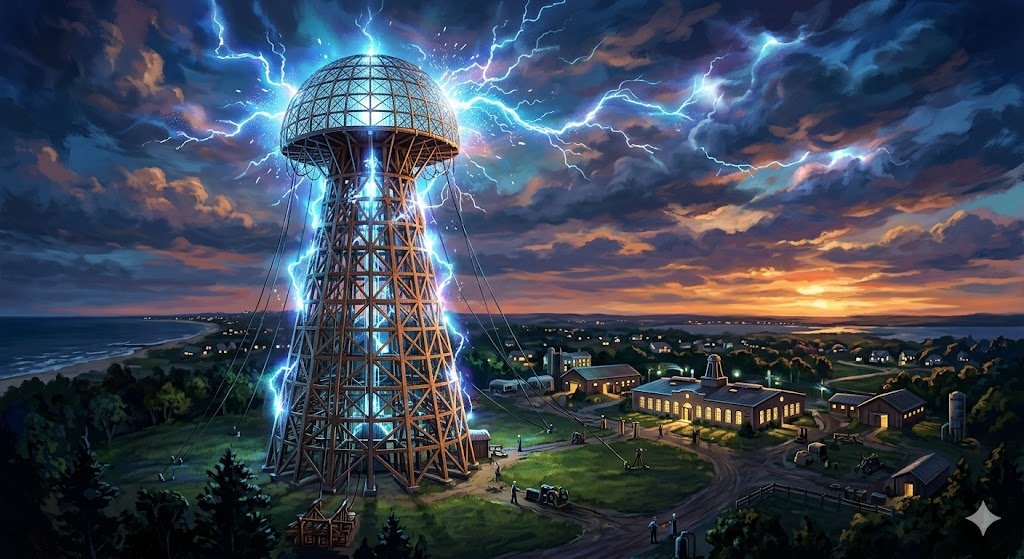
The wardenclyffe tower stands as the most haunting symbol of genius interrupted in the entire history of science and technology. It was not a monument to failure. It was a monument to what the world was not yet ready to receive. When Nikola Tesla broke ground on his long island laboratory in 1901, he believed he was building the nervous system of a new civilization, a global transmitter that would send electricity, voice, and images through the earth itself without a single wire. What he built instead was a 57-meter steel mast rising from the potato fields of Shoreham, New York, that would be torn down before it ever fired a single commercial transmission.
This is the story of the wardenclyffe tower: the dream, the science, the money, and the silence that followed.
Tesla’s Vision: A Planet Wired Without Wires
To understand why the wardenclyffe tower consumed Tesla so completely, you must first understand how he thought about energy. While other inventors of his era were obsessed with generating power, Tesla was obsessed with transmitting it. He had already proven at Niagara Falls that electricity could travel over copper wire for dozens of kilometers. But wire, to Tesla, was a compromise. Nature herself transmitted energy wirelessly every time lightning split the sky or sunlight crossed 150 million kilometers of vacuum to warm your face.
Tesla believed the earth was a conductor of enormous capacitance, and that by exciting it at the right resonant frequency, energy could propagate around the globe the way sound travels through a bell. This concept of earth resonance testing was not mysticism. It was rooted in serious electromagnetic theory, and the mathematics behind it were Tesla’s own.
Tesla calculated the earth’s fundamental resonant frequency using a relationship derived from its circumference and the speed of light:
f = v / λ
Where:
- f = resonant frequency (Hz)
- v = speed of electromagnetic wave propagation ≈ 3 × 10⁸ m/s
- λ = wavelength, approximated at twice the earth’s circumference ≈ 2 × 4.0 × 10⁷ m = 8.0 × 10⁷ m
f = (3 × 10⁸) / (8.0 × 10⁷) ≈ 3.75 Hz
This figure sits within what modern science calls the Schumann resonance band, the extremely low frequency (ELF) electromagnetic resonances of the earth-ionosphere cavity, observed experimentally to range from approximately 7.83 Hz upward through several harmonics. Tesla was working toward this discovery decades before it was formally documented by Winfried Otto Schumann in 1952. The wardenclyffe tower was designed to vibrate the earth at exactly these frequencies.
His broader ambition extended far beyond energy. The wireless telecommunications facility he envisioned at Wardenclyffe would transmit news, stock prices, private messages, and even images to receivers around the world. Every ship at sea would carry a simple device that could pull signals from the global transmitter and deliver real-time communication. He was, in practical terms, describing a primitive internet, in 1900.
Stanford White and the Architecture of Ambition (1901 – 1902)
Tesla did not build the wardenclyffe tower alone. He commissioned Stanford White, one of the most celebrated architects in America, to design the laboratory building and supervise construction of the tower structure. White, whose firm McKim, Mead and White had shaped the face of Gilded Age New York, brought both prestige and precision to the project.
The structural steel tower rose to 57 meters (187 feet) above a brick-and-concrete base. Beneath the tower, Tesla had planned a shaft descending 36 meters into the earth, from which a network of iron pipes would extend outward like roots, making intimate electrical contact with the deep-earth conductor he intended to excite. This underground root system was as critical to Tesla’s theory as the tower above ground. The infrastructure scale of this underground network was unprecedented for a private scientific facility.
The laboratory building beside the tower was a handsome red-brick structure designed to house Tesla’s experimental apparatus, transformers, high-voltage coils, and eventually commercial transmitting equipment. Tesla described the completed facility as his tesla dream laboratory, the place where every theory he had ever developed would finally be tested at planetary scale.
Construction costs mounted rapidly. By 1902, Tesla had spent approximately $150,000 on construction and equipment, a figure equivalent to several million dollars in modern purchasing power. The structural design was sound. The science was extraordinary. The financial foundations, however, were already cracking.
J.P. Morgan and the Promise of Investment Capital (1901)
The wardenclyffe tower would never have broken ground without the intervention of John Pierpont Morgan, the most powerful financier in the United States. In 1901, Tesla approached Morgan with his vision of a wireless telecommunications facility capable of reaching every corner of the globe. Morgan, who had recently reorganized U.S. Steel into a billion-dollar corporation and was accustomed to backing projects of industrial ambition, agreed to invest $150,000 in exchange for a 51% share of Tesla’s wireless patents.
Morgan’s interest was practical. He envisioned a communication hub that would give him a commercial advantage in transatlantic messaging, a market then dominated by undersea telegraph cables. He had no particular interest in Tesla’s grander vision of global wireless power distribution. That distinction, between what Morgan funded and what Tesla intended to build, would become the fatal fissure at the heart of the project.
Tesla, for his part, was not entirely transparent with Morgan about the full scope of his ambitions. He presented the tower primarily as a radio transmission tower and wireless telegraphy station, which it was, but he privately intended it as the first node of a global energy distribution network. He believed that once the system was operational, Morgan would see its potential and increase his investment capital commitment substantially.
This speculative science approach to fundraising, revealing ambitions incrementally while hoping results would compel further backing, was a gamble that would not pay off.
Marconi’s Shadow and the Race for Radio (1901 – 1903)
While Tesla was laying foundations at Shoreham, a young Italian inventor named Guglielmo Marconi was racing toward the same commercial finish line from a very different direction. Marconi had already transmitted radio signals across the English Channel in 1899. On December 12, 1901, he claimed to have received the letter “S” in Morse code transmitted from Cornwall, England, to Signal Hill in Newfoundland, a distance of over 3,500 kilometers.
The tesla and marconi radio invention dispute was immediate and bitter. Tesla had been experimenting with radio wave transmission since the early 1890s, and many of the technical foundations Marconi used drew directly from Tesla’s published work. The U.S. Patent Office had initially awarded radio patents to Tesla. But Marconi had something Tesla fatally lacked: a working commercial product and powerful financial backers.
When Morgan heard that Marconi had beaten Tesla to a transatlantic transmission, his enthusiasm cooled noticeably. Tesla tried to reassure him, pointing out that his system was superior in range, power, and versatility. He wrote to Morgan: “You should not be discouraged by Marconi’s system. He is using seventeen of my patents.” But Morgan was a businessman, not a scientist. He was not interested in technical superiority. He was interested in first-mover advantage, and Marconi appeared to have it.
The financial withdrawal that followed was gradual but inexorable.
The Mathematics of the Tower: Resonance and Power (1902 – 1904)
Tesla’s system at wardenclyffe tower was designed around the principle of electromagnetic resonance. In a resonant circuit, the frequency at which energy transfer is maximized is determined by:
f₀ = 1 / (2π√(LC))
Where:
- f₀ = resonant frequency (Hz)
- L = inductance (Henries)
- C = capacitance (Farads)
Tesla’s tower and its deep-earth root system formed a massive LC circuit, with the tower acting as the inductive element and the earth-ionosphere system providing the capacitance. By driving this circuit at its natural resonant frequency, Tesla believed he could establish standing waves in the earth with minimal energy loss. The concept mirrors the way a child sustains a swing’s motion with tiny, perfectly timed pushes rather than brute force.
The power required to establish global resonance was estimated by Tesla at approximately 10,000 to 100,000 watts of continuous RF output. The transmitter mast was designed to handle currents of extraordinary magnitude. Tesla’s high-frequency resonant transformers, the technology behind the tesla coil explained concept, were the central power conditioning technology for this system.
At resonance, the voltage at the top of the transmitter mast would be amplified dramatically from the input voltage according to the Q-factor of the circuit:
V_out = Q × V_in
Where Q (quality factor) for Tesla’s designs ranged from 100 to over 1,000. At Q = 500 and V_in = 20,000 V:
V_out = 500 × 20,000 = 10,000,000 V (10 MV)
This ten million volt potential at the top of the experimental radio mast was intended to drive electromagnetic energy into the earth-ionosphere waveguide, establishing the standing wave field through which receivers anywhere on earth could extract power. The engineering was not fantasy. It was ambitious, boundary-pushing physics that modern researchers continue to examine seriously.
Capital Starvation and Project Abandonment (1904 – 1906)
By 1904, the wardenclyffe tower stood structurally complete but operationally idle. Tesla had exhausted Morgan’s initial investment and desperately needed additional funding to install the full transmission equipment and begin resonance testing. He wrote letter after letter to Morgan, pleading, arguing, and cajoling. Morgan’s replies grew shorter and colder.
In 1904, Morgan declined to provide any further investment capital. His reasoning was blunt: Marconi’s simpler system was already operational and commercially viable. There was no business case for funding a grander but unproven alternative. The financial panic of 1901, triggered partly by the stock market crash following the Northern Pacific Corner crisis, had already made Morgan more conservative about speculative ventures.
Tesla turned to other potential investors but found no takers. The financial panic atmosphere of the early 1900s, combined with Marconi’s apparently decisive victory in the race for radio, made the wardenclyffe tower look like a losing bet to every businessman Tesla approached. Project abandonment became increasingly likely as the months of silence from investors stretched into years.
Tesla, now spending his own dwindling personal funds, tried to maintain the facility. He believed that a single dramatic demonstration of earth resonance power transmission would silence every skeptic and open every checkbook. He never got the chance to make that demonstration.
Bankruptcy, Foreclosure, and the End of the Dream (1906 – 1917)
The years following Morgan’s financial withdrawal were among the darkest of Tesla’s life. He had poured not just money but identity into the wardenclyffe tower. Its failure was not merely scientific bankruptcy; it was the collapse of a worldview. Tesla, who had once lit the 1893 World’s Fair with his own electrical system and electrified Buffalo from Niagara Falls, found himself unable to pay hotel bills.
The long island laboratory fell into legal and financial disorder. Tesla owed substantial sums to the proprietors of the Waldorf-Astoria Hotel, where he had been living, and he was forced to transfer the deed to the Wardenclyffe property to satisfy those debts. Real estate disposal of what had once been his greatest project was handled with the indifference of a creditor clearing a ledger.
As a Nikola Tesla visionary inventor, he had always operated ahead of the financial realities of his time, and the wardenclyffe tower was the most devastating proof of that disconnect. The scientific bankruptcy Tesla experienced at Wardenclyffe did not represent a failure of his ideas but a failure of the world’s financial systems to support ideas that could not be monetized quickly.
In 1917, with World War I in full fury and government authorities concerned that the tower could serve as a navigation aid for enemy submarines, the U.S. government ordered its demolition. The tower demolition 1917 was carried out by the Smiley Steel Company using explosives. The structural salvage recovered approximately $1,750 worth of steel, a grotesque reduction of a $200,000 vision to scrap metal value. The tower that was meant to power the world was sold for spare parts.
What the Wardenclyffe Tower Actually Proved
Despite never transmitting a single commercial signal, the wardenclyffe tower proved several things of lasting scientific and cultural importance. Tesla’s theoretical framework for earth resonance testing was sound enough to inspire generations of researchers. The Schumann resonances, confirmed in 1952, validated Tesla’s core intuition about the earth-ionosphere cavity as an electromagnetic waveguide. Modern wireless power transfer technologies, from inductive phone chargers to resonant coupling systems in electric vehicles, are direct descendants of the principles Tesla was testing at Wardenclyffe.
The tesla wireless power transmission concept has experienced a dramatic renaissance in the 21st century. Researchers at MIT demonstrated resonant inductive coupling over meaningful distances in 2007, describing their work in terms that would have been instantly familiar to anyone who had read Tesla’s wardenclyffe tower patents and papers. The global transmitter Tesla imagined has not been built, but smaller versions of his wireless energy vision are now embedded in billions of consumer devices.
The technological overreach that doomed the project from a funding perspective is now understood as being ahead of its time rather than wrong in principle. Infrastructure scale wireless power may yet become a reality; the wardenclyffe tower simply arrived about a century too early.
FAQ: The Wardenclyffe Tower and Tesla’s Wireless Vision
What was the wardenclyffe tower designed to do?
The wardenclyffe tower was designed to serve simultaneously as a wireless telecommunications facility and a global wireless power transmitter. Tesla intended to use earth resonance to distribute electrical energy to receivers worldwide without wires, while also transmitting voice, text, and images as a communication hub.
Why did J.P. Morgan stop funding the wardenclyffe tower?
Morgan withdrew his investment capital primarily because Marconi appeared to have won the commercial race for transatlantic radio communication. Morgan was interested in a profitable communication business, not in Tesla’s broader ambitions for global power distribution. The financial panic of the early 1900s also made further speculative science investment unattractive.
When was the wardenclyffe tower demolished and why?
The tower demolition took place in 1917. U.S. government authorities ordered it destroyed during World War I over concerns that enemy submarines could use the tall transmitter mast as a navigational landmark. The structural salvage yielded roughly $1,750 in recovered steel, a fraction of the project’s original cost.
Was Tesla’s wireless power science actually valid?
Yes, in fundamental terms. Tesla’s earth resonance testing concept anticipated the Schumann resonances confirmed in 1952. His resonant coupling principles underpin modern wireless charging technologies. The wardenclyffe tower represented speculative science in the best sense: ideas that were theoretically correct but required decades of additional material science and engineering development to become practical.
Who owns the wardenclyffe tower site today?
The former long island laboratory site in Shoreham, New York, was purchased by the Tesla Science Center at Wardenclyffe, a nonprofit organization, in 2013. Plans for a Tesla museum and education center on the site have been in development since then, preserving the historical significance of the location where Tesla’s greatest dream once stood.
Conclusion
The wardenclyffe tower was not a failure. It was a prophecy written in steel and earth, one that the world was too impatient and too financially cautious to wait for. Tesla’s vision of wireless electricity, dismissed as technological overreach in 1917, is now the foundational principle behind technologies used by billions of people every day. The long island laboratory that was seized for debt and its tower demolished for scrap housed ideas that outlived every one of the financiers who refused to fund them.
The wardenclyffe tower reminds us that the distance between visionary and failure is measured not in science but in timing, and in money. Tesla had the science. He ran out of time and money before the world caught up. That gap between genius and execution is the most expensive gap in the history of technology, and its cost is still being counted.