Few chapters in the history of science are as electrifying, and as tragically overlooked, as the story of tesla x ray experiments. Long before hospitals had radiology departments, long before a single bone fracture was diagnosed without surgery, a solitary inventor in a Manhattan laboratory was generating penetrating radiation rays by accident, studying them with obsessive precision, and writing letters warning the world about their dangers. That inventor was Nikola Tesla, and his contribution to what we now call medical imaging is one of the most underappreciated scientific gifts of the nineteenth century.
This is not merely a story about radiation. It is a story about curiosity, high voltage, photographic plates, and one of history’s greatest cases of a discovery being named for someone other than the person who found it first.
The Electrical Age That Made X-Rays Possible
To understand how tesla x ray experiments happened at all, you must first understand the technological environment Tesla was working in during the early 1890s. The second industrial revolution had placed high-voltage electrical equipment in the hands of experimenters across Europe and America. Vacuum discharge tubes, sealed glass vessels from which most air had been removed, were the most fashionable experimental apparatus of the era.
When a high voltage is applied across the electrodes of a vacuum tube, electrons are accelerated from the cathode toward the anode at enormous speeds. The relationship governing the kinetic energy gained by an electron accelerated through a potential difference is:
KE = eV
Where:
- KE = kinetic energy of the electron (Joules)
- e = elementary charge = 1.602 × 10⁻¹⁹ C
- V = accelerating voltage (Volts)
At the voltages Tesla routinely worked with, ranging from tens of thousands to millions of volts, electrons could be accelerated to relativistic speeds. When these high-speed electrons strike a target material, they produce bremsstrahlung radiation, meaning braking radiation in German, as the electrons decelerate rapidly and release energy in the form of high-energy photons across a broad spectrum, including the X-ray portion of the electromagnetic spectrum.
The energy of the X-ray photons produced is directly related to the accelerating voltage:
E_max = eV
For V = 50,000 V (50 kV):
E_max = 1.602 × 10⁻¹⁹ × 50,000 = 8.01 × 10⁻¹⁵ J = 50 keV
These 50 keV photons fall squarely in the diagnostic X-ray range used in modern medical imaging today. Tesla was routinely producing radiation at these energies years before Wilhelm Röntgen formally announced the discovery of X-rays in December 1895.
Tesla’s High-Voltage Laboratory and the First Shadowgraphs (1894 – 1895)
Tesla’s South Fifth Avenue laboratory in New York City was one of the most extraordinary private scientific facilities in the world during the mid-1890s. Coils of wire, capacitor banks, and vacuum discharge tubes of Tesla’s own design filled the space. The tesla coil explained principle was central to his work: resonant transformer circuits that could generate extremely high voltages at high frequencies, driving vacuum tubes to intensities far beyond what conventional electrical sources could achieve.
By 1894, Tesla had begun noticing something strange in his laboratory. Photographic plates stored near his high-voltage apparatus were being fogged, their silver halide emulsions darkened by an invisible agent even when the plates were still sealed in their protective packaging. Most experimenters of the era dismissed such fogging as a storage problem or a manufacturing defect. Tesla did not dismiss it. He investigated.
He began systematically placing sealed photographic plates at various distances from his vacuum discharge tubes while running experiments. He found that the fogging effect diminished with distance according to an inverse-square relationship, the same law that governs the intensity of light and sound:
I ∝ 1 / r²
Or more precisely:
I₁ / I₂ = r₂² / r₁²
Where I is radiation intensity and r is distance from the source. This inverse square law told Tesla that whatever was causing the fogging was radiating outward from a point source, behaving exactly as electromagnetic radiation should. He produced what he called shadowgraph photographs by placing objects between his tube and the photographic plate and observing that the dense materials cast shadows while less dense materials allowed the radiation to pass through.
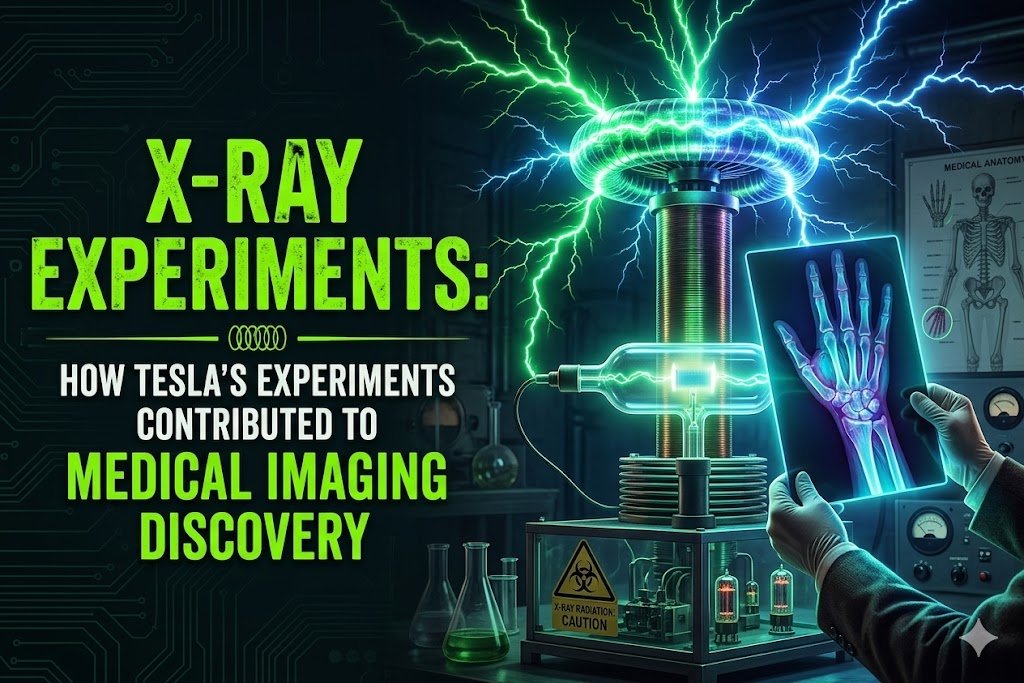
These shadowgraph photographs included images of the human hand, showing bone structure imaging with startling clarity. Dense tissue imaging of bones against the translucent background of soft tissue was visible with a sharpness that astonished Tesla. He recognized immediately that this penetrating radiation could see inside the human body.
Tesla sent some of these shadowgraph photographs to Wilhelm Röntgen in early 1896 after Röntgen’s announcement, and Röntgen himself praised their quality and technical sophistication. The awkward historical reality is that Tesla had been producing and studying these images for months or possibly years before Röntgen’s formal announcement.
Why Tesla Did Not Claim the Discovery of X-Rays
The question that every serious historian of science must confront is simple and painful: if tesla x ray experiments were producing clear radiographic images before Röntgen announced his discovery, why did Tesla not claim priority? The answer is characteristically Teslian, a combination of intellectual generosity, scientific caution, and catastrophic bad luck.
First, Tesla’s single-electrode tubes, a distinctive design in which one electrode was omitted and the tube operated as what he called a unipolar radiator, were producing radiation through a mechanism slightly different from Röntgen’s apparatus. Tesla did not initially recognize that the radiation he was observing was the same fundamental phenomenon Röntgen described. He referred to it cautiously as “radiant energy” rather than making bold discovery claims.
Second, and most devastatingly, a catastrophic laboratory fire in March 1895 destroyed Tesla’s South Fifth Avenue laboratory completely. Years of experimental notes, shadowgraph photographs, vacuum tube designs, and research documentation burned. The evidence that could have established Tesla’s priority in early radiology history was reduced to ash. By the time Tesla rebuilt his laboratory and resumed tesla x ray experiments, Röntgen had already become world-famous for the roentgen ray discovery.
Tesla, displaying the magnanimous character that marked his scientific communications throughout his life, wrote to Röntgen offering congratulations rather than competing for credit. As a Nikola Tesla visionary inventor, he was more interested in advancing the science than in claiming the trophy.
The Physics of Tesla’s X-Ray Tubes: A Deeper Look
What made tesla x ray experiments technically distinctive was the extraordinary voltage Tesla could generate using his resonant coil systems. Standard Crookes tubes used by Röntgen and other contemporary researchers operated at voltages measured in the low tens of thousands of volts. Tesla routinely drove his vacuum discharge tubes at hundreds of thousands of volts.
The quality of X-ray radiation, specifically its penetrating power, is determined by photon energy, which is determined by the peak accelerating voltage. Penetrating power is often characterized by the half-value layer (HVL), the thickness of a given material required to reduce radiation intensity by half:
I(x) = I₀ × e^(−μx)
Where:
- I(x) = intensity after passing through thickness x
- I₀ = initial intensity
- μ = linear attenuation coefficient (cm⁻¹)
- x = material thickness (cm)
The HVL is then:
HVL = ln(2) / μ = 0.693 / μ
Higher photon energies correspond to smaller attenuation coefficients and greater penetrating power. Tesla’s extremely high-voltage tubes produced harder, more penetrating radiation than Röntgen’s apparatus, which is exactly why his shadowgraph photographs achieved such sharp skeletal visualization. The contrast between bone density and soft tissue in his images was superior to many contemporaries precisely because his photon energies were higher.
Tesla also noted that image resolution in his shadowgraph photographs improved as he reduced the size of the focal spot where electrons struck the tube wall, a principle that remains central to modern X-ray tube design. A smaller focal spot produces sharper images because the geometric unsharpness, the blurring caused by the finite size of the radiation source, is reduced.
Geometric unsharpness: U_g = F × (OID / FFD)
Where F is focal spot size, OID is object-to-image distance, and FFD is focus-to-film distance. Tesla was optimizing these parameters intuitively through systematic observation long before formal radiographic geometry was articulated.
Tesla’s Warnings About Radiation Safety (1896 – 1897)
One of the most prescient and least celebrated aspects of tesla x ray experiments was Tesla’s early insistence on early radiation safety protocols. At a time when most experimenters were gleefully exposing their hands to X-ray tubes for extended periods, treating the novelty radiation as harmless entertainment, Tesla sounded clear and repeated warnings.
Tesla observed that extended exposure to his high-voltage tubes caused skin irritation, eye strain, and what he described as a general feeling of disturbance in the body. He recommended safe distance radiation practices, keeping a substantial gap between operator and tube during prolonged exposures. He wrote in technical publications that experimenting with these tubes without protective precautions was reckless and would eventually produce serious biological harm.
History proved him devastatingly correct. Many of the early radiation pioneers who ignored such warnings suffered severe radiation burns, lost fingers and hands to radiation necrosis, and in several cases died of radiation-induced cancers. Tesla’s early warnings about safe distance radiation were ignored by most of his contemporaries but were vindicated by decades of tragic medical evidence.
His understanding that X-rays were not merely a curiosity but a potentially dangerous tool requiring respect and controlled use placed him well ahead of the medical community’s eventual adoption of radiation protection principles in the 1920s and 1930s.
From Laboratory to Clinic: How Tesla’s Work Fed Clinical Imaging (1896 – 1910)
The direct line from tesla x ray experiments to clinical imaging pioneer status is not a straight one, but it is traceable. Tesla’s high-voltage techniques for driving vacuum tube radiation at extraordinary intensities influenced how manufacturers designed X-ray tubes for medical use in the late 1890s and early 1900s.
The core challenge for early medical radiography was exposure time. Early X-ray tubes operating at low voltages required patients to hold perfectly still for minutes at a time to accumulate enough photographic plate exposure to produce a diagnostic image. Motion blur made many early radiographs useless for medical visualization of moving or breathing structures.
Tesla’s demonstration that extremely high voltages produced dramatically more intense radiation meant that exposure times could be cut from minutes to seconds. The relationship between tube voltage, tube current, and radiation output is:
Output ∝ kVp² × mA
Where kVp is peak kilovoltage and mA is milliampere tube current. Doubling the voltage quadruples the radiation output for the same current. Tesla’s work at very high voltages was a practical demonstration of this relationship before it was formally quantified, and it directly pointed toward the high-voltage diagnostic imaging equipment that would transform medicine.
The nikola tesla patents filed in the 1890s included designs for high-frequency oscillators, resonant coil systems, and vacuum tube configurations, all of which fed into the technology stream that produced practical medical X-ray machines by 1900. The unintended x-ray creation that began as a photographic plate anomaly in his Manhattan laboratory had, within five years, become the most powerful new diagnostic tool in medical history.
Tesla’s Single-Electrode Tube: A Revolutionary Design
Among the most technically remarkable products of tesla x ray experiments was his development of the single-electrode tube, which he called the button lamp in some publications. Conventional X-ray tubes required two electrodes, a cathode to emit electrons and an anode to receive them. Tesla’s design used only a single electrode, driven by his high-frequency high-voltage coil, with the glass envelope of the tube itself serving as the return path for current.
This tube design was not merely a curiosity. It operated on principles that required a fundamentally different understanding of vacuum discharge than the prevailing Crookes tube model. Tesla’s single-electrode tubes were forerunners of later cold cathode tubes and influenced thinking about how electrons behave in extreme vacuum conditions.
The tesla wireless power transmission concepts Tesla was simultaneously developing were conceptually connected to his single-electrode tube work: both involved the transmission of electrical energy through media without conventional conducting paths. Tesla saw his vacuum discharge work and his wireless energy work as aspects of a single unified inquiry into the behavior of radiant energy in space.
The rotating magnetic field principles that had made Tesla famous through his AC motor work informed his thinking about the high-frequency oscillating fields inside his vacuum tubes. To Tesla, all of his research formed one continuous investigation into the nature of electrical force and its interaction with matter.
Tesla’s Correspondence with Röntgen and the Scientific Community (1896)
After Röntgen’s announcement in December 1895 electrified the scientific world, tesla x ray experiments took on new urgency and new context. Tesla immediately recognized that what he had been observing in his own laboratory for at least a year was the same phenomenon Röntgen had formalized. He resumed systematic radiographic experiments with great energy.
In January 1896, Tesla produced what he described as the most detailed shadowgraph photographs yet achieved, including a striking image of a human foot inside a shoe, showing bone structure imaging of the metatarsals with extraordinary clarity. He sent prints to Röntgen with a letter of congratulation and technical notes comparing their respective tube designs.
Tesla also shared his radiographic work broadly with the American scientific community through lectures at the New York Academy of Sciences and published notes in electrical engineering journals. His contributions to the early radiology history of the United States were widely acknowledged by his contemporaries, even if they were gradually obscured by the dominant narrative that credited Röntgen alone as the discoverer.
The tesla fluorescent and neon lights work Tesla pursued in parallel during this period was directly connected to his vacuum tube research: the same tubes that produced X-rays under high-voltage conditions produced visible light in different operational regimes, and Tesla studied both phenomena as aspects of the same radiant energy discharge process.
FAQs
Did Tesla actually discover X-rays before Röntgen?
Tesla was producing shadowgraph photographs showing bone structure imaging at least as early as 1894, before Röntgen’s formal announcement in December 1895. However, Tesla did not formally claim the discovery, partly due to scientific caution, partly because his laboratory fire in March 1895 destroyed his records, and partly because Röntgen published first and achieved immediate international recognition.
What made tesla x ray experiments technically different from Röntgen’s work?
Tesla operated his vacuum discharge tubes at significantly higher voltages than Röntgen, producing harder, more penetrating radiation with superior skeletal visualization capability. He also developed single-electrode tube designs that were conceptually distinct from standard Crookes tubes, and he was far more attentive to early radiation safety issues than most of his contemporaries.
How did Tesla’s work influence modern X-ray machines?
Tesla’s demonstration that extremely high voltages dramatically increased radiation output directly pointed toward the high-voltage tube designs used in medical radiography. The Output ∝ kVp² × mA relationship that governs modern X-ray machine settings was practically demonstrated in tesla x ray experiments before it was formally quantified.
Why did Tesla warn about radiation dangers so early?
Tesla experienced firsthand the physiological effects of prolonged exposure to his high-voltage tubes, including skin irritation and sensory disturbance. His systematic approach to experimental observation led him to connect these symptoms to the radiant energy his tubes were producing, years before the medical community recognized radiation as a significant biological hazard.
Are Tesla’s contributions to radiology officially recognized?
Tesla’s contributions to early radiology history are acknowledged in historical scholarship but are not as widely recognized in popular culture as his electrical engineering achievements. The Röntgen priority claim has dominated public history, though Tesla’s priority in producing and studying shadowgraph photographs before Röntgen’s announcement is supported by substantial documentary evidence.
Conclusion
The story of tesla x ray experiments is the story of a mind moving so fast that the world could not keep up with its footprints. Tesla was producing diagnostic-quality bone structure images before Röntgen named the phenomenon, warning about radiation dangers before the medical community acknowledged them, and advancing vacuum tube design before radiography had a clinical identity. The laboratory fire that consumed his records in 1895 robbed him of the credit that history might otherwise have assigned, and his characteristic generosity toward Röntgen sealed that loss.
But the science does not lie. Tesla x ray experiments produced real shadowgraph photographs of real human anatomy using bremsstrahlung radiation generated by real high-voltage vacuum discharge tubes. Every modern X-ray machine, every CT scanner, every radiographic diagnosis made in every hospital on earth carries a debt to that work. The man who was not credited with discovering X-rays may nevertheless have done more to make them medically useful than the man who was.
That is the peculiar justice of scientific history: the work endures even when the name does not.