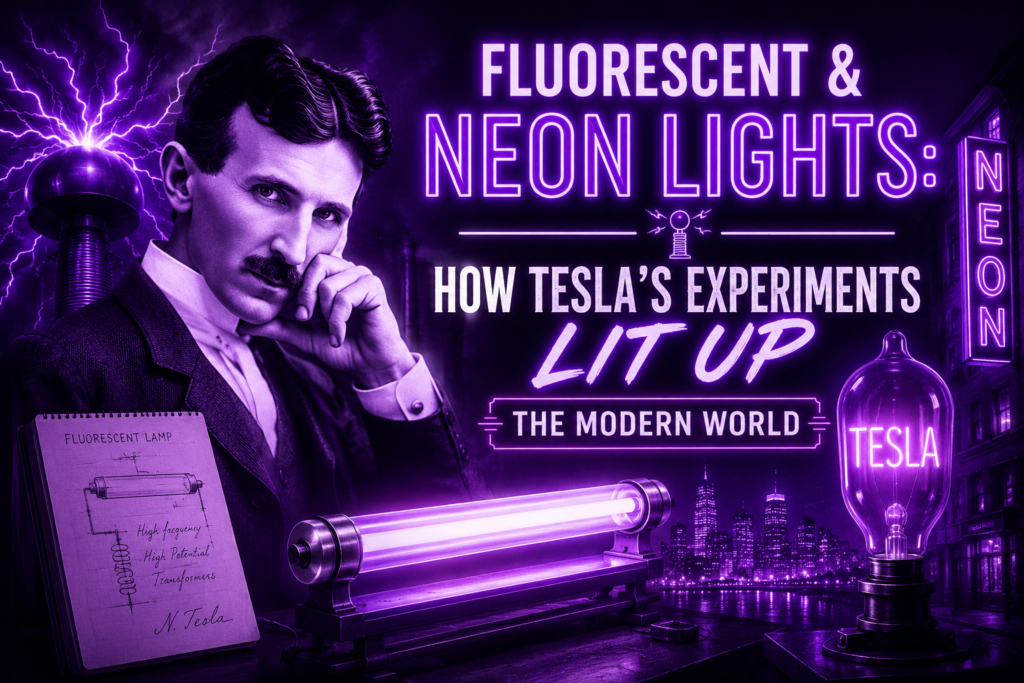
Fluorescent and neon lights are among the most influential innovations in the history of illumination technology. Long before modern LED systems became common, fluorescent lamps and neon signs transformed homes, businesses, factories, and cities around the world. Their colorful glow, energy efficiency, and distinctive appearance changed how people experienced light after sunset.
Although many inventors contributed to lighting technology, Nikola Tesla visionary inventor played a crucial role in advancing high frequency electrical systems that helped make modern lighting possible. Through groundbreaking experiments involving wireless electricity, gaseous discharge illumination, and high-frequency lighting, Tesla demonstrated concepts that inspired future generations of engineers and scientists.
Today, fluorescent and neon lights remain an important part of lighting history and continue influencing modern illumination technologies. Understanding Tesla’s contributions provides valuable insight into how these remarkable lighting systems evolved.
The World of Electric Lighting Before Tesla (1870 – 1890)
Before the development of fluorescent and neon lights, most artificial lighting relied on candles, gas lamps, or incandescent bulbs.
Incandescent lighting worked by heating a filament until it glowed. While effective, this approach wasted a significant amount of energy as heat.
Scientists began searching for more efficient methods of illumination.
During this period, Tesla was developing technologies associated with tesla alternating current, which would later become the foundation of modern electrical power distribution.
His research into high frequency electricity opened new possibilities for lighting systems that did not depend entirely on heated filaments.
Tesla’s Interest in High Frequency Lighting
Tesla believed future lighting technologies would be brighter, more efficient, and capable of operating without direct electrical connections.
His laboratory experiments focused on:
- High-frequency lighting
- Electrodeless lamps
- Wireless light bulbs
- Vacuum tube illumination
- Electrical field activation
These investigations revealed that gases inside glass tubes could emit light when energized by high frequency electrical fields.
This principle became fundamental to the development of fluorescent and neon lights.
How Fluorescent and Neon Lights Work
The operation of fluorescent and neon lights depends on electrical excitation of gases.
Unlike incandescent bulbs that rely on heated filaments, these lighting systems generate light through gas ionization and atomic excitation.
The process occurs in several stages:
- Electrical energy enters the tube.
- Gas molecules become energized.
- Electrons collide with atoms.
- Molecular excitation occurs.
- Light is emitted.
This process creates highly efficient illumination while producing significantly less heat than traditional incandescent lighting.
The Physics Behind Gas Discharge Illumination
Gas discharge lighting relies on the movement of charged particles through a gas.
According to electrical theory:
P = V × I
Where:
- P = Power (Watts)
- V = Voltage (Volts)
- I = Current (Amperes)
When sufficient voltage is applied, gas ionization begins inside the tube.
Electrons accelerate through the gas and collide with atoms.
These collisions create plasma discharge conditions that generate visible light.
This scientific principle forms the foundation of modern fluorescent and neon lights.
Tesla’s Experiments with Electrodeless Lamps
One of Tesla’s most remarkable achievements involved electrodeless lamps.
Traditional lamps require electrodes to introduce electrical current into a gas.
Tesla discovered that high frequency electromagnetic fields could energize gases without direct electrical contacts.
These electrodeless lamps demonstrated:
- Wireless illumination
- Reduced electrode wear
- Improved efficiency
- Longer operating life
Many researchers consider these experiments an important step toward future lighting innovations.
The concepts also supported Tesla’s investigations into tesla wireless power transmission.
Tesla Coil and Lighting Experiments
Many of Tesla’s lighting demonstrations used devices based on tesla coil explained principles.
The Tesla coil generated extremely high voltage and high frequency electrical currents.
These currents could energize nearby gas filled tubes without wires.
Observers witnessed glass tubes glowing brilliantly while remaining physically disconnected from the power source.
Such demonstrations amazed audiences and showcased the future potential of fluorescent and neon lights.
Neon Gas Excitation and Color Production
Neon lighting works because different gases emit unique colors when energized.
For example:
- Neon produces reddish orange light.
- Argon produces bluish light.
- Helium creates pink tones.
- Krypton generates pale white light.
The color depends on atomic excitation within the gas.
Each gas emits specific wavelengths according to:
E = hf
Where:
- E = Energy
- h = Planck’s Constant
- f = Frequency
This equation explains why different gases produce different colors when electrical energy excites their atoms.
The process of neon gas excitation remains central to modern neon lighting.
Fluorescent Lamps and Phosphor Excitation
Fluorescent lamps operate differently from neon tubes.
Inside the tube, mercury vapor lamps generate ultraviolet emissions.
These ultraviolet rays strike a special inner tube coating made from phosphor materials.
The phosphor converts invisible ultraviolet radiation into visible light.
This process is called phosphor excitation.
Because much of the energy becomes useful light instead of heat, fluorescent systems achieve higher luminescent efficiency than incandescent bulbs.
This efficiency helped drive the widespread adoption of fluorescent and neon lights throughout the twentieth century.
Tesla’s Public Demonstrations (1891 – 1893)
Tesla’s public lectures introduced audiences to revolutionary lighting concepts.
During these demonstrations he displayed:
- Wireless light bulbs
- Cold cathode lighting
- Electromagnetic glow effects
- Phosphorescent gas tubes
- Vacuum tube illumination
Many attendees saw electrically illuminated tubes glowing without direct wiring for the first time.
These demonstrations helped establish Tesla as one of the leading electric lighting pioneers of his era.
The Role of Alternating Current in Lighting
The success of fluorescent and neon lights depended heavily on alternating current technology.
Tesla’s AC system offered advantages including:
- Efficient power distribution
- Long distance transmission
- Voltage transformation
- Reliable electrical infrastructure
Projects such as the tesla niagara falls project demonstrated the practical effectiveness of AC electricity and helped support future lighting networks worldwide.
Without widespread AC distribution, modern fluorescent lighting systems would have been much more difficult to implement.
High Frequency Ballasts and Lamp Operation
Fluorescent systems require devices known as ballasts.
A ballast controls electrical current flowing through the lamp.
The resonant frequency equation remains important:
f = 1 / (2π√LC)
Where:
- f = Resonant frequency
- L = Inductance
- C = Capacitance
Modern high-frequency ballast systems improve efficiency, reduce flickering, and increase lamp lifespan.
Many of these principles can be traced back to Tesla’s pioneering work with high frequency electrical currents.
Cold Cathode Lighting and Modern Signage
Cold cathode lighting became a major advancement in decorative illumination.
Unlike incandescent lamps, cold cathode systems generate light through gas excitation rather than filament heating.
Applications include:
- Advertising signs
- Architectural lighting
- Artistic displays
- Commercial branding
The development of modern signage history owes much to innovations involving fluorescent and neon lights.
Neon signs eventually became iconic symbols of urban culture around the world.
Mercury Vapor Lamps and Industrial Illumination
Mercury vapor lamps represented another important branch of gas discharge technology.
These lamps produce light through electrical excitation of mercury atoms.
Their operation involves:
- Gas ionization
- Mercury spectrum emissions
- Plasma discharge formation
- Ultraviolet emissions
Mercury vapor systems became widely used in factories, streets, warehouses, and industrial facilities.
They demonstrated the growing influence of fluorescent and neon lights on large scale illumination.
The Science of Luminescent Materials
Luminescent materials convert energy into visible light.
Scientists study these materials to improve:
- Brightness
- Efficiency
- Color quality
- Lifespan
Important factors include:
- Molecular excitation
- Glowing vapors
- Phosphor excitation
- Luminescent efficiency
Research in these areas continues to support modern lighting development.
Tesla’s Broader Contributions to Electrical Science
Tesla’s achievements extended far beyond lighting.
His work on tesla polyphase system technology transformed power generation and transmission.
His discoveries involving the rotating magnetic field enabled modern motors and industrial machinery.
These innovations created the electrical infrastructure necessary for advanced lighting technologies to flourish.
Studying a detailed Nikola Tesla biography reveals how interconnected his inventions truly were.
Influence on Modern Energy Efficient Lighting
The principles demonstrated by Tesla continue influencing modern energy-efficient lighting technologies.
Today’s engineers focus on:
- Reduced energy consumption
- Improved brightness
- Longer lifespan
- Better color accuracy
Many modern illumination systems still rely on concepts first explored during Tesla’s experiments with high frequency electricity and gaseous discharge illumination.
For this reason, his contributions remain highly relevant even in the LED era.
Why Fluorescent and Neon Lights Changed the World
The widespread adoption of fluorescent and neon lights transformed society in several ways.
Benefits included:
- Lower electricity consumption
- Brighter illumination
- Extended operating life
- Enhanced commercial visibility
- Improved workplace lighting
These advantages accelerated industrial growth and reshaped urban environments across the globe.
The glowing city skylines familiar today owe much to the development of these technologies.
Frequently Asked Questions
Did Nikola Tesla invent fluorescent lights?
Tesla did not invent commercial fluorescent lamps, but his experiments with high frequency electricity and gas discharge lighting significantly influenced their development.
How do fluorescent lights produce light?
Fluorescent lamps use mercury vapor to create ultraviolet emissions that excite a phosphor coating, producing visible light.
Why are neon lights different from fluorescent lights?
Neon lights generate visible light directly from excited gases, while fluorescent lamps rely on phosphor excitation to convert ultraviolet radiation into visible light.
What were Tesla’s electrodeless lamps?
They were lamps that glowed through electromagnetic fields without requiring direct electrical connections.
Are fluorescent and neon lights still used today?
Yes. Although LEDs are becoming dominant, fluorescent and neon systems remain widely used in commercial, industrial, and decorative applications.
Conclusion
Fluorescent and neon lights represent a remarkable chapter in the evolution of illumination technology. Their efficiency, versatility, and visual appeal transformed cities, industries, and everyday life across the world.
Nikola Tesla’s pioneering experiments with high frequency electricity, wireless illumination, electrodeless lamps, and gaseous discharge systems helped establish many of the scientific principles behind these technologies. While he did not invent every lighting device that followed, his research provided critical foundations that inspired future innovations.
More than a century later, fluorescent and neon lights continue to showcase the lasting impact of Tesla’s vision and demonstrate how scientific exploration can illuminate the world in entirely new ways.