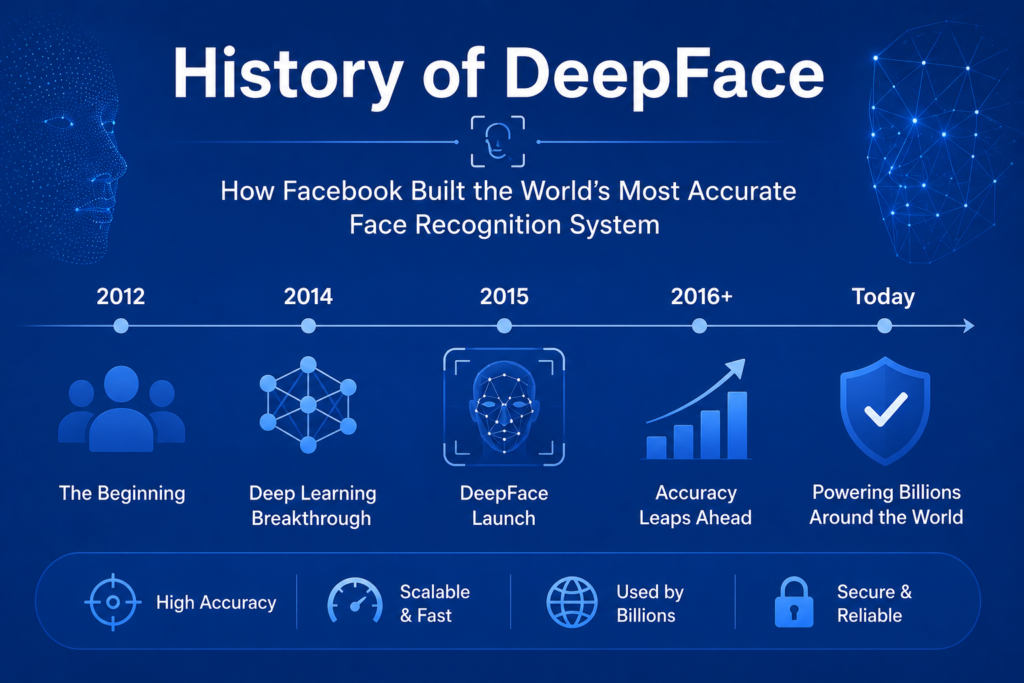
The fascinating history of deepface represents one of the most incredible technological leaps in the modern digital era. Before this revolutionary software system emerged, machines heavily struggled to accurately identify human faces under varying lighting conditions, different camera angles, and chaotic, dynamic backgrounds. The introduction of this highly specific verification algorithm fundamentally changed how massive social media platforms actively process billions of user uploaded images every single day. Exploring the history of deepface allows engineers to see exactly how computer perception evolved from simple pixel sorting into deep contextual understanding. In this comprehensive guide, we will deeply explore the intricate Facebook DeepFace architecture history 2014 and reveal exactly how elite researchers managed to bridge the massive gap between human visual perception and artificial intelligence. By diving deep into the history of deepface, we can clearly understand the monumental industry shifting from geometric models to deep face embeddings that permanently altered the global technology landscape.
The Early Days and Visual Challenges (1990 – 2010)
To fully appreciate the history of deepface, we must first examine the much broader history of computer vision. For decades, ambitious software engineers relied entirely on strict manual feature extraction techniques. Early computer programs required academic scientists to explicitly write rigid mathematical formulas to detect sharp edges, smooth curves, and subtle facial shading across a digital matrix. These primitive methods were incredibly fragile. If a human subject simply tilted their head sideways or stood in a harsh lighting shadow, the rigid mathematical algorithms failed completely. This severe technical limitation completely stalled the history of facial recognition for many long years, as traditional software simply could not handle the highly unpredictable nature of real world, unconstrained photography.
Everything rapidly shifted when deep learning transformed computer vision. Instead of manually programming the machine to look for specific pixel patterns, computer scientists began feeding massive amounts of labeled data directly into deep convolutional networks, allowing the complex algorithms to autonomously learn their own highly generalized visual features. This specific chapter in the history of deepface proves how this radical change was heavily inspired by the famous history of alexnet, which definitively proved that deep hierarchical layers of artificial neurons could easily conquer highly complex visual recognition tasks. The global technology sector was finally ready for a robust, highly scalable biometric verification system.
Facebook DeepFace Architecture Breakdown (2013 – 2014)
The monumental breakthrough finally occurred when a highly dedicated research team at Facebook introduced a radically new engineering approach to the public. The history of deepface is largely defined by its highly innovative, multi step image processing pipeline. The engineering team quickly realized that feeding raw, unaligned human faces directly into a deep neural network resulted in surprisingly poor classification accuracy. To decisively solve this severe mathematical problem, they developed an ingenious DeepFace 3D facial alignment history pipeline.
The complex alignment process actively begins with detecting basic facial landmarks across a flat digital photograph, such as the exact center of the eyes, the tip of the nose, and the outer mouth corners. The sophisticated system then utilizes a cutting edge 3D camera facial alignment model. By wrapping the original 2D input image firmly around a generic, computerized 3D face model, the software can execute complex piecewise affine transformations to artificially rotate the subject’s face into a perfectly forward facing, frontal position. This critical frontalization step ensures that the deep neural network always analyzes a highly standardized face, drastically reducing the overall complexity of the biometric identification task. This brilliant preprocessing stage remains a widely celebrated cornerstone in the history of deepface.
The Nine Layer Deep Neural Network Explained (2014 – 2015)
After the target face is perfectly aligned and digitally cropped, the standardized image is immediately fed directly into the core computational processing engine. The complete DeepFace neural network layers breakdown reveals a staggering Nine layer deep neural network designed for maximum spatial comprehension. Unlike traditional convolutional networks that aggressively use the exact same learned filters across the entire image grid, this specific, highly customized architecture introduced massive locally connected unshared layers. Because a standard human face always has specific distinct regions like eyes positioned firmly at the top and a mouth situated firmly at the bottom, applying the exact same convolutional filter across the entire facial canvas was mathematically inefficient.
By actively using locally connected unshared layers, the network could autonomously learn highly specialized mathematical filters strictly for the eyes, distinct texture filters specifically for the nose, and entirely separate geometric filters for the mouth. This brilliant architectural decision caused the total number of trainable network parameters to explode exponentially, resulting in a massive deep model containing well over 120 million parameter weights. Despite the immense computational cost required to train such a massive architecture, this specific structural design allowed the algorithm to extract exceptionally rich, high dimensional feature embeddings. The history of deepface continuously proves that this specific localized network design was absolutely essential for capturing the microscopic skin textures and subtle, distinct identity clues required for elite identity verification tasks.
How DeepFace Closed the Human Accuracy Gap (2014 – 2016)
One of the most widely celebrated and heavily documented moments in the history of deepface is its unprecedented academic benchmark performance. To scientifically prove its unmatched capabilities to the global academic community, the researchers tested the final algorithm against the notoriously difficult Labeled Faces in the Wild (LFW) dataset. This massive public database contains thousands of highly varied images of global celebrities taken in highly uncontrolled, real world environments. Before this Facebook algorithm officially arrived, the history of human level face verification performance remained a highly elusive, distant dream for software developers.
The research team deployed an advanced face verification Siamese loss training strategy to teach the neural network exactly how to reliably differentiate between two separate, distinct human identities. The astonishing result was a staggering 97.35 percent verification accuracy rate on the LFW benchmark, a massive industry milestone widely celebrated as the 97 percent facial recognition breakthrough in history. Because average human beings generally score roughly 97.53 percent on this exact same visual test, this specific artificial algorithm officially proved exactly how DeepFace closed the human accuracy gap. Furthermore, the robust system generated highly stable cross dataset generalization bounds that mathematically proved the network could easily, accurately identify diverse faces it had absolutely never seen before during its initial training phase.
The Legacy and Research Background (2015 – 2018)
The massive, unprecedented success of this historic engineering project was entirely driven by a brilliant team of dedicated computer scientists. The detailed Yaniv Taigman research background perfectly highlights a profound, lifelong dedication to solving the most complex biometric challenges facing the modern technology sector. Alongside his highly talented colleagues at the Facebook AI Research group, Taigman authored the original, groundbreaking scientific paper that permanently changed the biometric industry forever. Today, the DeepFace paper citation and legacy in tech is completely undeniable, having been formally referenced thousands of times by global computer scientists, software engineers, and artificial intelligence scholars.
The legacy surrounding the history of deepface dictates that this particular, highly disruptive era fundamentally accelerated the history of surveillance technology globally. While the initial, innocent goal was simply to help everyday social media users seamlessly tag their friends and family members in digital photo albums, the underlying mathematical mechanics proved that machines could easily track and verify civilian identities with frightening precision. Consequently, the modern history of deepface naturally sparked intense, ongoing global debates regarding digital consumer privacy, commercial biometric security, and the highly controversial ethical deployment of massive corporate facial datasets.
Evolution of Meta AI Facial Verification Models (2018 – 2026)
As the years naturally progressed, the history of deepface seamlessly evolved into far more streamlined, highly optimized mathematical frameworks. The broader history of deep learning in facial recognition quickly saw subsequent machine learning models aggressively move away from the heavy, computationally expensive 120 million parameter weights structural design. Forward thinking software engineers rapidly discovered newer, highly efficient loss functions, such as advanced triplet loss and large angular margin loss, which effortlessly allowed for even greater verification accuracy using much smaller, highly efficient mobile networks.
Today, the ongoing evolution of Meta AI facial verification models consistently continues to drive massive, disruptive innovations in mobile augmented reality, secure digital banking authentication, and advanced digital media moderation pipelines. While the original 2014 architecture may seem incredibly bulky and slow by today’s advanced computing standards, the history of deepface remains the ultimate foundational blueprint for all modern biometric security systems currently operating across the globe.
FAQs:
What exactly makes the history of deepface so important to the technology sector?
The history of deepface is incredibly important because it represents the very first time an artificial neural network successfully achieved near human level accuracy in complex facial verification. By completely abandoning rigid, handcrafted mathematical filters in favor of deep convolutional learning, Facebook’s engineering team proved that machines could reliably identify humans in highly chaotic, unconstrained digital photographs.
How did the 3D alignment process improve the network’s overall accuracy?
The deep learning algorithm utilized a generic 3D facial model to artificially rotate and warp 2D images into a perfectly forward facing perspective. This critical frontalization step removed the massive geometric variations caused by different camera angles, allowing the deep neural network to focus entirely on extracting distinct identity features rather than struggling to comprehend chaotic spatial distortions.
Why did the architecture use locally connected layers instead of standard convolutions?
Standard convolutions apply the exact same mathematical filter across an entire image grid. Because human faces have highly distinct, fixed regional structures such as eyes always at the top and a mouth always at the bottom, the researchers used locally connected layers to learn highly specialized, region specific filters. This unique design choice resulted in over 120 million trainable parameters and drastically boosted overall verification precision.
What is the Labeled Faces in the Wild dataset?
The Labeled Faces in the Wild dataset is a massive, widely used academic benchmark containing thousands of images of public figures taken in highly variable, real world environments. It served as the ultimate testing ground for early facial recognition algorithms, and the Facebook research team famously achieved an unprecedented 97.35 percent accuracy rate on this specific database.
Conclusion
The brilliant history of deepface stands as a monumental pillar in the rapid evolution of modern artificial intelligence. By fearlessly combining highly innovative 3D facial alignment techniques with massive, highly customized deep neural networks, a small team of dedicated researchers permanently shattered the existing limitations of machine perception. This revolutionary 2014 algorithm completely redefined what was computationally possible, pushing biometric identification out of the isolated academic laboratory and directly into the daily lives of billions of active global social media users. As we look toward an increasingly automated digital future, the foundational mathematical principles established by this historic project will undoubtedly continue to drive the next great wave of computer vision technology across the entire planet.
This comprehensive video tutorial provides excellent practical context for the history of deepface by demonstrating exactly how modern developers build deep learning facial tracking systems using Python and TensorFlow.