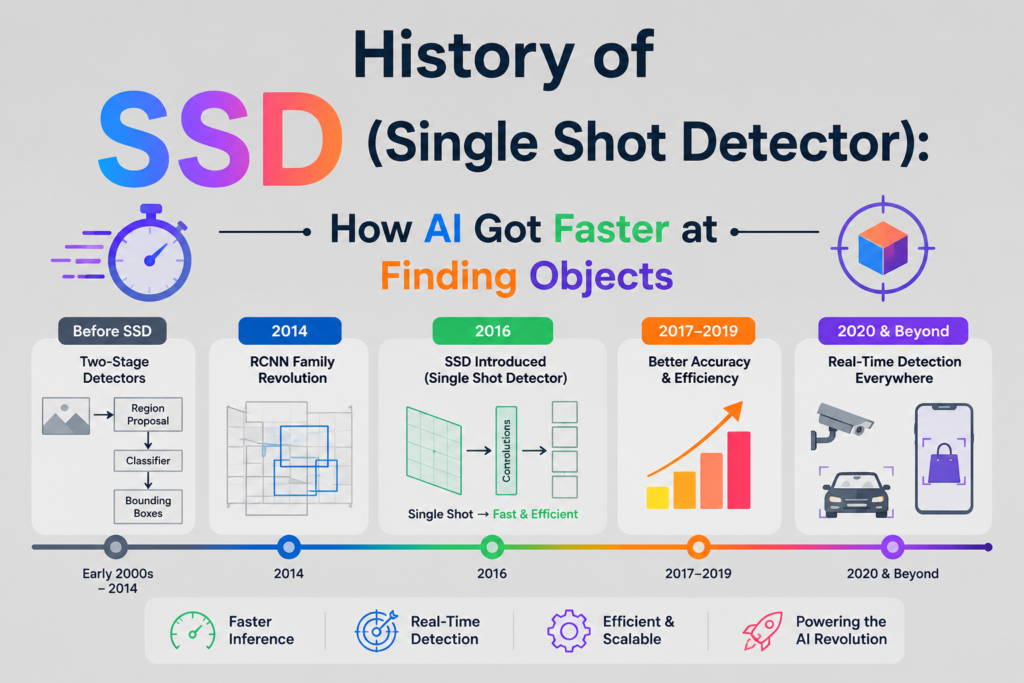
By 2016, object detection had already gone through several dramatic transformations. The history of r-cnn had brought deep learning to the problem, and the history of yolo had shown that detection could happen in a single pass through a network at remarkable speed. Into this rapidly evolving landscape arrived the single shot detector, an architecture that took the single-pass philosophy YOLO had pioneered and combined it with a more sophisticated use of multi-scale feature maps, producing a detector that balanced speed and accuracy in a way that quickly made it one of the most widely deployed object detection models in the world. This article explores the complete history of the single shot detector, its architecture, and its lasting impact on computer vision.
The Landscape Before SSD (2015 – 2016)
By the time the single shot detector was introduced, the broader history of object detection had already split into two distinct philosophies. Two-stage detectors, descended from the history of r-cnn and refined through the history of faster r-cnn, prioritized accuracy through region proposals followed by detailed classification. One-stage detectors, pioneered by the original history of yolo in 2015, prioritized speed by predicting all detections in a single forward pass.
The original YOLO had demonstrated that single-pass detection could achieve real-time speeds, but it struggled with small objects and objects that appeared close together, largely because it made predictions from a single feature map at a fixed resolution. This left an opening for an architecture that could maintain the speed advantages of single-pass detection while addressing this weakness more directly.
Wei Liu and the Introduction of SSD (2016)
Wei Liu Single Shot MultiBox Detector history begins with a paper published in 2016 titled “SSD: Single Shot MultiBox Detector,” authored by Wei Liu and collaborators. The paper introduced an architecture explicitly designed to combine the speed of single-pass detection with improved accuracy, particularly for objects of varying sizes.
SSD object detection architecture evolution reflects a deliberate design choice: rather than relying on a single feature map for all predictions, as the original YOLO had done, SSD made predictions from multiple feature maps at different layers of the network, each corresponding to a different spatial resolution. This multi-scale approach directly addressed the small object detection weakness that had limited earlier single-stage detectors.
How SSD’s Architecture Works
The single shot detector architecture begins with a Base network classifier (VGG16), the same convolutional architecture that had become popular following the history of VGGNet, used to extract initial feature maps from the input image. Rather than stopping at a single output layer, SSD adds a series of additional convolutional layers after the base network, each producing feature maps at progressively smaller spatial resolutions.
History of multi scale feature maps for detection is central to understanding SSD’s design. Early feature maps, with higher spatial resolution, are well suited to detecting smaller objects, since they preserve fine spatial detail. Later feature maps, with lower spatial resolution but larger receptive fields, capture more abstract, larger-scale information well suited to detecting larger objects. By making predictions from several of these feature maps simultaneously, SSD could handle objects across a wide range of sizes within a single forward pass.
Receptive field layer depth plays an important role here. As an image passes through successive convolutional layers, each neuron’s receptive field, the region of the original input image that influences its activation, grows larger. SSD exploits this property directly, using shallower layers with smaller receptive fields for small object detection and deeper layers with larger receptive fields for large object detection.
Default Boxes and the MultiBox Approach
At each location on each feature map, SSD evaluates a set of Default bounding boxes, sometimes called default boxes or, in earlier terminology, priors, each with a specific scale and aspect ratio. Aspect ratio variations across these default boxes allow the network to handle objects with different shapes, from roughly square objects to very wide or very tall ones, without needing to predict box dimensions entirely from scratch.
Feature map cell ratios determine how these default boxes are distributed spatially across each feature map, with each cell in the feature map grid responsible for predicting offsets and confidence scores for the default boxes associated with that location. For each default box, the network predicts both a confidence score for each object class and four values representing adjustments to the box’s position and size, allowing the default box to be refined into a more accurate bounding box for any object present.
MultiBox objective function, the loss function used to train SSD, combines two components: a localization loss measuring how well the predicted box offsets match the ground truth bounding boxes, and a confidence loss measuring how well the predicted class probabilities match the actual object classes present. End-to-end regression layers throughout the network are trained jointly to minimize this combined objective, allowing the entire detection process to be learned as a single optimization problem.
Handling the Class Imbalance Problem
One of the practical challenges in training the single shot detector, and indeed any dense, single-pass detector, is that the vast majority of default boxes at any given location do not correspond to an actual object. This creates a severe imbalance between positive examples, default boxes that match real objects, and negative examples, default boxes that do not.
Hard negative mining execution addresses this imbalance directly. Rather than using all negative examples during training, which would overwhelm the relatively rare positive examples, SSD selects a subset of negative examples, specifically those for which the network currently produces the highest confidence scores, meaning the cases where the network is most confidently wrong. Training primarily on these hard negative examples, along with all positive examples, produces a more balanced and effective training signal.
Focal loss mitigation represents a related but distinct approach to this same fundamental problem, developed in subsequent research and adopted by some later single-stage detectors. While SSD itself primarily relied on hard negative mining, the broader class imbalance challenge it highlighted influenced the design of loss functions in later architectures across the history of object detection.
SSD on Benchmarks (2016 – 2018)
Evolution of SSD on PASCAL VOC benchmarks shows that the original SSD achieved a notable combination of speed and accuracy compared to its predecessors. On standard object detection benchmarks of the time, SSD achieved accuracy competitive with, and in some cases exceeding, the original YOLO, while also demonstrating strong results on benchmarks that specifically tested multi-scale object handling, where its multi-scale feature map approach gave it a clear advantage over single-resolution detectors.
Single shot detector vs YOLO comparison history during this period generally placed SSD as offering a favorable balance: faster than two-stage detectors like the history of faster r-cnn, and more accurate on small objects than the original YOLO, though subsequent versions of YOLO would later incorporate similar multi-scale techniques and close much of this gap.
Architectural analysis of single shot multi box detector approaches during this period often highlighted SSD’s relative simplicity compared to two-stage detectors, combined with its strong performance, as key reasons for its rapid adoption across both research and industry applications.
SSD’s Influence on Subsequent Architectures (2017 – 2024)
Development of real time single stage networks following SSD’s introduction was significantly shaped by the architectural ideas it popularized. Multi-scale feature maps, in particular, became a standard component of nearly all subsequent object detection architectures, regardless of whether they were one-stage or two-stage detectors. Later versions of the history of yolo, for example, explicitly adopted multi-scale prediction approaches conceptually similar to those pioneered by SSD.
SSD object localization framework breakdown also influenced how researchers thought about the relationship between network depth and the scale of objects a given layer is best suited to detect, a principle that continues to inform the design of modern object detection architectures, including those used for the history of pose estimation and other related tasks that benefit from multi-scale feature representations.
The YOLO vs R-CNN vs SSD comparison that became a standard framework for understanding object detection tradeoffs owes much of its structure to SSD’s position as a middle ground: faster than two-stage detectors descended from the history of r-cnn, while offering accuracy advantages over the earliest single-stage approaches.
SSD in Edge AI and Practical Deployment
Legacy of single shot detectors in edge AI reflects one of SSD’s most enduring practical contributions. Because SSD’s architecture, while more complex than the original YOLO, remained significantly lighter and faster than two-stage detectors, it became a popular choice for deployment on resource-constrained devices, including smartphones, embedded systems, and edge computing hardware used in applications like drones and computer vision and computer vision in manufacturing.
The combination of reasonable accuracy, real-time or near-real-time speed, and a relatively straightforward architecture made SSD an attractive option for developers building practical computer vision applications throughout the late 2010s, and variants of SSD remain in use today, particularly in contexts where computational resources are limited and the multi-scale feature map approach provides a good balance between detection quality and efficiency.
Frequently Asked Questions
Who created the single shot detector?
The single shot detector, commonly known as SSD, was introduced by Wei Liu and collaborators in a 2016 paper titled “SSD: Single Shot MultiBox Detector.” It built on the single-pass detection philosophy introduced by the original YOLO the previous year, while adding a more sophisticated multi-scale feature map approach.
How does SSD differ from YOLO?
The original YOLO made predictions from a single feature map at a fixed resolution, which limited its ability to detect small objects effectively. SSD made predictions from multiple feature maps at different resolutions throughout the network, allowing it to better handle objects of varying sizes within a single forward pass, while remaining a one-stage, single-pass detector like YOLO.
What are default boxes in SSD?
Default boxes, sometimes called priors, are a predefined set of bounding box shapes and sizes evaluated at each location on each feature map used by SSD. For each default box, the network predicts a confidence score for each object class and adjustments to the box’s position and size, allowing default boxes to be refined into accurate bounding boxes for detected objects.
Why is hard negative mining important for SSD?
Because SSD evaluates a very large number of default boxes across multiple feature maps, the vast majority of these do not correspond to actual objects, creating a severe imbalance between positive and negative training examples. Hard negative mining addresses this by training primarily on the negative examples where the network is most confidently incorrect, producing a more effective and balanced training signal than using all negative examples equally.
Is SSD still used today?
Yes, particularly in edge AI and resource-constrained deployment scenarios, where SSD’s balance of speed, accuracy, and architectural simplicity remains valuable. While later versions of YOLO and other architectures have incorporated similar multi-scale techniques and often outperform SSD on modern benchmarks, SSD remains a relevant and widely understood architecture, particularly for applications like drones and computer vision and embedded computer vision in manufacturing systems.
Conclusion
The single shot detector represents an important moment in the evolution of object detection, taking the single-pass philosophy that the original YOLO had pioneered and refining it through a more sophisticated multi-scale feature map approach. Wei Liu’s 2016 architecture demonstrated that single-stage detectors did not need to sacrifice as much accuracy for speed as the earliest single-pass approaches had suggested, particularly for small and variably sized objects.
The architectural ideas SSD introduced, multi-scale feature maps, default boxes with varying aspect ratios, and hard negative mining, have become standard components across nearly every modern object detection architecture built on computer vision technology today. Understanding the history of the single shot detector is understanding how the field learned that speed and accuracy did not have to be opposing forces, but could be balanced through thoughtful architectural design.