Introduction
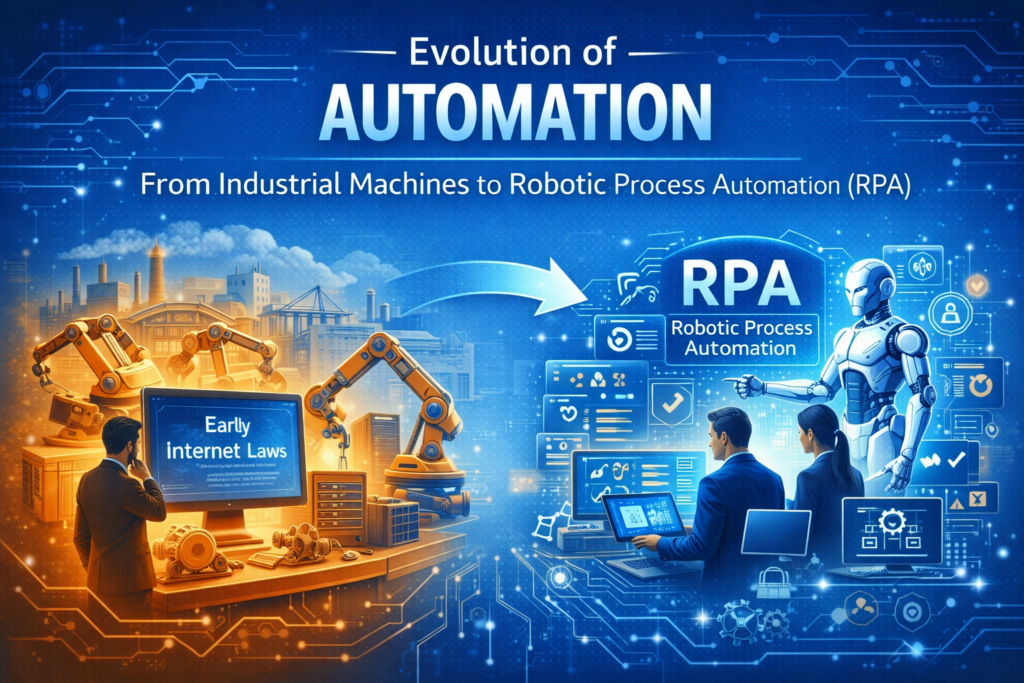
The desire to make machines work without human intervention is ancient. But the evolution of automation truly began with the Industrial Revolution and has accelerated dramatically in recent decades. What started with water wheels and steam engines has progressed through programmable logic controllers, industrial robots, and now software robots that mimic human keystrokes. The amazing journey of the evolution of automation has reshaped manufacturing, transformed offices, and is now redefining knowledge work. Understanding this powerful progression helps businesses and workers prepare for a future where Digital transformation touches every industry. This article traces the remarkable path from mechanical automation to intelligent systems that learn and adapt.
Before Automation: The Age of Manual Labor (Pre 1700)
Before the evolution of automation began, nearly all work was manual. Craftsmen shaped materials with hand tools. Farmers tilled soil with animal drawn plows. Scribes copied documents letter by letter. The history of computers was centuries away. The only “automation” came from simple machines like levers, pulleys, and water wheels. These devices multiplied human strength but could not operate independently. A water wheel required a river. A lever required a person. The evolution of automation needed three things: a power source, a control mechanism, and a feedback system. The Industrial Revolution would supply all three.
The First Industrial Revolution: Mechanical Power (1760 – 1830)
The evolution of automation took its first great leap with steam power. James Watt’s improved steam engine, patented in 1769, provided reliable mechanical power that did not depend on flowing water. Factories could now be built anywhere. The spinning jenny, the power loom, and the cotton gin automated textile production. A single machine could do the work of dozens of hand weavers. The evolution of automation had begun in earnest.
These early machines were not “programmable” in any modern sense. A water wheel or steam engine ran continuously at a fixed speed. Operators started and stopped machines with mechanical clutches and levers. But the principle was established: machines could replace human muscle. The history of computer hardware would later apply similar thinking to information processing. The evolution of automation in manufacturing set the stage for automation in computing.
The Second Industrial Revolution: Electricity and Assembly Lines (1870 – 1914)
The next phase of the evolution of automation came with electricity. Electric motors were smaller, cleaner, and more controllable than steam engines. Each machine could have its own motor. Factories could arrange workstations in logical sequences rather than clustering around a central steam engine. Henry Ford’s assembly line, introduced in 1913, represented a breakthrough in Workflow optimization. A Model T Ford moved from station to station. Each worker performed a single Repetitive task. The car was built in 93 minutes instead of 12 hours.
The evolution of automation during this era also introduced feedback control. James Watt’s centrifugal governor, invented in 1788, was an early example. A spinning ball mechanism detected engine speed. If the engine ran too fast, the governor reduced the steam flow. If the engine slowed, the governor increased steam flow. This automatic regulation was a form of Operational efficiency that required no human intervention. Feedback control became essential for everything from room thermostats to cruise control.
The Birth of Programmable Control (1930 – 1970)
The evolution of automation took a conceptual leap with programmable control. Instead of designing a machine to perform one task forever, what if a machine could be reconfigured for different tasks? The first programmable machines used punched paper tape. Player pianos from the late 19th century played different songs by changing the roll of paper with holes. Similarly, early industrial machines used punched cards or tape to change operations.
The real breakthrough came with the Programmable Logic Controllers (PLC) . In 1968, GM engineer Richard Morley proposed replacing complex relay based control systems with a computer that could be reprogrammed. Modicon (Morley’s company) built the first PLC, the Modicon 084. A PLC could monitor inputs (sensors, switches) and control outputs (motors, valves) based on a program written in ladder logic. The evolution of automation had entered the digital age. PLCs were rugged, reliable, and easy for factory electricians to program. They became ubiquitous in manufacturing.
SCADA systems (Supervisory Control and Data Acquisition) emerged alongside PLCs. SCADA provided centralized monitoring and control of distributed industrial processes. A single operator at a computer screen could oversee an entire factory or an oil pipeline stretching hundreds of miles. SCADA collected data from remote PLCs, displayed status information, and allowed operators to send control commands. The evolution of automation made it possible to run massive industrial facilities with minimal on site personnel.
Industrial Robots Enter the Factory (1960 – 1990)
The evolution of automation added articulated arms and grippers. George Devol patented the first industrial robot in 1954, but it took until 1961 for the first Unimate robot to operate at a GM factory. Unimate was a hydraulic arm that lifted hot die cast parts. It replaced a worker who might otherwise be injured by heat or heavy lifting. The evolution of automation had moved beyond fixed machines to devices that could mimic human arm movements.
The history of computers and microprocessors made robots smarter. By the 1980s, robots could weld car bodies, paint vehicles, and assemble electronics. Each robot repeated the same motion thousands of times per day with precision no human could match. The evolution of automation created new jobs (robot programmers, maintenance technicians) while eliminating others (manual welders, painters). This pattern of workforce displacement and creation would repeat with software automation decades later.
The Rise of Office Automation (1970 – 1990)
While factories automated physical work, offices began automating information work. The evolution of automation entered the white collar world. Word processors automated typing and editing. Spreadsheets automated calculations that accountants once performed by hand. Email automated postal mail. These tools did not replace office workers entirely, but they dramatically increased Productivity gains. A single secretary with a word processor could produce more documents than a team of typists.
The personal computer, popularized by IBM in 1981 and the Macintosh in 1984, brought automation to every desk. History of operating systems like MS-DOS and Windows provided platforms for endless automation tools. Macro recorders captured keystrokes and played them back. Scripting languages like batch files and later PowerShell automated repetitive tasks. The evolution of automation was no longer confined to factories. It was happening on every office computer.
Business Process Automation (1990 – 2010)
As computers networked together, the evolution of automation expanded from individual tasks to entire processes. Business Process Automation (BPA) used software to automate sequences of activities across multiple systems. For example, when a customer placed an order online, BPA software could check inventory, charge the credit card, send a confirmation email, and create a shipping label. No human touched the order unless something went wrong.
BPA relied on integration between systems. An order system needed to talk to inventory, payment, email, and shipping systems. This was often achieved through application programming interfaces (APIs) or enterprise application integration (EAI) middleware. The history of databases and history of software engineering both contributed to making BPA possible. However, traditional BPA had a limitation. It required that all systems have APIs or integration capabilities. Many legacy systems did not.
The Birth of Robotic Process Automation (2010 – 2015)
The evolution of automation took a different path with Robotic Process Automation (RPA) . RPA software “robots” interact with applications through the user interface, just like a human would. An RPA robot can open a browser, click buttons, type into forms, copy data from spreadsheets, and log into legacy systems. Because RPA works at the UI layer, it does not require APIs. This made RPA an attractive option for automating processes that involved old, hard to integrate systems.
UiPath and Blue Prism emerged as leaders in the RPA space. UiPath, founded in 2005 but gaining prominence after 2015, offered a visual designer where users could drag and drop activities to build automation workflows. Blue Prism, founded in 2001, focused on enterprise scale RPA with governance and security features. The evolution of automation had created a new category of software that could work across virtually any application. RPA robots could work 24/7, never made typos, and executed processes exactly as programmed.
RPA proved especially valuable in finance, insurance, healthcare, and other industries with many legacy systems. A bank might use RPA to open new accounts by pulling data from a customer relationship management system, entering it into a core banking system, and sending welcome emails. The evolution of automation showed that not every integration needed an API. Sometimes a robot mimicking human clicks was faster and cheaper.
Hyperautomation and Intelligent Automation (2017 – Present)
The evolution of automation accelerated further with Hyperautomation. Gartner named hyperautomation a top technology trend in 2020. Hyperautomation combines RPA with artificial intelligence, machine learning, process mining, and other advanced tools. Instead of just automating repetitive tasks, hyperautomation aims to automate entire business processes end to end, including decisions that once required human judgment.
Artificial Intelligence (AI) and Machine learning workflows enable RPA robots to handle unstructured data. A traditional RPA robot could read a well formatted Excel sheet. An intelligent robot can read an invoice scanned as a PDF, extract the vendor name, invoice number, and amount using optical character recognition (OCR) and natural language processing, then enter that data into an accounting system. The evolution of automation had moved from deterministic rules to probabilistic intelligence.
Low code/No code platforms democratized automation. Business users without programming skills could build automations using visual interfaces. Microsoft Power Automate, Zapier, and Make (formerly Integromat) allowed anyone to connect cloud services and automate workflows. The evolution of automation meant that automation was no longer the exclusive domain of IT departments. Marketing, sales, HR, and finance teams could automate their own processes.
Cognitive Automation and AI Agents (2020 – Present)
The evolution of automation entered its most sophisticated phase with cognitive automation. Chatbots and Virtual Assistants automated customer service interactions. Instead of waiting on hold, customers could chat with an AI that answered common questions, reset passwords, or processed returns. When the AI could not resolve the issue, it transferred the customer to a human agent along with the full conversation history. This hybrid approach improved efficiency and customer satisfaction.
Cognitive automation also enabled document understanding. AI models could review contracts, flag unusual clauses, and suggest changes. They could analyze medical records to support diagnosis. They could read legal briefs and summarize key arguments. The evolution of automation was beginning to automate cognitive tasks that required education and expertise, not just repetitive manual work.
Process mining emerged as a complementary technology. Process mining tools analyzed event logs from enterprise systems to discover how processes actually executed, not how they were designed on paper. They identified bottlenecks, deviations, and opportunities for automation. The evolution of automation became data driven. Organizations could measure their automation potential and prioritize the highest value opportunities.
The Industrial Revolution 4.0 (2015 – Present)
The evolution of automation in manufacturing entered a new phase called Industrial Revolution 4.0 . Industry 4.0 combines automation with connectivity, data exchange, and cyber physical systems. Smart factories use sensors, IoT devices, and cloud analytics to optimize production in real time. A machine can detect that it is wearing down, order its own replacement part, and schedule its own maintenance.
The history of the Internet of Things and history of cloud computing enabled Industry 4.0. Machines that were once isolated now report their status to central systems. Predictive analytics forecast failures before they happen. Digital twins (virtual replicas of physical assets) allow engineers to simulate changes before implementing them on the factory floor. The evolution of automation had made the factory a self optimizing system.
Scalability became easier with cloud based automation platforms. A small manufacturer could access the same automation tools as a global giant, paying only for what they used. The evolution of automation was democratizing access to advanced manufacturing capabilities.
The Impact on Work and Skills
The evolution of automation has always created anxiety about Workforce displacement. Every wave of automation, from the spinning jenny to RPA, has eliminated some jobs while creating others. The Luddites of early 19th century England destroyed machines they feared would take their work. Their concerns were not irrational. Many weavers did lose livelihoods. But over time, automation created more jobs than it destroyed. The nature of work changed.
Today, the evolution of automation is eliminating routine cognitive work. Data entry, invoice processing, report generation, and even some legal and accounting tasks can be automated. The jobs that remain require creativity, emotional intelligence, complex problem solving, and human interaction. The evolution of automation suggests that workers will need continuous Upskilling and reskilling to stay relevant.
Operational efficiency gains from automation have been enormous. A process that took a human hours might take an RPA robot minutes. Robots work 24/7/365 without breaks, benefits, or burnout. They never take vacation. They never make arithmetic errors. The evolution of automation has enabled organizations to do more with fewer people. The challenge for society is to distribute the benefits of these productivity gains broadly.
The Future of Automation
What comes next in the evolution of automation ? Several trends are clear. First, AI and automation will continue to converge. Intelligent automation will handle increasingly complex tasks. Second, autonomous systems will spread beyond factories. Self driving vehicles, autonomous drones, and robotic delivery devices will become common. Third, the evolution of automation will reach small businesses and individuals. Low code tools and affordable robots will put automation within reach of everyone.
The evolution of the first digital computer from a room sized machine to a device in every pocket shows how technology becomes more capable and accessible over time. The same is happening with automation. Early automation required massive factories and huge budgets. Today, a solo entrepreneur can automate their business with cloud tools. Tomorrow, everyone may have an AI assistant automating routine digital tasks.
The history of devOps and devops tools evolution have shown how automation transforms software development. The same principles are spreading to every industry. The evolution of automation is not slowing down. It is accelerating.
Frequently Asked Questions (FAQs)
Q1: What is the difference between RPA and traditional automation?
Robotic Process Automation (RPA) works at the user interface level, interacting with applications like a human would by clicking and typing. Traditional automation uses APIs or direct database connections. RPA is faster to implement for legacy systems but can be less reliable when user interfaces change.
Q2: Will automation eliminate all jobs?
No. The evolution of automation has consistently created new job categories while eliminating others. Jobs requiring creativity, emotional intelligence, complex problem solving, and human interaction are least likely to be automated. However, workers will need continuous Upskilling and reskilling to adapt.
Q3: What is hyperautomation?
Hyperautomation is the combination of RPA, artificial intelligence, process mining, analytics, and other tools to automate entire business processes end to end. It goes beyond automating individual tasks to orchestrating complex workflows that once required human judgment.
Q4: How do low-code platforms relate to automation?
Low code/No code platforms allow business users to build automations using visual drag and drop interfaces instead of writing code. They democratize the evolution of automation, enabling non programmers to automate their own workflows.
Q5: What is Industry 4.0?
Industrial Revolution 4.0 refers to the current phase of manufacturing automation, characterized by cyber physical systems, the Internet of Things, cloud computing, and cognitive automation. Smart factories use real time data to optimize production autonomously.
Q6: Can small businesses benefit from automation?
Absolutely. Cloud based RPA tools, low code platforms, and AI services are available on subscription models with no upfront hardware costs. A small business can automate invoicing, customer support chatbots, social media posting, and many other tasks for a few hundred dollars per month.
Q7: What skills will be valuable as automation advances?
Skills that complement automation rather than compete with it. These include problem framing (defining what to automate), data analysis, process design, human oversight of automated systems, and uniquely human skills like creativity, empathy, and strategic thinking. The evolution of automation rewards those who work with machines rather than against them.
Conclusion
The evolution of automation from water wheels to RPA to cognitive AI is an amazing story of human ingenuity. Each wave of automation has expanded what machines can do, from replacing muscle to replacing routine cognition. The evolution of automation has delivered powerful Productivity gains while creating persistent challenges around workforce displacement and inequality. The future will bring hyperautomation, intelligent agents, and autonomous systems that seem like science fiction today. The evolution of automation is not something that happens to us. It is something we build. The choices we make about how to deploy automation will shape the future of work and society.