
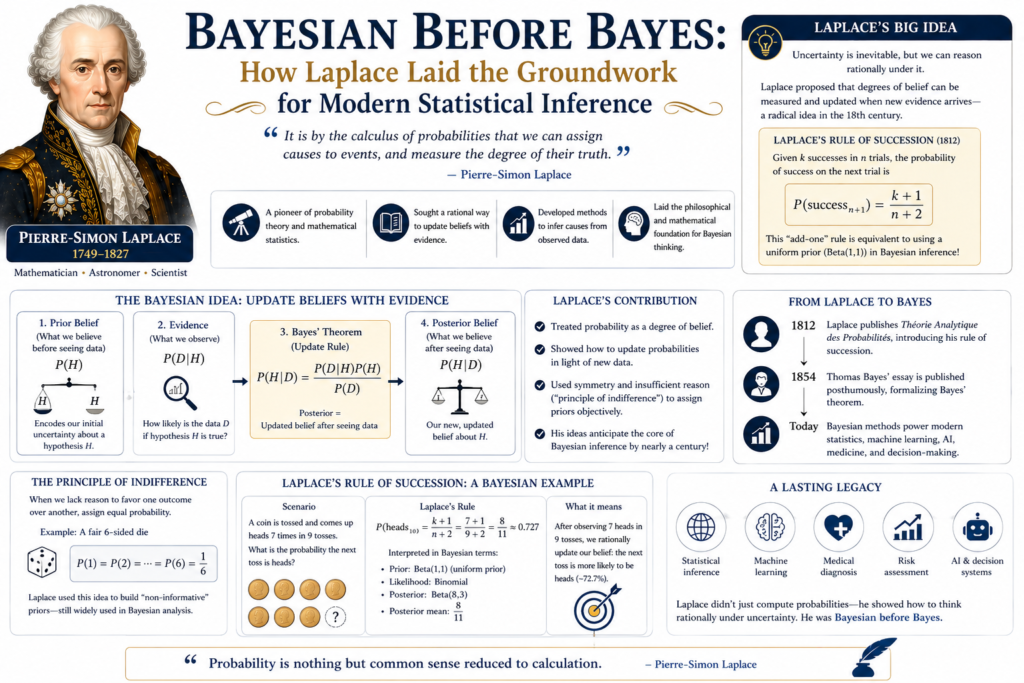
laplace bayesian foundations represent one of the most brilliant and powerful turning points in the history of mathematics and science. Long before modern statistics and machine learning became central to data analysis, Pierre-Simon Laplace was already building a framework that would define how humans reason under uncertainty.
While Thomas Bayes is often credited with Bayesian thinking, it was Laplace who transformed these early ideas into a complete and usable system of statistical inference. Through deep mathematical insight, inductive logic, and evidence-based math, laplace bayesian foundations reshaped scientific reasoning forever.
The Origins of laplace bayesian foundations (1760 – 1780)
The story of laplace bayesian foundations begins in the late 18th century, a time when mathematics was evolving rapidly. Early probability theory was limited to games of chance and simple calculations. However, Laplace saw something much deeper.
Inspired by thinkers like Pierre-Simon Laplace, he explored inverse probability, a concept that focuses on determining causes from observed effects. This idea became the backbone of statistical inference.
Laplace believed that probability was not just about random events but about understanding uncertainty in real life. His work bridged the gap between abstract mathematics and practical scientific reasoning.
Mathematical Core of laplace bayesian foundations
At the heart of laplace bayesian foundations lies a simple yet powerful idea: updating beliefs based on evidence. This is captured in what we now call Bayes theorem.
This formula represents how prior probability is updated to form a posterior distribution after observing new data.
Laplace expanded this idea by applying it systematically to real problems. He introduced methods to calculate likelihood and combine it with prior probability to produce accurate predictions.
Another key contribution was his use of continuous probability distributions, allowing for more advanced data analysis.
From Bayes to Laplace: The True Transformation
Although Thomas Bayes introduced the initial concept, his work was limited and not widely known during his lifetime. Laplace took these ideas and turned them into a complete theory.
He developed methods for sampling, estimators, and population statistics. His work provided mathematical proofs that validated Bayesian reasoning.
This is why many historians consider him not just a contributor but the true architect of laplace bayesian foundations.
Rule of Succession and Predictive Power
One of the most famous contributions of laplace bayesian foundations is the rule of succession. This rule estimates the probability of future events based on past observations.
Here, s represents the number of successes and n represents total observations.
Laplace used this formula to answer questions like the probability that the sun will rise tomorrow. While simple, this idea demonstrates the power of predictive modeling and inductive logic.
Statistical Inference and Scientific Reasoning
Laplace transformed probability into a tool for scientific reasoning. His work showed that uncertainty can be measured and managed.
He applied laplace bayesian foundations to astronomy, physics, and social sciences. His methods allowed scientists to analyze data and draw conclusions with confidence.
This approach laid the groundwork for modern data analysis and evidence-based decision making.
Bayesian vs Frequentist Debate
The influence of laplace bayesian foundations continues in the ongoing debate between Bayesian vs Frequentist approaches.
Bayesian methods focus on subjective probability and updating beliefs. Frequentist methods rely on long-term frequency of events.
Laplace’s work strongly supports the Bayesian perspective, emphasizing the importance of prior knowledge and uncertainty.
Today, both approaches are used in statistics, but Bayesian methods are increasingly popular in machine learning and artificial intelligence.
Connection to Other Scientific Contributions
Laplace’s work in probability was deeply connected to his broader scientific achievements.
His deterministic philosophy is reflected in laplace’s demon, which imagines a universe where everything can be predicted. His mathematical tools like laplace transform show his versatility.
He also contributed to physics and astronomy through celestial mechanics, demonstrating the universal application of his ideas.
His masterpiece mécanique céleste integrates mathematical reasoning with physical laws, further highlighting his genius.
Applications of laplace bayesian foundations in Modern World
Today, laplace bayesian foundations are everywhere. They are used in:
- Machine learning algorithms
- Predictive modeling systems
- Risk assessment in finance
- Medical diagnosis and research
- Data science and artificial intelligence
Modern technologies rely on Bayesian reasoning to handle uncertainty and make informed decisions.
From recommendation systems to fraud detection, the principles developed by Laplace continue to shape innovation.
Philosophical Impact and Legacy
Beyond mathematics, laplace bayesian foundations have a profound impact on philosophy of science.
They provide a framework for understanding how knowledge evolves with evidence. This aligns with the scientific method and inductive reasoning.
Laplace’s work emphasizes that certainty is rare, but probability allows us to make rational decisions in uncertain situations.
His legacy as the father of probability is well deserved, as he transformed a simple concept into a powerful scientific discipline.
Modern Relevance in Data Driven World
In today’s data driven world, laplace bayesian foundations are more relevant than ever.
They help analyze large datasets, improve decision making, and enhance predictive accuracy. In fields like population statistics and machine learning, Bayesian methods are essential.
Even everyday applications like search engines and recommendation systems rely on these principles.
Laplace’s ideas have become a cornerstone of modern technology and innovation.
Important FAQs About laplace bayesian foundations
What are laplace bayesian foundations?
They are the mathematical and conceptual framework developed by Laplace for updating probabilities based on evidence.
Did Laplace invent Bayesian theory?
While Thomas Bayes introduced the idea, Laplace expanded and formalized it into a complete system.
What is the rule of succession?
It is a formula used to estimate the probability of future events based on past observations.
How are laplace bayesian foundations used today?
They are used in data science, machine learning, finance, and scientific research.
What is the difference between Bayesian and Frequentist approaches?
Bayesian methods use prior probability and update beliefs, while Frequentist methods rely on long-term frequencies.
Conclusion
The story of laplace bayesian foundations is a powerful example of how one brilliant mind can reshape the way we think about uncertainty and knowledge. Laplace did not just refine probability, he transformed it into a universal language of reasoning.
His work continues to influence modern science, technology, and philosophy. By combining mathematics with logic and evidence, he created a system that remains essential in today’s world.
To fully understand the evolution of scientific thought, we must also explore how ancient greek scientists changed modern science, as their foundational ideas paved the way for Laplace’s revolutionary contributions.
The legacy of laplace bayesian foundations reminds us that even in uncertainty, there is structure, logic, and the potential for discovery.
LKIWIN! Sounds promising. Gonna give it a whirl and see if I can turn that luck around. Maybe this is the one. Check it out: lkiwin