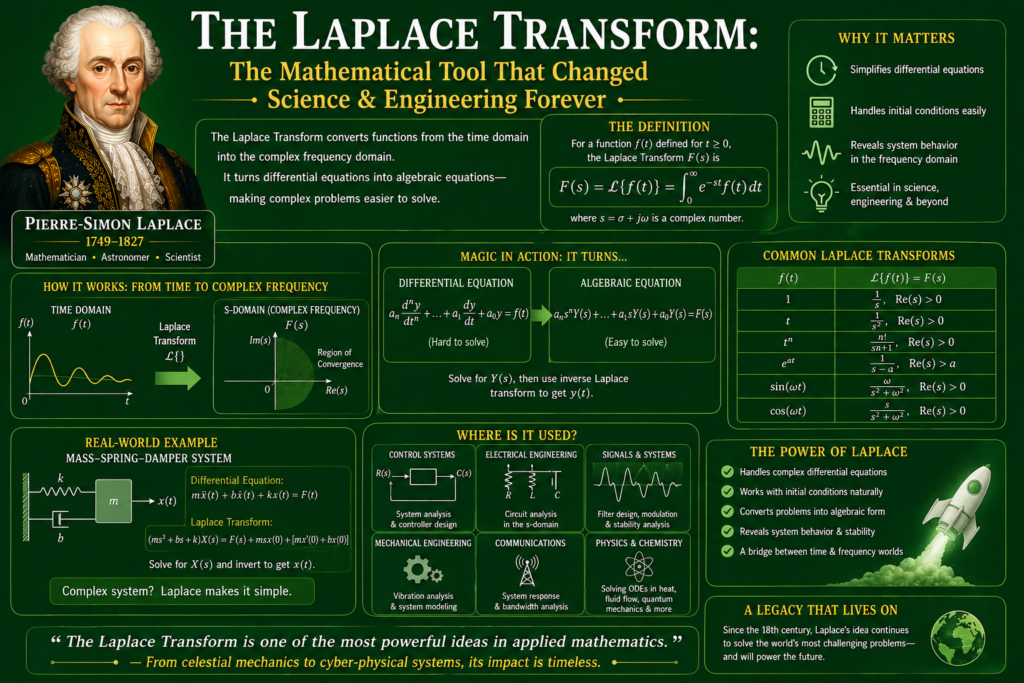
Imagine facing a terrifyingly complex differential equation that describes an electrical circuit, a swinging pendulum, or a robotic arm. Solving it directly in the time domain feels almost impossible. Then you learn a magical trick: transform the entire problem into a different universe, solve it with simple algebra, and then transform back. That is exactly what the laplace transform does. This brilliant mathematical tool, named after Pierre Simon Laplace, has fundamentally altered how engineers and scientists approach dynamic systems. From designing autopilots to analyzing heartbeats, from stabilizing power grids to understanding suspension bridges, the laplace transform works silently behind the scenes. It converts calculus problems into algebra problems, turning derivatives into multiplications and integrals into divisions. In this article, we will explore the astonishing power of this technique, its history, its mathematics, and its endless real world applications. By the end, you will see why no engineer or physicist can live without it.
The Man Behind the Name: Pierre Simon Laplace (1749 – 1827)
Before diving into mathematics, we must understand the genius who lent his name to this tool. Pierre Simon Laplace was a French mathematical giant whose work spanned celestial mechanics, probability, and physics. He wrote the monumental Mécanique Céleste, which applied Newtonian gravity to the entire solar system. He also formulated Laplace’s Equation (∇²φ = 0), a cornerstone of potential theory. However, Laplace himself did not invent the transform that bears his name. The laplace transform was developed later, primarily by the English engineer Oliver Heaviside in the late 19th century. Heaviside discovered a powerful operational calculus for solving differential equations, but his methods lacked rigorous mathematical foundations. Mathematicians like Henri Poincaré and others subsequently connected Heaviside’s work to Laplace’s earlier integrals. The name “laplace transform” stuck because the core integral ∫₀^∞ f(t)e^{-st} dt appears in Laplace’s probability and celestial mechanics research. So while Laplace did not create the transform as we use it today, his mathematical DNA runs through its veins. He is also known as the Father of Probability and proposed Laplace’s Demon, a hypothetical intellect that could predict the entire future. The laplace transform is a more practical legacy, one that truly changed the world.
The Mathematical Definition: From Time to s Domain
Let us write down the laplace transform in its pure mathematical form. For a function f(t) defined for all t ≥ 0, the laplace transform F(s) is given by:
F(s) = ∫₀^∞ f(t) e^{-st} dt
Here, t represents time (the time domain), and s is a complex variable written as s = σ + iω (the frequency domain or s domain). The exponential term e^{-st} acts as a damping factor, ensuring that many functions produce convergent integrals. The power of the laplace transform lies in how it handles derivatives. For a function f(t) with zero initial conditions, the transform of its first derivative is:
L{f'(t)} = s F(s) f(0)
If f(0) = 0, this simplifies to L{f'(t)} = s F(s). Similarly, the second derivative becomes:
L{f”(t)} = s² F(s) s f(0) f'(0)
With zero initial conditions, L{f”(t)} = s² F(s). Notice what happened: differentiation in the time domain becomes multiplication by s in the s domain. Integration becomes division by s. This is the revolutionary insight. A messy differential equations problem transforms into a simple algebraic equation. Solve for F(s) using basic algebra, then apply the inverse laplace transform to return to f(t). The inverse transform is:
f(t) = (1/2πi) ∫_{c i∞}^{c+i∞} F(s) e^{st} ds
In practice, engineers rarely compute this complex integral. They use tables of known transform pairs, which is far easier.
Why This Transform Is a Powerful Engineering Tool
The laplace transform is not just a mathematical curiosity; it is an essential engineering tool. Before its widespread adoption, solving linear systems with differential equations was painfully slow. Each new problem required custom integration techniques. With the laplace transform, engineers gained a universal method. Consider a simple RC electrical circuit. The governing differential equation is:
R C (dv/dt) + v = v_in(t)
Taking the laplace transform of both sides (assuming zero initial conditions) gives:
R C (s V(s)) + V(s) = V_in(s)
Factor V(s): V(s) (R C s + 1) = V_in(s)
Thus: V(s) = V_in(s) / (R C s + 1)
This is an algebraic expression. To find v(t), one looks up the inverse transform of 1/(RC s + 1), which is an exponential decay. The entire solution takes minutes instead of hours. This same procedure works for mechanical systems (mass spring damper), thermal systems, fluid systems, and more. The laplace transform treats all time invariant systems uniformly. It reveals the transfer function H(s) = output/input, which completely characterizes a system’s behavior. The impulse response (reaction to a sudden spike) is simply the inverse transform of H(s). Stability analysis becomes checking whether the poles of H(s) (roots of denominator) have negative real parts. This is the foundation of modern control systems.
Historical Development (1880 – 1920)
The laplace transform did not appear fully formed. Its journey began with Oliver Heaviside, a self taught English electrical engineer. Between 1880 and 1895, Heaviside developed “operational calculus,” a set of symbolic rules where the differential operator p = d/dt was treated as an algebraic variable. Heaviside solved telegraphy equations and predicted the existence of the ionosphere using these methods. However, pure mathematicians criticized his lack of rigor. Heaviside famously replied: “I do not understand my methods, but I am applying them correctly.” Enter the mathematicians. In the early 20th century, Thomas Bromwich and others provided rigorous foundations using contour integration in the complex plane. They connected Heaviside’s methods to Laplace’s earlier integral work. The formal laplace transform definition using ∫₀^∞ f(t)e^{-st} dt became standard. By 1920, the laplace transform was a mature mathematical discipline. It soon migrated from electrical engineering to mechanical engineering, chemical engineering, and aerospace. The development of signal processing heavily relied on it. The frequency domain (s domain) became as important as the time domain. Today, every engineering student learns the laplace transform in their second year. It is as fundamental as calculus.
Application in Control Systems (1930 – 1970)
The golden age of control systems coincided with the widespread adoption of the laplace transform. In the 1930s, Harold Black and Harry Nyquist at Bell Labs developed feedback amplifiers. They needed a way to analyze stability and performance. The laplace transform provided the perfect language. A feedback control system has a forward path G(s) and a feedback path H(s). The closed loop transfer function is:
T(s) = G(s) / (1 + G(s)H(s))
Stability requires that all poles of T(s) lie in the left half of the complex s plane (negative real parts). Engineers could now design controllers using root locus plots, Bode plots, and Nyquist criteria all derived from laplace transform theory. During World War II, control systems became critical for radar antennas, gun aiming systems, and aircraft autopilots. The laplace transform enabled rapid design and tuning. Post war, it fueled the aerospace industry. Saturn V rockets, Apollo guidance computers, and jet engine controls all relied on laplace transform based analysis. In robotics, the transform helps model joint dynamics and design feedback loops for precise positioning. Vibration analysis of buildings, bridges, and aircraft wings uses the same mathematical framework. The laplace transform turned systems engineering from an art into a science. Without it, modern automation, drones, and self driving cars would be unthinkable.
Modern Applications and Computational Advances (1980 – Present)
With digital computers, the laplace transform has become even more powerful. Numerical inverse transforms allow engineers to solve systems that lack analytical solutions. Software like MATLAB, Mathematica, and Python’s SciPy include built in laplace transform functions. In circuit analysis, SPICE simulators use transform methods to compute transient responses. In signal processing, the laplace transform is the continuous time cousin of the Z transform (for discrete signals). Medical engineering uses it to model drug concentration in the bloodstream, where the body is a linear system with elimination rates. In electrical engineering, power system stability analysis relies on laplace transform models of generators, transformers, and transmission lines. In mechanical engineering, vehicle suspension design uses the transform to optimize ride comfort. Even calculus of variations problems in optimal control often reduce to laplace transform domain conditions. The s domain representation is so intuitive that engineers think directly in terms of poles, zeros, and transfer functions. They transform a physical system into a block diagram, manipulate blocks algebraically, and then transform back to time responses. The laplace transform bridges the abstract world of mathematics and the concrete world of hardware. It is truly one of the most successful integral transforms ever devised.
Comparison with Fourier Transform and Z Transform
Students often ask how the laplace transform differs from the Fourier transform. The Fourier transform uses e^{-iωt} (pure imaginary exponent) and requires absolute integrability. The laplace transform uses e^{-st} with s = σ + iω, meaning it can handle growing and decaying functions. The Fourier transform is a special case of the laplace transform when σ = 0 (the imaginary axis). In practice, the Fourier transform is better for steady state frequency analysis, while the laplace transform excels at transient and stability problems. For discrete time systems, the Z transform plays the same role as the laplace transform for continuous time. The mapping z = e^{sT} (where T is sampling period) connects them. Many engineers learn all three transforms as a unified family. However, the laplace transform remains the most fundamental for analog systems. Its ability to incorporate initial conditions (nonzero starting states) is a major advantage. Solving a circuit with charged capacitors or a spring with initial stretch is straightforward with the laplace transform. The Fourier transform struggles with such problems. This flexibility makes the laplace transform the first choice for most dynamic system analyses.
Frequently Asked Questions (FAQs)
What is the laplace transform in simple words?
It is a mathematical tool that converts differential equations (hard) into algebraic equations (easy) by moving from the time domain to the frequency domain, then converts the answer back to time.
Why is the laplace transform so useful in engineering?
Because it turns calculus operations (derivatives and integrals) into simple multiplication and division by the variable s, making it much faster to solve problems in circuits, controls, and mechanics.
What is the difference between laplace transform and Fourier transform?
The laplace transform uses a complex variable s = σ + iω and handles functions that grow over time. The Fourier transform uses only iω and is better for steady state frequency analysis. Laplace includes Fourier as a special case.
Who actually invented the laplace transform?
Oliver Heaviside developed the operational calculus in the late 1800s. Mathematicians like Bromwich later connected it to Laplace’s integrals. So Heaviside is the practical inventor, but Laplace’s name honors the mathematical foundation.
Can the laplace transform be used for nonlinear systems?
Directly, no. The laplace transform applies only to linear time invariant systems. However, engineers often linearize nonlinear systems around an operating point and then apply the laplace transform to the linearized model.
Conclusion: The Indispensable Mathematical Engine
From the telegraph to the Mars rover, from the first feedback amplifier to the latest self driving car, the laplace transform has powered modern technology. It transformed the way we think about dynamic systems, replacing ad hoc methods with a universal algebraic framework. Pierre Simon Laplace, though not its sole inventor, lent his name to a tool that changed human civilization. His other contributions, including Laplace’s Equation, Nebular Hypothesis, Celestial Mechanics, Bayesian Foundations, and Early Black Hole Theory, are impressive individually. But the laplace transform reaches more engineers and scientists than any other single idea bearing his name. It connects to Laplace & Lavoisier experimental work on heat, as thermal systems are modeled using the same transform methods. The Shape of the Earth problem also used potential theory related to Laplace’s work. Yet the transform stands apart as a practical, everyday tool used on whiteboards and laptops across the globe. It is humbling to realize that how ancient greek scientists changed modern science by developing geometry and logic, creating the foundation upon which Laplace and others built. The Greeks asked abstract questions; the laplace transform provides concrete answers. So the next time you adjust your thermostat, fly on an airplane, or watch a robot arm move, remember: a brilliant mathematical tool is working silently to make it all possible. That tool is the laplace transform.