magine a star so massive and compact that not even light can escape its grip. That is a black hole, one of the most astonishing predictions of modern physics. But here is a stunning fact: more than 120 years before Einstein’s theory of general relativity, a French mathematician envisioned something remarkably similar. The laplace black hole prediction emerged from the pages of his 1796 masterpiece, long before anyone knew about curved spacetime or event horizons. Using only Newtonian gravity and simple algebra, Pierre Simon Laplace calculated that a sufficiently dense star could trap light itself. This brilliant idea, later forgotten and then rediscovered, stunned 20th century astronomers who realized that an 18th century genius had glimpsed one of the universe’s strangest secrets. In this article, we will explore how Laplace arrived at this shocking conclusion, why his work was dismissed, and how modern science finally validated his visionary insight.
The Dark Star Concept Before Laplace (1783)
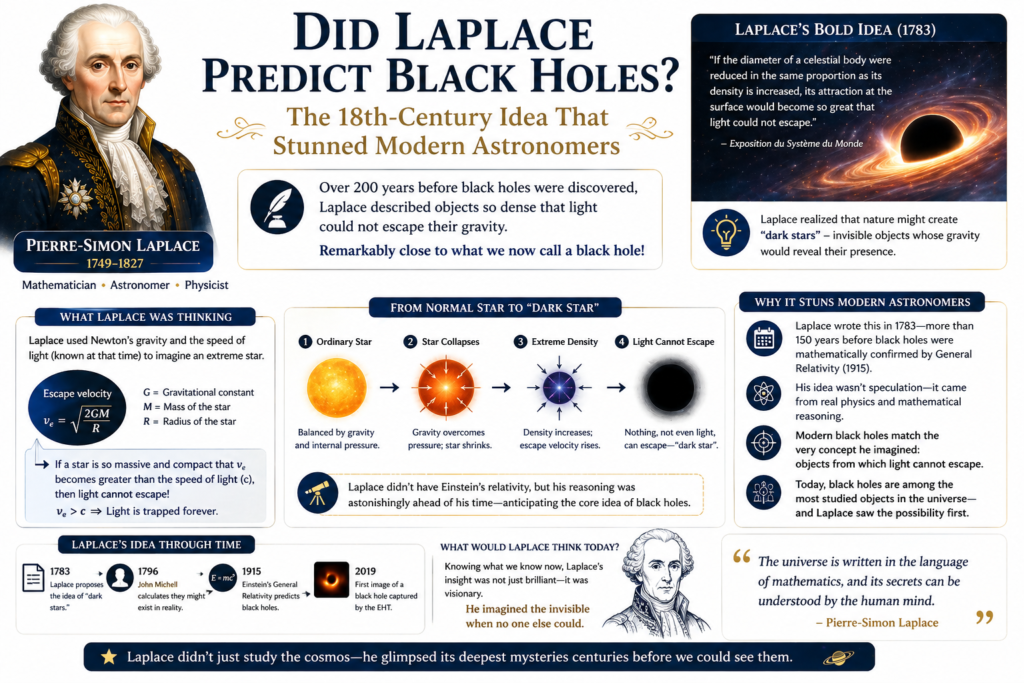
Laplace was not entirely alone in his thinking. Two years earlier, in 1783, an English clergyman and natural philosopher named John Michell published a similar idea in the Philosophical Transactions of the Royal Society. Michell asked a powerful question: what if a star had the same density as the Sun but was 500 times larger? Using Newton’s law of gravity and the known speed of light limit, he calculated that the escape velocity from such a star would exceed the velocity of light. Such a star would be completely invisible stars to any distant observer. Michell called them “dark stars.” However, Michell’s work received little attention. It was Pierre Simon Laplace, working independently in France, who gave the idea mathematical rigor and placed it within his grand treatise Mécanique Céleste. Laplace’s version was cleaner, more confident, and embedded in a respected astronomical text. This is why history often credits the laplace black hole prediction as the more influential early formulation. Laplace had no concept of an event horizon or singularities; he simply followed Newtonian gravity to its logical extreme. And that logical extreme pointed toward objects that emit no light, invisible wanderers in the cosmic dark.
The Mathematical Core: Escape Velocity and Light Trapping
Let us examine the actual mathematics that Laplace used. This is where the laplace black hole prediction shows its elegant power. The formula for escape velocity from a spherical body of mass M and radius R is derived from energy conservation. The kinetic energy needed to escape is exactly balanced by gravitational potential energy:
½ mv² = GMm / R
Here, m is the mass of the escaping object (which cancels out), G is Newton’s gravitational constant, M is the star’s mass, and R is its radius. Solving for the escape velocity v gives:
v = √(2GM / R)
Now Laplace asked a daring question: what happens if v equals the known speed of light c? Setting v = c and solving for the radius R yields:
R = 2GM / c²
This is the critical mass to radius ratio that traps light. Any object with mass M and radius smaller than this value would have an escape velocity greater than c, meaning light cannot leave its surface. Laplace did not have modern notation for c, but he understood the concept of light having a finite speed (measured by Ole Rømer in 1676). Using this calculation, Laplace concluded that the largest dense stars could be completely invisible. This is the essence of the laplace black hole prediction. Notice how simple the mathematics is: just algebra, no calculus required. Yet it leads to a cosmic conclusion so profound that it took two centuries to fully appreciate.
Laplace’s Original Wording and Its Context (1796)
In the first edition of his famous work Exposition du Système du Monde (Exposition of the System of the World), Laplace wrote a passage that still sends chills down the spine of modern astrophysicists. He stated: “A luminous star, of the same density as the Earth, and whose diameter would be 250 times larger than that of the Sun, would not, in consequence of its attraction, allow any of its light rays to reach us. It is therefore possible that the largest luminous bodies in the universe are, for this very reason, invisible.” Let us appreciate the astronomical precursors in this statement. Laplace chose a density equal to Earth’s (about 5.5 g/cm³), far denser than the Sun’s average density (1.4 g/cm³). He then calculated the diameter needed to trap light. His result was roughly 250 solar diameters, which corresponds to a mass-to-radius ratio satisfying R = 2GM/c². The laplace black hole prediction was not a throwaway line; it was a serious mathematical conclusion based on established physics. However, Laplace removed this passage from the third edition of his book (1808) and later editions. Why? Some historians believe that the wave theory of light, championed by Thomas Young and Augustin Fresnel, made Laplace doubt whether light particles (corpuscles) were the correct model. If light was a wave, perhaps gravity would not affect it. Laplace, ever cautious, withdrew his bold claim. For nearly two centuries, the idea of dark stars faded into obscurity.
Why Laplace’s Idea Was Forgotten (1800 – 1915)
After Laplace removed his black hole speculation, the scientific community largely ignored the concept. Several factors contributed to this neglect. First, the wave theory of light gained acceptance. In a wave model, gravity’s effect on light is not obvious. Newton’s corpuscular theory, which Laplace used, fell out of favor. Second, no observational method existed to detect such invisible objects. Astronomers could not prove or disprove the existence of dark stars. Third, the history of black holes was still in its infancy. Most physicists considered the idea of infinitely dense points as unphysical. Fourth, Laplace’s own reputation as the Father of Probability and Celestial Mechanics meant his speculative side was less emphasized. He was known for rigorous mathematics, not wild cosmic guesses. During most of the 19th century, the laplace black hole prediction remained a curious footnote. Even when Einstein published his theory of general relativity in 1915, few immediately connected it to Laplace’s earlier work. The concept of gravitational collapse was not yet fully developed. It would take another generation of physicists, including Karl Schwarzschild, Subrahmanyan Chandrasekhar, and John Wheeler, to revive and refine the idea.
The Modern Rebirth: Einstein and Schwarzschild (1915 – 1960)
Everything changed with general relativity. In 1915, Albert Einstein proposed that gravity is not a force but a curvature of spacetime caused by mass and energy. A few months later, Karl Schwarzschild solved Einstein’s field equations for a point mass, obtaining the now famous Schwarzschild radius:
Rₛ = 2GM / c²
Look familiar? It is exactly the same formula Laplace derived using Newtonian physics! This coincidence stunned modern astronomers. The laplace black hole prediction had accidentally stumbled upon the correct general relativistic result. However, the interpretation differs. In Newtonian gravity, the Schwarzschild radius is where escape velocity equals light speed. In general relativity, it represents the location of the event horizon a boundary beyond which no information, including light, can escape outward. Inside this radius, spacetime curvature becomes so extreme that all paths lead inevitably toward the central singularities. Modern cosmology now recognizes these objects as black holes. The term “black hole” was coined by John Wheeler in 1967, but the essential physics was already present in the laplace black hole prediction of 1796. It took the genius of 20th century astrophysics to realize that Laplace’s dark stars were not merely theoretical curiosities but actual astronomical objects formed by the gravitational collapse of massive stars.
Observational Evidence and Modern Confirmation (1970 – Present)
For decades, black holes remained purely theoretical. But starting in the 1970s, observational evidence began accumulating. Cygnus X-1, a powerful X ray source in our galaxy, became the first strong black hole candidate. Subsequent discoveries of gravitational waves from merging black holes (announced in 2016 by LIGO) provided direct proof. Today, the Event Horizon Telescope has produced actual images of the supermassive black holes in the galaxies M87 and the Milky Way (Sagittarius A*). Each of these discoveries validates in a profound way the laplace black hole prediction. Laplace could never have imagined instruments capable of “seeing” an invisible object, but his core insight that light can be trapped by gravity remains absolutely valid. Modern physics history recognizes him as a true pioneer. His work also connects to Laplace’s Equation (∇²φ = 0), which describes gravitational potential in empty space and is used in modeling black hole exteriors. The journey from an 18th century French mathematician to 21st century gravitational wave detectors is one of the most remarkable arcs in all of science.
Why This Prediction Stuns Scientists Today
The laplace black hole prediction continues to amaze researchers for several reasons. First, it demonstrates the power of pure mathematical reasoning. Using only Newtonian gravity and the known speed of light, Laplace arrived at a formula that matches the general relativistic Schwarzschild radius. Second, it shows that great ideas can be forgotten and then reborn. Laplace’s dark stars were ignored for 150 years before being rediscovered. Third, it highlights how scientific progress is not always linear. An 18th century insight using “wrong” physics (Newtonian gravity and corpuscular light) produced a correct result. Fourth, the laplace black hole prediction inspires humility. Even the greatest minds, including Laplace himself, sometimes retreat from their own bold ideas. He removed the passage from later editions, perhaps doubting his own brilliance. Yet modern astrophysics proves he was right. The Nebular Hypothesis for solar system formation is another of his lasting legacies, but his black hole prediction is arguably even more astonishing. It touches on physics history at its most dramatic: a prediction made long before its time.
Frequently Asked Questions (FAQs)
What exactly did Laplace predict about black holes?
Using Newtonian gravity and escape velocity calculations, Laplace predicted that a star sufficiently massive and compact could have an escape velocity exceeding the speed of light, making it completely invisible from outside. This matches the modern concept of a black hole’s event horizon.
When did Laplace make his black hole prediction?
Laplace published his dark star hypothesis in 1796 in the first edition of his book Exposition du Système du Monde. He later removed it from subsequent editions after the wave theory of light gained acceptance.
Is Laplace’s black hole formula the same as Einstein’s?
Remarkably, yes. Laplace derived R = 2GM/c² as the radius where escape velocity equals light speed. Einstein’s general relativity gives the same formula, but interprets it as the Schwarzschild radius or event horizon.
Why did Laplace remove his black hole idea from later books?
Laplace became uncertain because the wave theory of light (which suggested gravity might not affect light) was replacing Newton’s corpuscular theory. Being a cautious mathematician, he withdrew the speculative claim.
Are Laplace’s dark stars the same as modern black holes?
Conceptually yes, but with important differences. Laplace imagined Newtonian dark stars where light particles are slowed by gravity. Modern black holes are relativistic objects where spacetime curvature itself traps light, with no need for light particles.
Conclusion: A Visionary Ahead of His Time
The story of the laplace black hole prediction is one of brilliance, forgetfulness, and triumphant rediscovery. Pierre Simon Laplace, already celebrated for Laplace’s Equation and Laplace Transform, showed that even without general relativity, one can glimpse the universe’s darkest secrets. His calculations on escape velocity and light speed were simple yet profound. Today, every time astronomers detect gravitational waves or image an event horizon, they validate an 18th century intuition. Laplace also contributed to Bayesian Foundations of probability and worked alongside Laplace & Lavoisier on calorimetry experiments. His restless intellect explored Celestial Mechanics, the Shape of the Earth, and even Early Black Hole Theory as we now call it. But his dark star hypothesis remains his most astonishing leap. It connects directly to how ancient greek scientists changed modern science by first asking what lies beyond visible reality. The Greeks speculated about atoms and void; Laplace calculated invisible stars. Both represent humanity’s relentless drive to see the unseen. So the next time you hear about a black hole, remember: a French mathematician in 1796, using paper, pen, and Newton’s laws, already imagined it. That is the enduring power of fearless human curiosity.