laplace celestial mechanics represents one of the most powerful achievements in the history of science. Through deep mathematical insight and relentless logic, Pierre-Simon Laplace transformed our understanding of planetary motion and proved that the solar system is not chaotic but remarkably stable over long periods.
Before his work, scientists feared that gravitational interactions between planets could eventually destroy orbital harmony. However, laplace celestial mechanics introduced a revolutionary framework using calculus, perturbation theory, and dynamical systems to explain orbital stability with stunning precision.
The Scientific Challenge of Planetary Motion (1700 – 1770)
Before laplace celestial mechanics, Newton’s laws explained gravity but left unanswered questions about long term solar system behavior. The N-body problem, which studies gravitational interactions among multiple bodies, appeared nearly impossible to solve.
Planets like Jupiter and Saturn showed irregularities in their motion. These deviations raised serious doubts about orbital stability. Scientists wondered whether small perturbations could accumulate and lead to cosmic chaos.
This is where laplace celestial mechanics emerged as a brilliant solution.
Who Was Pierre Simon Laplace and His Vision
To understand laplace celestial mechanics, we must recognize Pierre-Simon Laplace, a mathematical genius who extended Newton’s ideas into a complete system of celestial dynamics.
Laplace believed that the universe follows precise mathematical laws. His work was deeply connected to mécanique céleste, where he systematically explained planetary motion using advanced calculus.
He was not only solving equations but uncovering the hidden structure of the cosmos.
Mathematical Foundation of laplace celestial mechanics
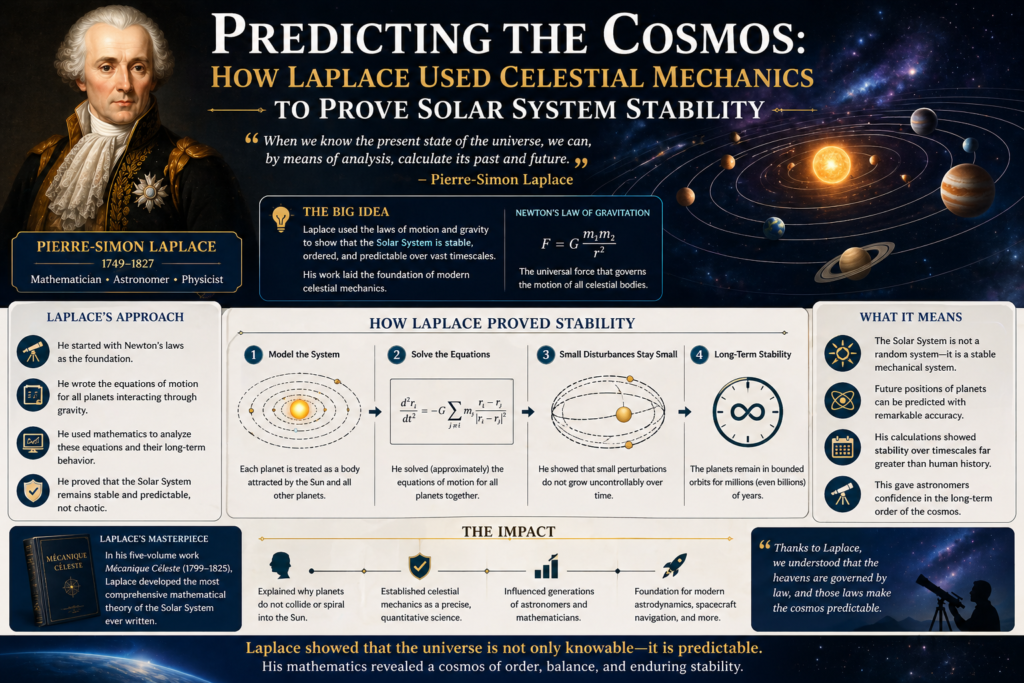
At the heart of laplace celestial mechanics lies Newton’s law of gravitation:
This equation describes the gravitational force between two bodies. However, when more than two bodies interact, the complexity increases dramatically.
Laplace used differential equations and approximations to tackle the N-body problem. He applied perturbation theory to analyze how small forces affect planetary orbits over time.
Another key mathematical concept he used is based on potential theory:
This equation, known as laplace’s equation, plays a crucial role in understanding gravitational fields and celestial dynamics.
Solving the N Body Problem with Genius Insight
The N-body problem is one of the hardest challenges in physics. Laplace approached it by simplifying interactions and studying perturbations.
Instead of solving the system exactly, he analyzed how small deviations influence orbits. This method allowed him to calculate secular variations, which are slow changes in orbital elements like eccentricity and inclination.
Laplace showed that these variations do not grow indefinitely. Instead, they oscillate within limits, ensuring orbital stability.
This was a groundbreaking discovery in laplace celestial mechanics.
Jupiter and Saturn Mystery Solved (1785 – 1795)
One of the most famous achievements of laplace celestial mechanics was solving the irregular motion of Jupiter and Saturn.
These two massive planets exhibit resonance effects due to their gravitational interactions. Their orbital periods are linked in a near ratio, causing long term fluctuations.
Laplace demonstrated that these fluctuations are periodic and not destructive. Using mathematical expansions, he proved that the system remains stable.
This discovery confirmed that gravitational interactions do not lead to chaos but to predictable patterns within celestial dynamics.
Concept of Orbital Stability and Energy Conservation
A key idea in laplace celestial mechanics is orbital stability. Laplace showed that the total energy of the solar system remains nearly constant.
Here, energy consists of kinetic energy and potential energy. Conservation of energy ensures that planets do not spiral into the sun or escape into space.
Laplace used this principle along with calculus to prove long term solar system stability.
Role of Perturbation Theory in laplace celestial mechanics
Perturbation theory is central to laplace celestial mechanics. It studies how small forces affect a system.
Laplace expanded orbital equations into series, allowing him to calculate tiny corrections over time. This method is still used in modern astronomy and space missions.
Through perturbation theory, he showed that planetary motion follows predictable patterns despite gravitational interactions.
Laplace vs Newton: Extending the Legacy
Newton laid the foundation with his laws of motion and gravity. But Laplace extended these ideas into a complete mathematical framework.
While Newton explained how planets move, laplace celestial mechanics explained why their motion remains stable over millions of years.
This distinction is crucial. Laplace transformed classical mechanics into a predictive science capable of modeling the entire solar system.
Connection with Other Scientific Ideas
Laplace’s work connects with several other concepts:
- His deterministic view is reflected in laplace’s demon
- His theories influenced probability and statistics
- His ideas contributed to early cosmological models like nebular hypothesis
- His logical thinking shaped scientific method
These connections show how laplace celestial mechanics is part of a broader intellectual framework.
Modern Applications of laplace celestial mechanics
Today, laplace celestial mechanics is essential in space science and technology.
- Predicting satellite orbits
- Planning space missions
- Creating ephemeris data for astronomy
- Understanding resonance and orbital dynamics
Modern fields like chaos theory and dynamical systems build on his work. Even advanced simulations rely on principles he introduced.
Long Term Solar System Stability Explained
Laplace proved that the solar system is stable over long periods. While small fluctuations occur, they do not lead to catastrophic outcomes.
This insight changed our understanding of the universe. It showed that cosmic systems are governed by order, not randomness.
Laplace celestial mechanics revealed the hidden harmony of planetary motion.
FAQs About laplace celestial mechanics
What is laplace celestial mechanics?
It is a mathematical framework developed by Laplace to explain planetary motion and prove solar system stability.
How did Laplace solve the N-body problem?
He used perturbation theory and approximations to study gravitational interactions and orbital changes.
Why are Jupiter and Saturn important in his work?
Their gravitational interaction helped Laplace demonstrate resonance and long term stability.
What is orbital stability?
It is the idea that planetary orbits remain consistent over time despite small perturbations.
How is laplace celestial mechanics used today?
It is used in astronomy, space missions, satellite tracking, and understanding celestial dynamics.
Conclusion
The story of laplace celestial mechanics is a powerful testament to human intellect. Laplace did not just study the universe, he decoded its hidden mathematical structure.
His work proved that the solar system is stable, predictable, and governed by precise laws. This achievement remains one of the greatest triumphs in scientific history.
By combining calculus, physics, and logical reasoning, he transformed our understanding of planetary motion forever. His ideas continue to influence modern science, from space exploration to dynamical systems.
To fully appreciate this journey, we must also explore how ancient greek scientists changed modern science, as their early discoveries laid the foundation for the revolutionary work of Laplace.
The cosmos is not chaos. Thanks to laplace celestial mechanics, we now know it is a masterpiece of mathematical harmony.