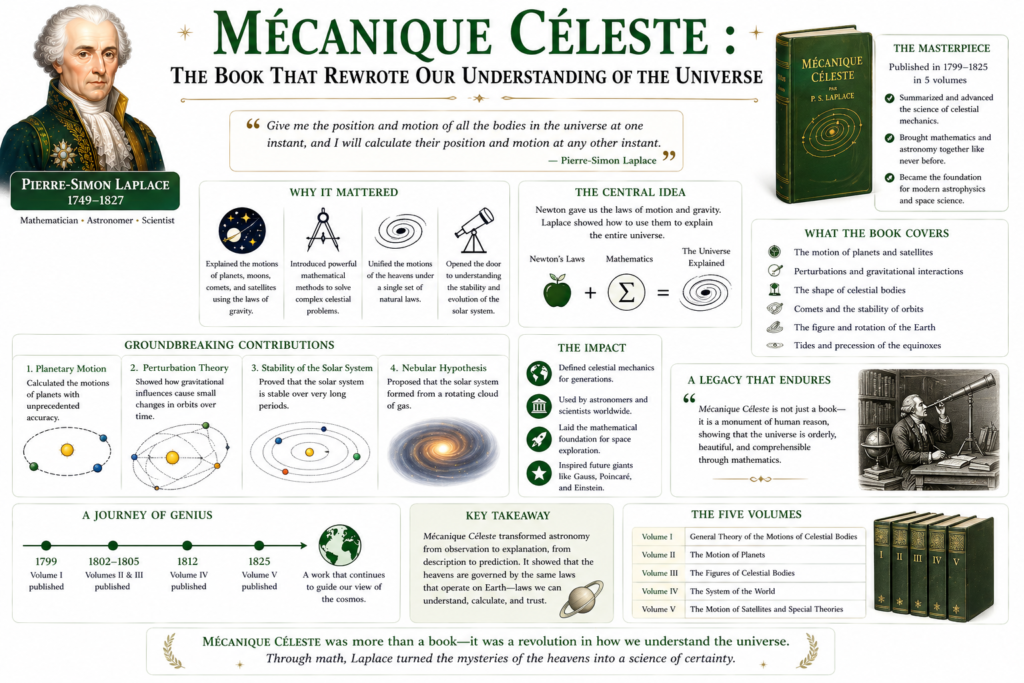
mecanique celeste laplace is widely regarded as one of the most powerful and brilliant scientific works ever written. Created by Pierre-Simon Laplace, this multi-volume masterpiece transformed mathematical astronomy and redefined how humanity understands the universe.
Before this groundbreaking work, Newton’s Principia had laid the foundation for gravitational theory. However, many questions about planetary motion, perturbations, and long term stability remained unanswered. With mecanique celeste laplace, these mysteries were addressed using advanced mathematics, analytical mechanics, and precise reasoning.
This article explores how this extraordinary book reshaped science, introduced powerful mathematical tools, and became a cornerstone of the scientific canon.
The Background of mecanique celeste laplace (1780 – 1799)
The development of mecanique celeste laplace began during a time of intense intellectual activity. The Enlightenment era encouraged scientific discovery and mathematical rigor.
Laplace sought to extend Newton’s Principia into a complete and unified system. His goal was simple yet ambitious: to explain all celestial motion using mathematics alone.
This ambition led to the creation of a celestial mechanics treatise that would become one of the greatest works in the history of astronomy.
Who Was Pierre Simon Laplace and His Vision
To understand mecanique celeste laplace, we must first recognize Pierre-Simon Laplace, the genius behind it.
Laplace was a master of mathematical astronomy and analytical mechanics. He believed that the universe operates according to precise laws that can be expressed mathematically.
His famous statement, often paraphrased as “I had no need of that hypothesis,” reflects his confidence in scientific reasoning over speculation.
Mathematical Foundation of mecanique celeste laplace
At the heart of mecanique celeste laplace lies Newton’s law of gravitation:
Laplace expanded this equation into complex systems involving multiple bodies. He used differential equations to describe how gravitational forces influence orbits.
Another key mathematical structure used in the book is:
This is laplace’s equation, which plays a central role in gravitational potential theory.
Laplace also applied series expansions to solve problems involving perturbations, allowing him to approximate solutions for complex systems.
A Multi Volume Work That Changed Science (1799 – 1825)
Mecanique celeste laplace was published as a multi-volume work over several years. Each volume focused on different aspects of celestial mechanics.
- Planetary motion and orbits
- Perturbations caused by gravitational interactions
- The motion of the Moon and tides
- Stability of the solar system
- Saturn’s rings and their dynamics
This comprehensive approach made it one of the most influential works in scientific literature.
Understanding Orbits and Perturbations
One of the most important contributions of mecanique celeste laplace is the study of orbits and perturbations.
Planets do not move in perfect ellipses. Their paths are influenced by gravitational interactions with other bodies. Laplace developed mathematical methods to analyze these deviations.
He used perturbation theory to show that these changes are predictable and do not lead to instability. This insight was crucial in proving the long term stability of the solar system.
The Role of Analytical Mechanics
Laplace’s work is deeply rooted in analytical mechanics. Instead of relying on geometric methods, he used calculus and algebra to solve problems.
For example, the motion of a body can be described using equations of motion:
This equation represents how forces influence motion. Laplace applied such equations to entire systems of celestial bodies.
This approach allowed him to create a unified framework for understanding gravitation and motion.
Moon Motion, Tides, and Earth Effects
Mecanique celeste laplace also explored the motion of the Moon and its effects on Earth.
He analyzed tides using gravitational theory, showing how the Moon and Sun influence ocean movement. He also studied Earth’s shape and rotation, connecting his work to geophysics.
These contributions highlight the practical importance of his work beyond theoretical astronomy.
Connection to Broader Scientific Ideas
Laplace’s masterpiece is connected to many other scientific concepts.
His deterministic philosophy is reflected in laplace’s demon, which suggests that the universe is fully predictable given enough information.
His work also influenced probability theory, earning him recognition as the father of probability.
Additionally, his ideas contributed to cosmology through concepts like nebular hypothesis, explaining the formation of the solar system.
Influence on Modern Science and Technology
The impact of mecanique celeste laplace extends far beyond its time.
- It shaped modern astronomy and space science
- It influenced physics textbooks and scientific education
- It laid the foundation for computational models of celestial dynamics
- It contributed to advancements in gravitational theory
Even today, scientists use principles from this work in space missions and satellite calculations.
Why mecanique celeste laplace Is a Scientific Masterpiece
There are several reasons why mecanique celeste laplace is considered an astronomy masterpiece.
First, it unified existing knowledge into a single coherent system. Second, it introduced advanced mathematical techniques that are still used today. Third, it demonstrated the power of analytical mechanics in solving real world problems.
Its influence on the history of astronomy and scientific canon is unmatched.
Legacy of mecanique celeste laplace
The legacy of mecanique celeste laplace is profound. It transformed celestial mechanics into a precise and predictive science.
Laplace showed that the universe is governed by mathematical laws, not randomness. His work continues to inspire scientists and mathematicians around the world.
From planetary motion to modern space exploration, his influence is everywhere.
FAQs About mecanique celeste laplace
What is mecanique celeste laplace?
It is a multi-volume scientific work by Laplace that explains celestial motion using advanced mathematics.
Why is it important in astronomy?
It provides a complete mathematical framework for understanding planetary motion and gravitational interactions.
How did it differ from Newton’s Principia?
While Newton introduced the laws of motion, Laplace expanded them into a detailed and comprehensive system.
What topics are covered in the book?
It covers orbits, perturbations, Moon motion, tides, and solar system stability.
Is mecanique celeste laplace still relevant today?
Yes, its principles are used in modern astronomy, physics, and space science.
Conclusion
The story of mecanique celeste laplace is a powerful reminder of how human intellect can unlock the secrets of the universe. Laplace took the foundations laid by Newton and transformed them into a complete and unified system of celestial mechanics.
His work remains a cornerstone of scientific literature, influencing generations of scientists and shaping modern astronomy. To fully appreciate this journey, we must also explore how ancient greek scientists changed modern science, as their early ideas laid the groundwork for revolutionary works like mecanique celeste laplace.
This masterpiece is not just a book. It is a timeless symbol of mathematical brilliance and scientific discovery.