Imagine a single mathematical statement so elegant and universal that it describes the steady flow of heat, the shape of a stretched rubber membrane, the electric field around a conductor, and even the curvature of space time. That is the astonishing power of laplace’s equation. This formula, written simply as ∇²φ = 0, ranks among the most influential discoveries in intellectual history. It appears wherever nature seeks balance, equilibrium, or smoothness. From designing aircraft wings to predicting gravitational fields, from medical imaging to climate modeling, this equation works silently in the background. Its beauty lies in its deceptive simplicity. Behind the compact notation hides a profound truth: many physical systems naturally evolve toward a state where the average value at any point equals the average of its neighbors. In this article, you will learn not only the mathematics but also the real world magic of this brilliant tool. We will explore its origins, its mathematical structure, and its endless applications.
The Man Behind the Formula: Pierre Simon Laplace (1749 – 1827)
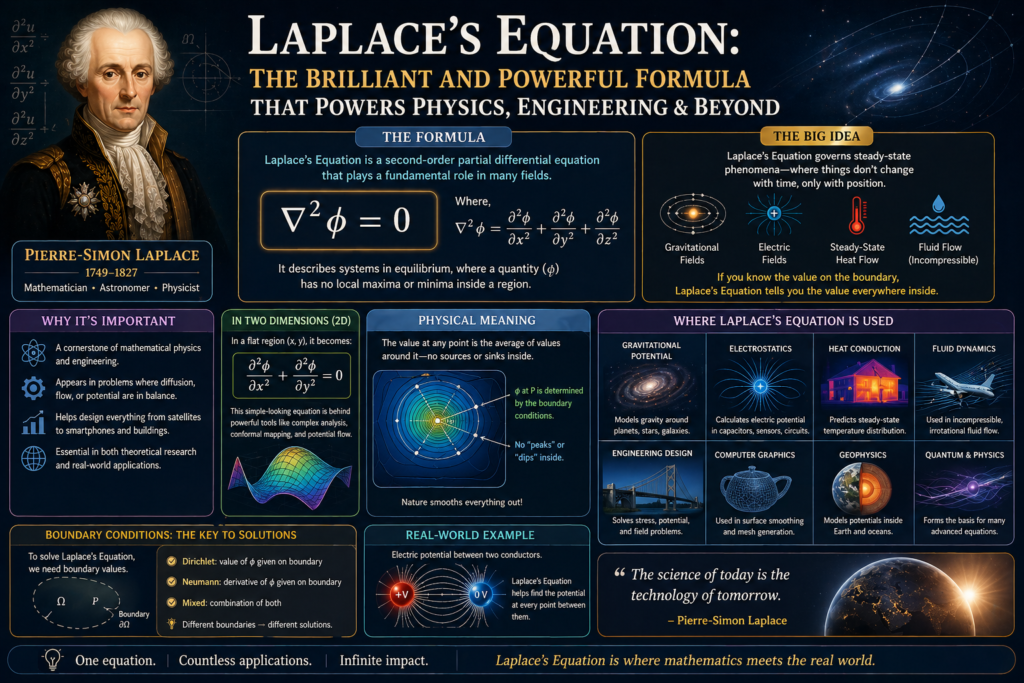
Before diving into mathematics, we must honor its creator. Pierre Simon Laplace was a French mathematical giant who thrived during the French Revolution and the Napoleonic era. Unlike many pure mathematicians, Laplace applied his genius to the physical universe. He wrote the monumental five volume work Mécanique Céleste (Celestial Mechanics), which translated Newton’s law of gravitation into the language of calculus. Within this masterpiece, laplace’s equation emerged naturally from his studies of gravitational potential. He sought a function whose second derivatives captured the net attraction at any point in space. The result was a partial differential equation that has since invaded nearly every branch of science. Laplace was also known for Laplace’s Demon, a hypothetical intellect that knows the position and velocity of every particle and thus can predict the entire future. While that idea touches on determinism, his equation is far more practical. As the Father of Probability, he developed tools for uncertainty, but laplace’s equation deals with certainties in continuous media. His collaborators included Laplace & Lavoisier, with whom he performed experiments on heat using an ice calorimeter. That experimental work directly linked to the heat equation, a close cousin of his famous formula.
The Mathematical Heart: Understanding ∇²φ = 0
What does laplace’s equation actually say? Let us break it down without fear. In three dimensional Cartesian coordinates, the equation expands to:
Here, ∇²φ represents a harmonic function – a smooth function with no local minima or maxima inside the domain. The symbol ∇² is called the Laplacian operator. It sums the second partial derivatives. Physically, it measures how much a function deviates from the average of its surroundings. When $\nabla^2 \phi = 0$, the value at every point equals the average of its neighbors. This is the ultimate statement of balance. For example, consider a steady-state heat distribution in a metal plate. If no heat sources exist inside, the temperature satisfies laplace’s equation. No point can be hotter than all surrounding points; otherwise heat would flow away. Similarly, the height of a soap film stretched over a wire frame follows this equation. The film finds the smoothest shape with minimal surface area. Solving laplace’s equation means finding a harmonic function that matches prescribed boundary conditions, known as a boundary value problem. This is where the real challenge and beauty reside. Techniques include separation of variables, complex analysis, and numerical methods like finite differences. The solutions are always smooth – infinitely differentiable – reflecting nature’s aversion to abrupt jumps in equilibrium.
Applications in Physics: Electrostatics and Gravity (1780 – 1900)
The first major triumph of laplace’s equation occurred in gravitational potential theory. Newton’s law says gravity attracts masses. Laplace showed that the gravitational potential $V$ satisfies ∇²φ = 0 in empty space. This allowed astronomers to compute planetary orbits with unprecedented precision. Then came electrostatics. In the 19th century, scientists realized that the electric potential around a conductor also obeys the same equation. If you have a charged metal sphere, the electric field outside the sphere derives from a potential that solves laplace’s equation with constant potential on the sphere’s surface. This insight unlocked the design of capacitors, transmission lines, and even lightning rods. Fluid dynamics soon followed. For an incompressible, irrotational flow, the velocity potential also satisfies laplace’s equation. Engineers could now map ideal flow around a cylinder or an airfoil. The Kant-Laplace hypothesis (nebular theory) also indirectly relied on these potential calculations. In every case, the Laplacian operator reveals the hidden harmony. One of the most elegant solutions is the spherical harmonic expansion, used to model Earth’s gravitational field – which helped determine the shape of the Earth (an oblate spheroid). By 1900, laplace’s equation was firmly established as a pillar of mathematical physics.
Engineering Breakthroughs (1900 – 1970)
The 20th century saw laplace’s equation move from blackboard theory to practical engineering. The rise of boundary value problems in elasticity and heat conduction demanded efficient solution methods. Civil engineers used it to calculate stress distributions in bridges and dams. Electrical engineers designed grounding systems for power grids by solving laplace’s equation for the soil’s electric potential. In aerodynamics, the equation became the basis for subsonic flow theory. Wing sections, or airfoils, were designed by mapping solutions from a cylinder to a wing shape – a technique called conformal mapping. This required solving laplace’s equation in two dimensions, then applying complex functions. The results were faster, more stable aircraft. During World War II, the Manhattan Project employed mathematicians to solve laplace’s equation numerically for neutron diffusion. These early calculations, done with mechanical calculators and human computers, laid the groundwork for modern computational physics. Around 1950, the invention of the digital computer revolutionized solution methods. The finite difference method and finite element method were born. Suddenly, engineers could solve laplace’s equation on complicated geometries like turbine blades, car bodies, and integrated circuits. The Laplace Transform, although different from the equation, was also developed as a tool for solving differential equations, further enriching applied mathematics.
Modern Computational Solutions (1970 – Present)
Today, solving laplace’s equation is routine even for complex three dimensional shapes. Computational modeling drives innovation. In computational physics, algorithms like successive over relaxation and multigrid methods solve laplace’s equation millions of times faster than manual methods. Orthogonal coordinates (cylindrical, spherical, elliptical) allow analytical solutions for symmetric problems, but for real world geometries, numerical simulation is king. Consider a smartphone chip. The heat generated by transistors must spread evenly. Engineers simulate steady-state heat conduction using laplace’s equation in the silicon substrate. Hotspots indicate design flaws. Similarly, oil reservoir modeling uses the equation to predict fluid pressure underground. Medical physics also benefits. Electroencephalography (EEG) uses laplace’s equation to map electric potentials from the scalp back to the brain’s surface. This is an inverse problem: given boundary data, reconstruct internal sources. Even astrophysics uses the concept. The Nebular Hypothesis for solar system formation involves gravitational collapse described by potential theory. And in Early Black Hole Theory, the vacuum region around a black hole’s event horizon can be modeled by laplace’s equation in curved spacetime. The equation’s reach is truly cosmic. One of the most active research areas is computational fluid dynamics (CFD). While full fluid flow is complex, many subproblems (like potential flow around a ship’s hull) reduce to laplace’s equation. The solutions provide initial guesses for more complex simulations.
Why This Equation Is a Gateway to Advanced Science
For students, mastering laplace’s equation opens doors. It is the ideal training ground for learning partial differential equations, vector calculus, and boundary value problems. The mathematical properties of harmonic functions are delightful. They satisfy the mean value property (value at center equals average on any sphere). They obey the maximum principle (extreme values occur only on boundaries). They are infinitely smooth even if boundary data are rough. These properties make laplace’s equation the foundation of potential theory. In electrical engineering, the equation underpins the method of images, used to compute capacitance and inductance. In geophysics, it helps interpret gravity anomalies to find oil and minerals. In materials science, it models diffusion in equilibrium. Even in finance, the Black Scholes equation for option pricing reduces to laplace’s equation after a change of variables for perpetual options. The Laplacian operator is so fundamental that it appears in quantum mechanics (Schrödinger equation), wave equation, and diffusion equation. By subtracting a time derivative or a source term, you return to laplace’s equation. Understanding this equation is like learning to read the language of smooth equilibrium in nature. Every physicist and engineer must know it. It is also a stepping stone to Bayesian Foundations in statistical physics, where maximum entropy states often satisfy similar equations.
Frequently Asked Questions (FAQs)
What is laplace’s equation in simple words?
It is a mathematical rule stating that at any point in a steady, source free system, the average value of a quantity (like temperature or electric potential) equals the value at that point. No local peaks or valleys exist inside the region.
Why is laplace’s equation so important in physics?
Because it describes equilibrium states. Any physical system that has reached a steady condition with no internal sources or sinks obeys this equation. Examples include electrostatic fields in empty space, steady heat flow, and gravitational potentials.
What is the difference between laplace’s equation and Poisson’s equation?
laplace’s equation (∇²φ = 0) applies when there are no sources or sinks inside the region. Poisson’s equation (∇²φ = 0) includes a source term $\rho$, such as electric charge density or mass density.
How do you solve laplace’s equation?
Common methods include separation of variables (for simple geometries like rectangles or spheres), complex analysis (for 2D problems), and numerical methods like finite differences, finite elements, or boundary element methods for complex shapes.
Is laplace’s equation linear?
Yes, it is linear. This means that if φ₁ and φ₂ are solutions, then any linear combination aφ₁ + bφ₂ is also a solution. This property allows powerful techniques like superposition and Fourier series.
Conclusion: The Eternal Harmony of Nature’s Blueprint
From the silent attraction of planets to the invisible push of electric fields, from the smooth curve of an airplane wing to the steady warmth of a microchip, laplace’s equation reveals the hidden mathematics of balance. Pierre Simon Laplace gave science more than a formula; he gave a lens through which to see harmony in chaos. His work on Celestial Mechanics and Early Black Hole Theory (he first speculated about objects so massive light cannot escape) shows his visionary reach. Yet this particular equation transcends its creator. It appears wherever nature optimizes, smoothes, or equilibrates. Every time an engineer runs a simulation of heat flow or a physicist models a gravitational field, they are whispering Laplace’s name. The equation’s power is both brilliant (elegantly simple) and powerful (immensely useful). And here is a beautiful historical thread: how ancient greek scientists changed modern science by first pondering the ideal shapes of circles and spheres. Their geometric intuition evolved into Euclidean geometry, then into calculus, and finally into laplace’s equation. The Greeks asked: what is the smoothest surface? Laplace answered with a formula that governs the very fabric of potential. So whether you are a student encountering ∇²φ = 0 for the first time or a researcher solving it on a supercomputer, remember: you are touching a piece of timeless cosmic mathematics.