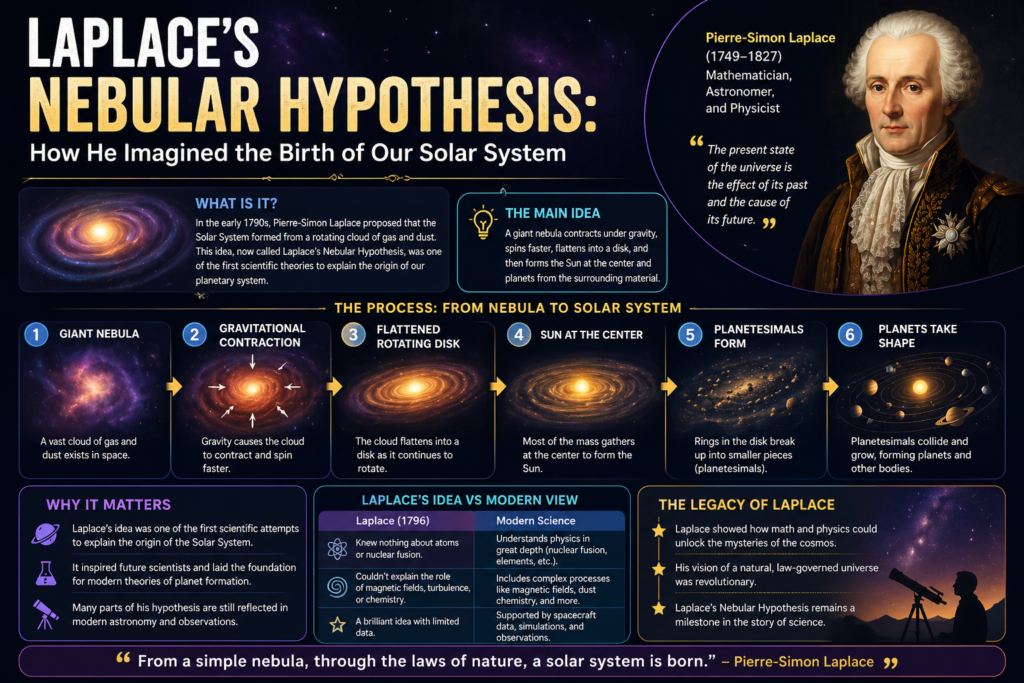
The origin of our cosmic home has puzzled scientists for centuries. Among the most stunning and powerful ideas ever proposed, laplace’s nebular hypothesis stands as a monumental leap in human understanding. In 1796, the French mathematician Pierre Simon Laplace envisioned a breathtaking process where a slowly spinning cloud of glowing gas transformed into the ordered solar system we see today. This theory was not just a guess; it was a brilliant, mathematically inspired narrative that challenged older beliefs and shaped modern astronomy. While later discoveries refined its details, the core vision of a collapsing nebula giving birth to planets remains a cornerstone of astrophysics. Let us travel back to the Age of Enlightenment and explore how this profound idea emerged, why it was so revolutionary, and why it continues to influence space science.
The Ancient Puzzle Before Laplace’s Vision (Pre 1796)
Before the 18th century, most explanations for the solar system’s birth were rooted in religious or mythological stories. Many thought planets were divine creations placed in perfect circular orbits. Others, like René Descartes, proposed clumsy vortex theories. But none offered a natural, physical law based mechanism. The key missing piece was a unifying concept: gravity and motion working over millions of years. Into this void stepped multiple thinkers. The Swedish mystic Emanuel Swedenborg in 1734 suggested a nebular origin, but his work lacked rigorous mathematics. Then in 1755, the German philosopher Immanuel Kant proposed a similar idea, where a primordial cloud slowly condensed. However, Kant’s version was philosophical and obscure. It was Pierre Simon Laplace who, independently and with dazzling mathematical elegance, transformed this vague notion into a testable scientific hypothesis. He combined Celestial Mechanics with observational astronomy, creating a coherent story of solar system formation.
The Core Idea: A Giant Spinning Gas Cloud (1796)
So, what exactly is laplace’s nebular hypothesis? Imagine an enormous, slowly rotating cloud of superheated gas and dust, many times larger than our current solar system. Laplace called this a “primordial nebula.” According to his hypothesis, gravity began to pull this cloud inward. As the cloud contracted, something remarkable happened due to the law of conservation of angular momentum. Think of a spinning ice skater who pulls her arms in; she spins much faster. Similarly, as the nebula shrank, its rotational speed increased dramatically. This rapid spin created immense centrifugal force, especially at the cloud’s equator. Eventually, this force balanced gravity, causing the cloud to flatten into a huge, rotating protoplanetary disk. Then came Laplace’s most imaginative leap: as the disk continued to spin and cool, it shed successive rings of material. Each ring, he proposed, would condense into a planet. The central remaining mass became the protosun – our young Sun. The outer rings formed Jupiter, Saturn, and the rest, while inner rings formed smaller, rocky planets like Earth. This elegant picture explained why all planets orbit in roughly the same plane and direction, a fact that had long baffled astronomers.
Why the Theory Was Revolutionary and Powerful
At the time, laplace’s nebular hypothesis was a intellectual thunderbolt. It replaced supernatural creation with a purely physical explanation. Laplace famously told Napoleon Bonaparte that he had “no need of that hypothesis” – referring to God as a cosmic mechanic. This was a power word stance. The theory unified disparate observations: the Sun’s slow rotation (compared to the planets’ orbital speeds) could be explained by the Sun retaining less angular momentum, a problem Laplace acknowledged but did not fully solve. Moreover, he applied his mastery of Laplace’s Equation to model gravitational stability within the nebula. This was applied mathematics at its finest. The hypothesis also predicted that other star systems should form similarly, a concept now confirmed by thousands of exoplanets. For over a century, this idea dominated astronomical thought. It became the standard model for origin of planets, taught in every university. It sparked debates, inspired telescopic searches for protoplanetary disks, and laid the foundation for stellar evolution studies. Even today, when astronomers photograph young stars with dusty rings (like HL Tauri), they are essentially seeing Laplace’s vision made real.
Challenges and Refinements (1900 – 1950)
No great theory survives without criticism. By the early 20th century, astronomers spotted fatal flaws in the original laplace’s nebular hypothesis. The most damaging problem was angular momentum distribution. Calculations showed that the Sun should have 99% of the solar system’s angular momentum if it formed from a single collapsing cloud. But reality says the Sun holds less than 1% – the planets have the rest. This was a staggering contradiction. How could the Sun spin so slowly if the nebula spun so fast? Laplace’s ring separation idea also failed mathematically; rings would disperse rather than clump into planets. Other scientists proposed alternative cosmological theory. The Chamberlin Moulton planetesimal hypothesis (early 1900s) suggested a near collision between the Sun and another star, pulling out filaments of gas. The tidal theory (1940s) modified this. However, these encounter theories also failed statistical and physical tests. For a few decades, laplace’s nebular hypothesis seemed dead. But science learns from failure. Instead of discarding the nebular idea entirely, researchers refined it. They realized that magnetic fields, turbulence, and viscosity in the accretion disk could transfer angular momentum outward, allowing the Sun to slow down naturally. This rescue mission began in the 1960s, reviving Laplace’s ghost.
The Modern Comeback Since 1970
Today, laplace’s nebular hypothesis lives, reborn as the solar nebula disk model (SNDM). Thanks to advances in computer simulations, radio astronomy, and space telescopes, we now know that protoplanetary disks are real. The Hubble Space Telescope and ALMA (Atacama Large Millimeter/submillimeter Array) have imaged dozens of young stars surrounded by gas and dust disks, exactly as Laplace imagined. The Kant-Laplace hypothesis is now seen as the brilliant precursor to modern theory. Scientists have solved the angular momentum problem through magnetorotational instability – weak magnetic fields in the ionized gas create turbulence, which drags material inward and sends angular momentum outward. The Sun did spin faster in its youth, but it lost speed via magnetic braking and mass loss. Moreover, planet formation is no longer thought to occur via ring condensation, but through dust grain sticking, pebble accretion, and eventual core accretion. Yet the big picture remains Laplace’s: a rotating gas cloud collapsing under gravitational collapse, forming a disk, and that disk birthing planets. Every textbook on astronomy origins begins with his name. Even modern missions studying early universe chemistry in nebular regions owe a debt to his original insight.
Why Laplace’s Idea Still Matters for Space Science
Understanding laplace’s nebular hypothesis is not just historical curiosity. It provides a powerful framework for exoplanet research. When NASA’s James Webb Space Telescope observes a newborn star with a dusty disk, scientists use Laplace’s logic to predict where planets might form. The hypothesis also helps explain the diversity of alien worlds – hot Jupiters, super Earths, and mini Neptunes. It tells us that solar system formation is a common process, not a rare miracle. Furthermore, the study of cosmogonical myths across cultures shows that humans always sought a birth story for the sky. Laplace gave us a scientific one rooted in astrophysics and space science. His approach also demonstrated the power of mathematical modeling. He applied Bayesian foundations (another of his legacies) to assess probabilities in celestial mechanics, even if indirectly. Today, when we simulate planetary orbits backward in time, we are testing hypotheses that trace directly to his 1796 vision. The shape of the Earth, which he also studied using Laplace’s Equation, is indirectly related – the same gravitational physics that shaped planets also shaped our world.
Frequently Asked Questions (FAQs)
What is laplace’s nebular hypothesis in simple terms?
It is the idea that our solar system formed from a huge, spinning cloud of hot gas that contracted under gravity, flattened into a disk, and then created planets from material left over after the Sun formed at the center.
Why was laplace’s nebular hypothesis initially rejected?
Scientists rejected it mainly because it failed to explain why the Sun rotates so slowly. The original hypothesis predicted the Sun should spin much faster than it actually does due to angular momentum conservation.
Is laplace’s nebular hypothesis still accepted today?
Yes, in a modernized form called the solar nebula disk model. The basic concept of a collapsing gas cloud forming a planetary disk is universally accepted, though the details of planet formation have changed.
How did Laplace imagine planets forming?
He imagined that the spinning nebula would shed rings of gas and dust at specific distances. Each ring would cool, condense, and clump together under gravity to form a planet, while the center became the Sun.
What is the main evidence supporting laplace’s nebular hypothesis today?
Direct images of protoplanetary disks around young stars (like HL Tauri and TW Hydrae) provide powerful evidence. These disks show gaps and rings, likely caused by forming planets, exactly as Laplace envisioned.
Conclusion: A Brilliant Legacy of Cosmic Imagination
More than two centuries after its proposal, laplace’s nebular hypothesis remains a testament to human curiosity and mathematical genius. Pierre Simon Laplace, often called the Father of Probability, gave us not only this elegant theory but also tools like Laplace Transform and Bayesian Foundations that power modern science. His work on Early Black Hole Theory (he speculated about invisible massive objects) and Laplace & Lavoisier (calorimetry experiments) shows a restless intellect. Yet his nebular hypothesis is his most beautiful and accessible idea. It allows every person to look up at the night sky and imagine a time when the Sun was a newborn star wrapped in a glowing disk of creation. Today, as we discover thousands of exoplanets and photograph stellar nurseries, we are walking in Laplace’s footsteps. He dared to apply physics to the grandest question of all: where do we come from? For that reason, his hypothesis is not just an old theory; it is a living, breathing part of how ancient greek scientists changed modern science. Their geometric cosmos evolved into Laplace’s mechanical nebula, which then evolved into our current dynamic universe. The story of our solar system’s birth, first imagined cleverly by Laplace, continues to unfold with every new telescope and every curious mind.