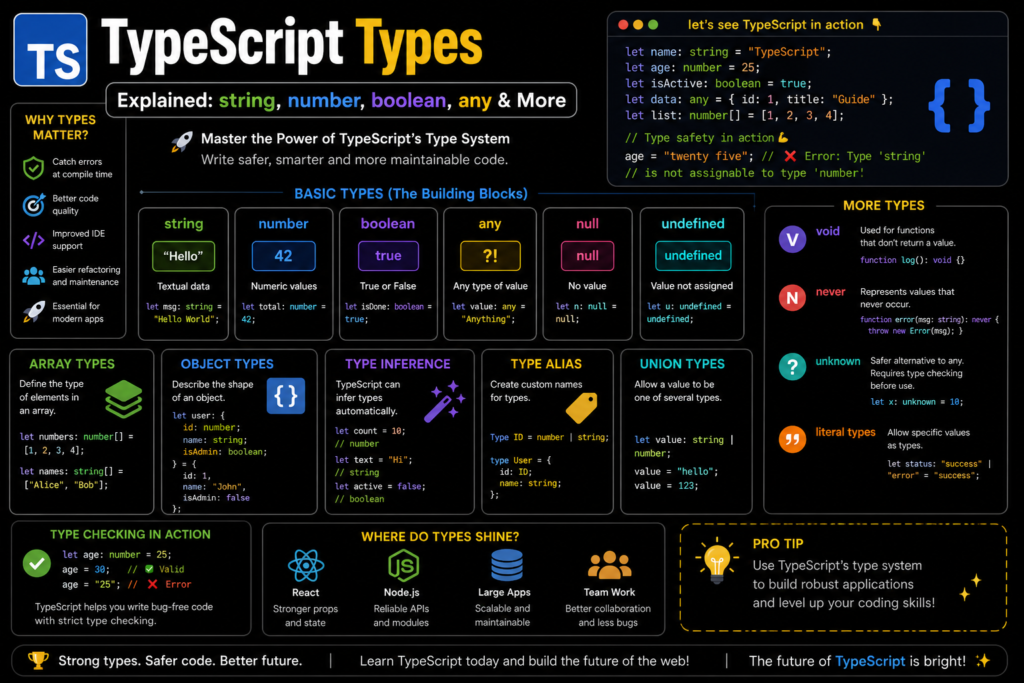
Understanding typescript types is one of the most powerful steps you can take in mastering modern programming. Whether you are a beginner or an experienced developer, learning typescript types helps you write cleaner, safer, and more reliable code. In today’s world of large scale applications, having a strong understanding of typescript types is not just helpful, it is essential.
TypeScript introduced a strong type system that enhances JavaScript by adding structure and predictability. This article will guide you through everything you need to know about typescript types, including primitive types, advanced concepts, and real world usage.
The Evolution of Type Systems (1995 – Present)
Before diving into typescript types, it is important to understand how type systems evolved. JavaScript, created in 1995, was designed as a dynamic language with flexible data types. While this flexibility made it easy to use, it also introduced challenges in large applications.
TypeScript, introduced in 2012 by Anders Hejlsberg, brought a new approach. It added static analysis and type safety to JavaScript, making it more suitable for modern development.
The typescript history shows how the language evolved to address issues like code maintainability and debugging. This evolution highlights the importance of learning typescript types.
What Are TypeScript Types?
At its core, typescript types define the kind of data a variable can hold. This includes numbers, strings, booleans, and more complex structuresIf you are wondering what is typescript?, it is a superset of JavaScript that adds static typing and compile time checks. This means errors can be detected before the code runs.
TypeScript uses type checking to ensure that values match their expected types. This improves code reliability and reduces runtime errors.
Basic TypeScript Types Explained
Understanding the basic typescript types is the foundation of learning the language. These types are simple but powerful.
String Type
The string type represents textual data. It is one of the most commonly used typescript types.
Number Type
The number type is used for numeric values. It supports integers and floating point numbers.
Boolean Type
The boolean type represents true or false values. It is essential for conditional logic.
These primitive values form the core of TypeScript’s type system. They are easy to use and provide strong type safety.
The Any Type and Its Use Cases
One of the most flexible typescript types is the any type. It allows a variable to hold any value without type checking.
While this flexibility can be useful, it should be used carefully. Overusing the any type reduces the benefits of static typing.
Understanding when to use the any type is important for maintaining code quality and avoiding errors.
Arrays and Data Structures in TypeScript
Arrays are another important part of typescript types. They allow you to store multiple values in a single variable.
TypeScript supports array types, enabling you to define the type of elements within an array. This improves code readability and ensures consistency.
Data structures like arrays and objects are essential for building complex applications.
Null, Undefined, and Special Types
TypeScript includes special typescript types like null and undefined. These types represent the absence of a value.
Understanding null and undefined in TS is important for avoiding runtime errors. TypeScript also provides strict type checking to handle these cases effectively.
Other special types include void and never. These types are used in functions and advanced scenarios.
Type Inference and Type Safety
Type inference is a powerful feature of typescript types. It allows TypeScript to automatically determine the type of a variable based on its value.
This feature reduces the need for explicit type annotations while maintaining type safety. It also improves developer productivity.
Type safety ensures that your code behaves as expected, reducing bugs and improving software quality.
Interfaces and Type Aliases
As you explore typescript types, you will encounter interfaces and type aliases. These features allow you to define custom types.
Understanding interfaces vs types helps you choose the right approach for your project. Interfaces are often used for object structures, while type aliases provide more flexibility.
These features are essential for building scalable applications and maintaining clean code.
Functions and Type Signatures
Functions are a key part of programming, and TypeScript enhances them with type signatures. Learning typescript functions helps you define input and output types clearly.
Type signatures improve code readability and ensure that functions behave as expected. This is especially important in large projects.
Using typescript types in functions helps you avoid errors and write more predictable code.
Advanced TypeScript Types
As you progress, you will explore advanced typescript types. These include union types, intersection types, and literal types.
Learning advanced typescript allows you to handle complex scenarios and build sophisticated applications. These types provide greater flexibility and control.
Advanced types are a powerful tool for experienced developers.
TypeScript vs JavaScript Type System
When comparing typescript vs javascript, the type system is one of the biggest differences. JavaScript uses dynamic typing, while TypeScript uses static typing.
This difference impacts code reliability and debugging. TypeScript’s type system provides better tools for maintaining large codebases.
Understanding this comparison helps you appreciate the value of typescript types.
Practical Examples for Beginners
For those starting with typescript for beginners, practicing simple examples is the best way to learn. Try creating variables with different types and experimenting with functions.
Simple TypeScript examples help you understand how types work in real world scenarios. They also build confidence and improve your skills.
Practice is essential for mastering typescript types.
Common Mistakes and How to Avoid Them
While learning typescript types, beginners often make mistakes. These include overusing the any type, ignoring type errors, and misunderstanding type inference.
Avoiding these mistakes requires practice and attention to detail. Always focus on maintaining type safety and writing clean code.
Learning from errors is an important part of the process.
The Future of TypeScript Types
The future of typescript is closely tied to the evolution of its type system. New features and improvements continue to enhance its capabilities.
TypeScript will play a major role in the future of software engineering, especially as applications become more complex. Its focus on type safety and productivity makes it a valuable tool for developers.
FAQs About TypeScript Types
What are TypeScript types?
TypeScript types define the kind of data a variable can hold, improving code safety and reliability.
Why are types important in TypeScript?
They help catch errors early and make code easier to understand and maintain.
What is the any type?
The any type allows a variable to hold any value without type checking.
What is type inference?
Type inference automatically determines the type of a variable based on its value.
Are TypeScript types hard to learn?
No, with practice and examples, they are easy to understand and use.
Conclusion
Learning typescript types is a crucial step in becoming a skilled developer. From basic types like string and number to advanced concepts, TypeScript provides powerful tools for building reliable applications.
By understanding typescript types, you can improve code quality, reduce errors, and enhance your development skills. As the technology continues to evolve, mastering TypeScript types will give you a strong advantage in the world of programming.
Start practicing today and unlock the full potential of TypeScript in your projects.