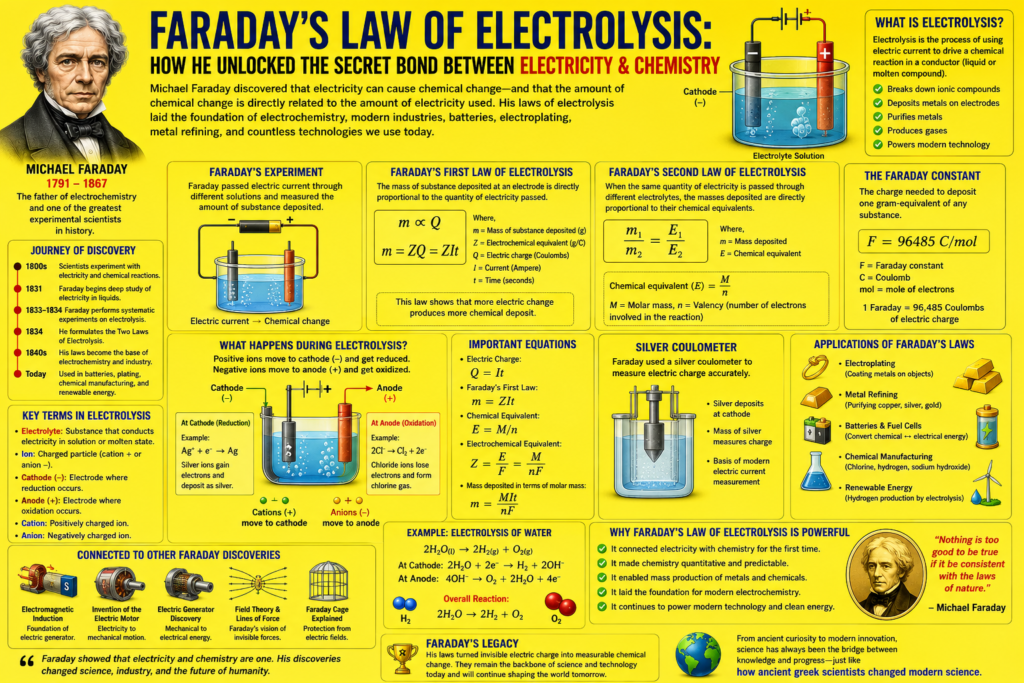
Faraday’s law of electrolysis is one of the most important discoveries in the history of chemistry and physics. Through this revolutionary work, Michael Faraday proved that electricity and chemical reactions are deeply connected. His discoveries transformed electrochemistry, industrial manufacturing, metal purification, batteries, and modern science forever.
Before Faraday’s experiments, scientists did not fully understand how electric charge interacted with matter. Chemical reactions seemed mysterious and difficult to measure accurately. Everything changed when Faraday carefully studied the electrolysis process and discovered mathematical relationships between electric current and chemical change.
Today, faraday’s law of electrolysis remains essential in electrochemistry, quantitative chemistry, batteries, electroplating, and industrial chemical production. Modern industries continue using Faraday’s principles nearly two centuries after his discoveries.
This article explains the history, equations, scientific principles, experiments, and global impact of faraday’s law of electrolysis in simple language.
The Scientific World Before Electrolysis (1800 – 1830)
During the early 19th century, scientists were exploring electricity rapidly.
Volta’s battery had already demonstrated that steady electric current could be produced chemically. Researchers began experimenting with electric current flowing through liquids.
Scientists noticed that some liquids decomposed when electricity passed through them.
However, nobody fully understood:
- Why decomposition occurred
- How electric charge affected matter
- The relationship between electricity and atoms
This mystery fascinated Michael Faraday deeply.
Faraday believed electricity and chemistry were connected through natural laws.
His careful experiments eventually created the foundations of modern electrochemistry.
Michael Faraday and Electrochemical Research
Faraday approached science through experimentation rather than complex theory.
Using simple laboratory equipment, he studied how electric current affected ionic compounds dissolved in liquids.
His work introduced important scientific terms still used today:
- Ion
- Electrolyte
- Electrode
- Cathode and anode
- Anion
- Cation
These terms became essential for chemistry and physics worldwide.
Faraday’s experiments revealed that electric charge controls chemical reactions in measurable ways.
This discovery became known as faraday’s electrochemical laws.
What Is Electrolysis?
Electrolysis is the process of using electricity to drive chemical reactions.
When electric current passes through a conducting liquid or molten salts:
- Positive ions move toward the cathode
- Negative ions move toward the anode
Chemical decomposition then occurs.
For example, water electrolysis can be represented as:
Electricity breaks water molecules into hydrogen and oxygen gases.
Electrolysis became one of the most important industrial and scientific processes in history.
Faraday’s First Law of Electrolysis
Faraday’s first law states:
The mass of substance deposited during electrolysis is directly proportional to the electric charge passing through the electrolyte.
The mathematical equation is:
Or:
Where:
- = Mass of substance deposited
- = Electrochemical equivalent
- = Electric charge
Since electric charge is:
Then:
Where:
- = Current
- = Time
This equation became one of the most important relationships in electrochemistry.
Understanding Electric Charge in Electrolysis
Electric charge plays a central role in electrolysis.
Faraday proved that chemical reactions depend directly on the amount of electricity flowing through a solution.
Electric charge is measured in coulombs.
The charge equation is:
Where:
- = Electric charge
- = Current in amperes
- = Time in seconds
More electric charge produces greater chemical change.
This relationship transformed chemistry into a more quantitative science.
Faraday’s Second Law of Electrolysis
Faraday’s second law states:
When the same electric charge passes through different substances, the masses deposited are proportional to their chemical equivalents.
The equation is:
Where:
- = Deposited masses
- = Chemical equivalents
Chemical equivalent depends on:
- Molar mass
- Valence electrons
The chemical equivalent formula is:
Where:
- = Molar mass
- = Valency number
This discovery connected electricity directly to atomic structure.
The Faraday Constant
One of Faraday’s greatest achievements was establishing the relationship between electric charge and chemical reactions.
This eventually led to the Faraday constant:F=96485C/mol
Where:
- = Faraday constant
- = Coulombs per mole of electrons
The Faraday constant represents the electric charge carried by one mole of electrons.
This became one of the most important constants in chemistry and physics.
Electrochemical Equivalent Explained
Electrochemical equivalent measures how much material deposits per unit charge.
The equation is:
Where:
- = Electrochemical equivalent
- = Chemical equivalent
- = Faraday constant
This equation became essential for industrial electrochemical calculations.
It allows scientists to predict chemical deposition precisely.
Cathode and Anode in Electrolysis
Faraday carefully studied the behavior of electrodes during electrolysis.
Cathode
The cathode is the negative electrode where reduction occurs.
Positive ions gain electrons here.
Example:
Silver ions become solid silver metal.
Anode
The anode is the positive electrode where oxidation occurs.
Negative ions lose electrons here.
Example:
Chloride ions form chlorine gas.
These concepts became central to modern chemistry.
Silver Coulometer Experiment
One famous application of Faraday’s laws was the silver coulometer.
In this experiment:
- Electric current passes through silver nitrate solution
- Silver deposits on the cathode
- Deposited mass measures electric charge precisely
The silver coulometer became an important scientific instrument for measuring current accurately.
This demonstrated the practical power of faraday’s law of electrolysis.
Electrolysis and Industrial Chemistry (1850 – 1900)
Faraday’s discoveries transformed industrial chemistry completely.
Electrolysis became essential for:
- Metal purification
- Electroplating
- Battery production
- Aluminum extraction
- Chemical manufacturing
Modern industries still rely heavily on electrochemical reactions.
Faraday’s work accelerated the Industrial Revolution dramatically.
Electroplating and Metal Purification
Electroplating uses electrolysis to coat objects with metal.
Examples include:
- Gold plating
- Silver plating
- Chromium coating
The deposited mass follows Faraday’s equations directly.
Electrolysis also purifies metals like copper using controlled electrical reactions.
These processes remain essential in manufacturing worldwide.
Relation Between Electrolysis and Electricity
Faraday’s work connected chemistry and electricity permanently.
His studies also influenced electromagnetic induction research.
Together, these discoveries helped create modern electrical science.
Faraday showed that electricity is not merely energy but also a fundamental part of chemical behavior.
This transformed scientific understanding forever.
Atomic Theory and Electrochemistry
Faraday’s laws later supported atomic theory strongly.
Scientists realized that:
- Matter contains charged particles
- Chemical reactions involve electron transfer
- Electric charge exists in discrete amounts
These ideas later influenced modern quantum chemistry and atomic physics.
Faraday’s experiments helped scientists understand the structure of matter itself.
Electrolysis and Energy Conservation
Electrolysis obeys conservation laws carefully.
Electrical energy entering the system becomes chemical energy.
The electrical power equation is:
Where:
- = Power
- = Voltage
- = Current
Chemical energy storage inside batteries depends heavily on these principles.
Modern rechargeable batteries rely on reversible electrochemical reactions.
Faraday and Maxwell Connection
Faraday’s discoveries later inspired James Clerk Maxwell.
The faraday and maxwell connection transformed electricity and magnetism into advanced mathematical science.
Maxwell’s equations helped scientists understand electric fields and charged particles more deeply.
Faraday’s experimental work became one of the foundations of modern physics.
Faraday’s Chemical Discoveries
Faraday contributed to chemistry beyond electrolysis.
His work included:
- Gas liquefaction
- Magnetism studies
- Organic chemistry
One famous achievement was faraday discovery of benzene, which later became extremely important in industrial chemistry.
Faraday’s scientific influence extended across multiple disciplines.
Modern Applications of Electrolysis (1900 – Present)
Today, faraday’s law of electrolysis remains essential worldwide.
Applications include:
- Hydrogen fuel production
- Battery manufacturing
- Electroplating industries
- Chemical synthesis
- Water purification
- Semiconductor manufacturing
Modern renewable energy systems increasingly depend on electrolysis for clean hydrogen production.
Faraday’s discoveries continue shaping the future of science and technology.
Why Faraday’s Law of Electrolysis Still Matters
Modern civilization depends heavily on electrochemical technology.
Without Faraday’s laws:
- Batteries would be poorly understood
- Industrial metal production would slow
- Electrochemical engineering would collapse
- Modern electronics would suffer
Faraday transformed chemistry into a measurable electrical science.
His work continues influencing industries globally.
Faraday’s Scientific Legacy
Faraday’s scientific legacy extends across chemistry, physics, and engineering.
His discoveries influenced:
- Electricity
- Magnetism
- Electrochemistry
- Industrial technology
- Atomic science
Despite worldwide fame, Faraday remained humble and deeply committed to scientific education.
His experimental methods still inspire scientists today.
FAQs About Faraday’s Law of Electrolysis
What is Faraday’s law of electrolysis?
Faraday’s law explains how electric charge determines chemical deposition during electrolysis.
Who discovered the laws of electrolysis?
Michael Faraday discovered the laws of electrolysis during the 1830s.
What is electrolysis?
Electrolysis is the use of electricity to drive chemical reactions in liquids or molten compounds.
What is the Faraday constant?
The Faraday constant is the electric charge carried by one mole of electrons.
What is electrochemical equivalent?
Electrochemical equivalent measures deposited mass per unit electric charge.
Where is electrolysis used today?
Electrolysis is used in batteries, hydrogen production, electroplating, and industrial chemistry.
Conclusion
Faraday’s law of electrolysis was one of the greatest breakthroughs in scientific history. Michael Faraday revealed the deep relationship between electricity and chemistry, transforming both fields forever.
His discoveries showed that electric charge controls chemical reactions in predictable mathematical ways. This insight became the foundation of modern electrochemistry, batteries, industrial manufacturing, and quantitative chemistry.
Today, industries worldwide continue using Faraday’s laws in electroplating, hydrogen production, batteries, and chemical engineering. His work also helped scientists understand atoms, electrons, and matter itself.
The impact of faraday’s law of electrolysis on civilization is as revolutionary as how ancient greek scientists changed modern science, proving once again that simple scientific experiments can transform humanity forever.